
Rental property operating expenses are the ongoing costs of owning and operating a rental property. Understanding these expenses is important because they affect Net Operating Income (NOI), cap rate, cash flow, and other property calculations.
Common operating expenses can include property taxes, insurance, repairs, maintenance, property management, utilities paid by the owner, landscaping, and other recurring property costs. However, mortgage payments and some major capital improvements are generally treated separately when calculating NOI.
For a broader breakdown of ownership costs, see our complete rental property expenses guide
What Are Rental Property Operating Expenses?
Operating expenses are the ordinary costs required to operate and maintain a rental property. They are generally deducted from effective gross operating income when calculating NOI.
NOI = Effective Gross Operating Income − Operating Expenses
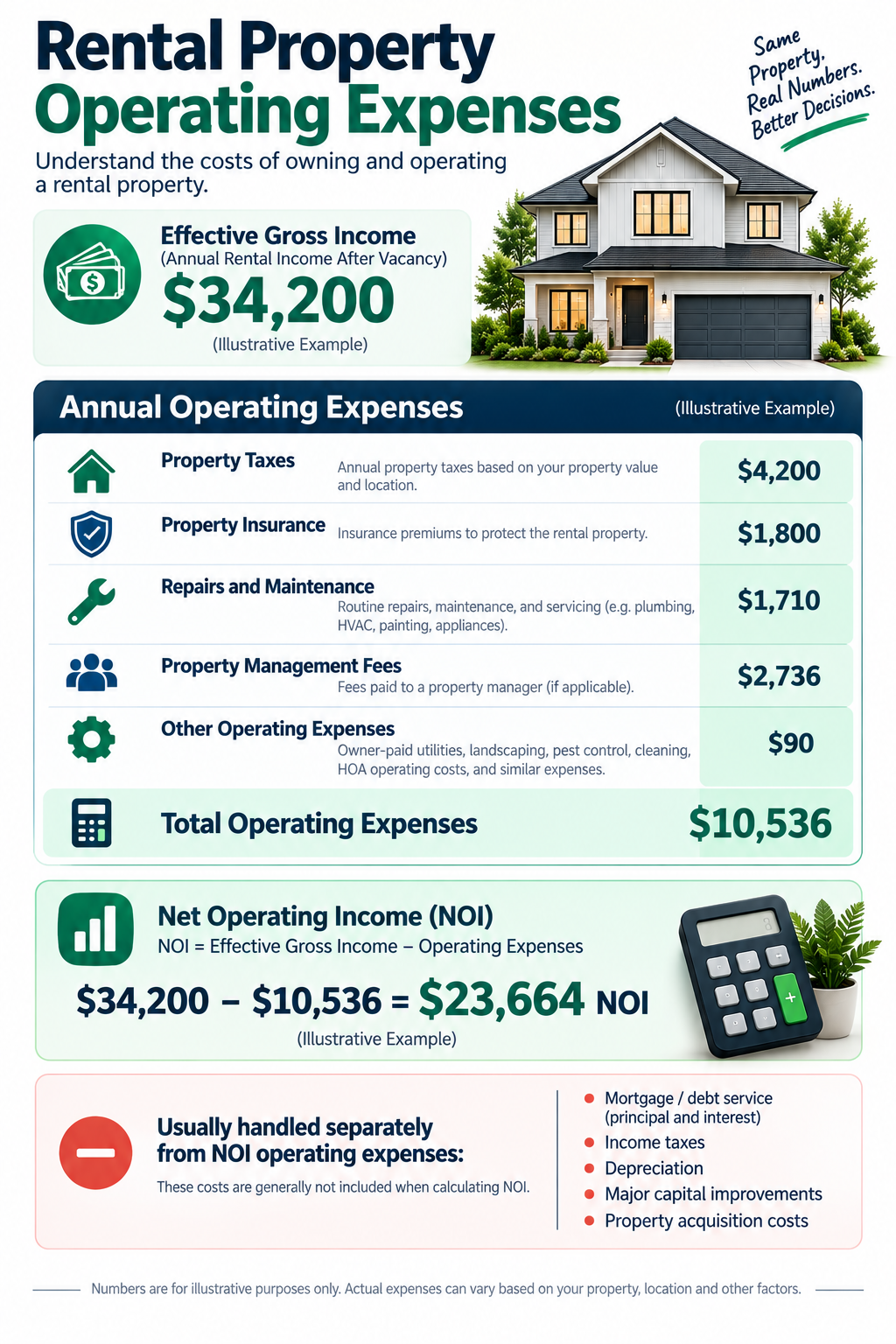
For example, if a rental property has $34,200 in effective gross operating income and $10,536 in annual operating expenses, its NOI would be $23,664.
$34,200 − $10,536 = $23,664 NOI
What Operating Expenses Should You Include?
Property Taxes
Property taxes are commonly included as an operating expense. The amount can vary significantly by property value and location.
For U.S. properties, local property taxes are generally administered by local governments, so tax rates and assessment rules can vary by location.
Property Insurance
Insurance premiums paid to protect the rental property are generally included when estimating operating expenses.
Repairs and Maintenance
Routine repairs and maintenance may include plumbing repairs, appliance servicing, painting, HVAC maintenance, and other costs required to keep the property operating.
Property Management Fees
If you use a property manager, management fees are generally treated as an operating expense. The actual fee depends on the property and management agreement.
Owner-Paid Utilities and Other Costs
Utilities paid by the property owner, landscaping, pest control, cleaning of common areas, HOA-related operating costs, and similar recurring expenses may also need to be considered.
What Is Usually Not Included in NOI Operating Expenses?
Not every property-related cost is treated as an operating expense when calculating NOI. Financing and certain owner-specific or capital costs are generally handled separately.
Mortgage principal and interest • Income taxes • Depreciation • Major capital improvements • Property acquisition costs
For example, replacing an entire roof is generally considered a capital expenditure rather than an ordinary operating expense. Accounting and tax treatment can vary, so this distinction should not be used as tax advice.
Rental Property Operating Expense Example
Suppose a rental property has $34,200 in effective gross operating income. Its annual operating expenses are: Property taxes $4,200; Insurance $1,800; Maintenance $1,710; Property management $2,736; Other operating expenses $90 . Total operating expenses = $10,536.
NOI = $34,200 − $10,536 = $23,664.”
This example shows why operating expenses matter: changing the expenses changes NOI, which can also affect calculations such as cap rate and DSCR.
Do Rental Property Operating Expenses Include Mortgage Payments?
No. Mortgage principal and interest payments are generally not included in rental property operating expenses when calculating Net Operating Income (NOI). NOI measures a property’s operating performance before financing costs. However, mortgage payments still affect the money available to the property owner.
For example, suppose a rental property has $34,200 in effective annual income and $10,536 in operating expenses. Its NOI is $23,664. If annual mortgage payments are $19,910, the simplified annual cash flow after financing is $3,754, before other relevant cash outflows.
NOI − Mortgage Payments = Simplified Cash Flow
This distinction is important because a property can have positive NOI but much lower cash flow after mortgage payments. Major capital expenditures can reduce available cash further.
Learn More About NOI and Mortgage Payments
For a detailed explanation, read our Does NOI Include Mortgage Payments?
Why Operating Expenses Matter
Operating expenses directly affect a rental property’s NOI. If operating expenses increase while income stays the same, NOI decreases. If expenses decrease while income stays the same, NOI increases.
Because NOI is used in calculations such as cap rate and DSCR, accurate operating expense estimates can also affect those results.
Operating Expenses vs Mortgage Payments
Mortgage payments are generally not included as operating expenses when calculating NOI. NOI measures property operations before financing costs
Financing costs can still matter when calculating rental property cash flow. A simplified calculation is:
Cash Flow = NOI − Debt Service
Operating Expenses vs Capital Expenditures
Routine repairs and maintenance are different from major capital improvements. Regular maintenance helps keep a property operating, while a capital expenditure generally involves a major improvement or replacement with a longer useful life.
For example, repairing a small roof leak may be maintenance, while replacing an entire roof may be treated as a capital expenditure. Exact accounting and tax treatment can vary.
Common Operating Expense Mistakes
Forgetting Vacancy and Property Management Costs
Ignoring realistic vacancy or management costs can make a property’s estimated performance look different from what actually occurs.
Including the Mortgage in NOI
Debt service should generally be kept separate when calculating NOI.
Underestimating Repairs and Maintenance
Repairs may not occur evenly every month, but they should still be considered when estimating property expenses.
Using the Same Expenses for Every Property
Expenses vary by property type, age, condition, location, services, insurance costs, taxes, and management arrangements.
Calculate Your Rental Property Numbers
You can use Realtolic’s free calculators to see how income and operating expenses affect different rental property metrics.
NOI Calculator
Rental Cash Flow Calculator
Cap Rate Calculator
Rental Property ROI Calculator
Frequently Asked Questions.
What are operating expenses on a rental property?
Rental property operating expenses are the ongoing costs of operating and maintaining a property. Common examples include property taxes, insurance, routine repairs and maintenance, property management fees, owner-paid utilities, landscaping, and other recurring property costs.
Is a mortgage an operating expense?
Generally, no. Mortgage principal and interest are financing costs and are usually kept separate from operating expenses when calculating Net Operating Income (NOI).
Are property taxes an operating expense?
Property taxes are generally included as an operating expense when calculating NOI because they are an ongoing cost associated with owning and operating the property.
Is property insurance an operating expense?
Property insurance premiums are generally included as an operating expense when calculating NOI. Actual insurance costs can vary depending on the property, location, coverage, and insurer.
Are repairs and maintenance operating expenses?
Routine repairs and maintenance are generally treated as operating expenses. Examples can include minor plumbing repairs, HVAC servicing, painting, and appliance maintenance.
Are major renovations operating expenses?
Major improvements or replacements are generally treated differently from ordinary operating expenses. For example, replacing an entire roof may be considered a capital expenditure rather than routine maintenance. Accounting and tax treatment can vary.
Do operating expenses affect NOI?
Yes. NOI is calculated by subtracting operating expenses from effective gross operating income. If income stays the same while operating expenses increase, NOI decreases.
Do operating expenses affect cap rate?
Yes. Because cap rate commonly uses NOI in its calculation, changes in operating expenses can change NOI and therefore affect the calculated cap rate.
Should every rental property use the same expense estimates?
No. Actual expenses can vary significantly based on the property’s location, age, condition, size, taxes, insurance, management arrangement, utilities, and maintenance needs. Use property-specific information whenever possible.
Final Thoughts
Rental property operating expenses are an important part of understanding a property’s financial performance. Property taxes, insurance, maintenance, management fees, owner-paid utilities, and other recurring costs can reduce NOI and affect calculations such as cap rate, DSCR, cash flow, and ROI.
Use realistic, property-specific expenses whenever possible instead of relying only on general estimates. This can give you a clearer picture of the property’s numbers before making financial decisions.
Disclaimer: This article and Realtolic calculators are for educational and informational purposes only. Results and examples are estimates and are not financial, investment, lending, tax, accounting, or legal advice. Actual property expenses and treatment of costs can vary.