A rental property expenses list can help landlords understand the common costs that may reduce rental income and affect cash flow. Rent may look attractive at first, but landlords can also face property taxes, insurance, maintenance, repairs, vacancy, property management fees, utilities, financing costs, and other expenses.
Understanding these costs is important when estimating net operating income (NOI), rental property cash flow, and potential returns.
Missing even one major expense can make a rental property’s projected numbers look stronger than they really are. This guide explains the common expenses landlords may need to consider, which expenses are generally included when calculating NOI, and how different costs can affect rental property cash flow.
What Are Rental Property Expenses?
Rental property expenses are costs associated with buying, owning, operating, maintaining, and financing a rental property.Not every expense should be treated the same way. Some costs are recurring operating expenses, some relate to financing, and others may occur when purchasing, improving, or selling the property.Separating these categories makes it easier to understand where money is going and prevents different real estate calculations from being mixed together.
Rental Property Expenses List: Common Costs for Landlords
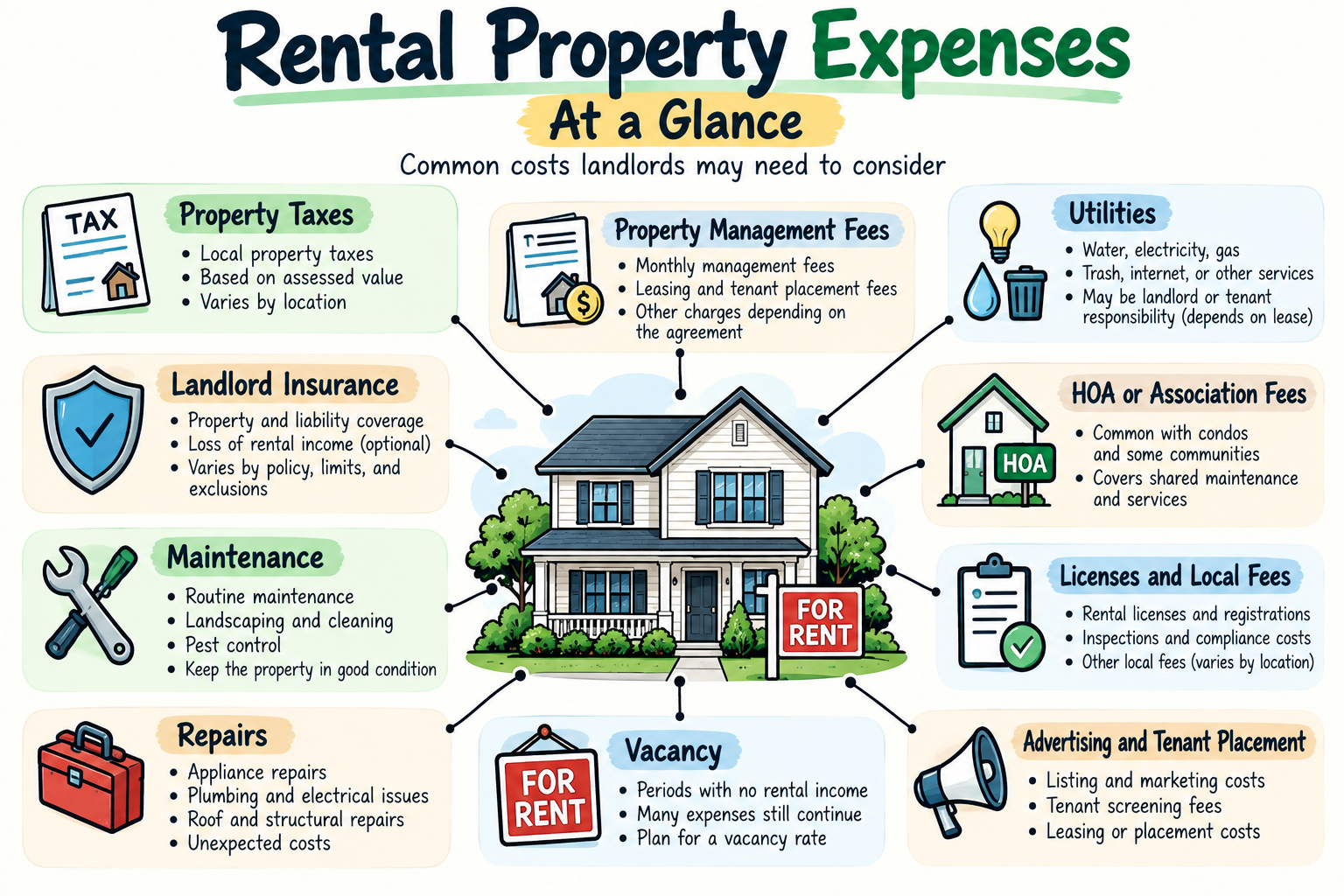
The exact expenses depend on the property, location, lease terms, financing, and how the rental is managed. However, landlords commonly evaluate the following costs:
Property Taxes — Local property taxes can be a significant recurring expense. The amount can depend on assessed value, tax rates, exemptions, and local rules.
Landlord Insurance — Rental property insurance may help cover certain property, liability, and loss-of-rental-income risks, depending on the policy, limits, and exclusions.
Maintenance — Routine maintenance can include servicing equipment, landscaping, cleaning, pest control, and other work needed to maintain the property.
Repairs — Plumbing problems, appliance failures, electrical repairs, roof issues, and other unexpected problems can create additional costs.
Property Management Fees — Owners who hire a property manager may pay ongoing management fees plus other charges depending on the agreement.
Vacancy — When a rental unit is vacant, rental income can fall while many property expenses continue.
Utilities — Depending on the lease, the landlord may be responsible for water, electricity, gas, trash, internet, or other services.
HOA or Association Fees — Condos and properties in some communities may have recurring association fees.
Licenses and Local Fees — Some jurisdictions may require rental licenses, inspections, registrations, or other fees.
Advertising and Tenant Placement — Finding a tenant can involve listing, marketing, screening, leasing, or placement costs.
Several of these expenses deserve a closer look. Read our guides to Rental Property Taxes, Rental Property Insurance Costs, Rental Property Maintenance Costs, Rental Property Management Fees, and Rental Property Vacancy Rate when estimating your own property expenses.
You can also use our NOI Calculator to see how operating expenses affect a property’s Net Operating Income.
Rental Property Operating Expenses vs Other Costs
Not every cost associated with a rental property is treated as an operating expense. This distinction matters because Net Operating Income (NOI) is generally calculated before financing costs such as mortgage payments.
A useful way to organize rental property expenses is to separate them into operating expenses, financing costs, and acquisition or capital costs.
1. Operating Expenses
Operating expenses are recurring costs associated with operating and maintaining the rental property.Common examples may include:
• Property taxes
• Landlord insurance
• Maintenance and repairs
• Property management fees
• Owner-paid utilities
• HOA fees, when applicable
• Certain licenses and recurring local fees
These expenses are generally considered when estimating NOI.
2. Financing Costs
Financing costs relate to how the property is funded rather than its day-to-day operation.The biggest example is the mortgage payment.
Mortgage principal and interest are generally not included as operating expenses when calculating NOI. However, debt payments matter when estimating the actual cash flow available after financing.
3. Acquisition and Capital Costs
Some costs occur when purchasing or significantly improving a property rather than during normal monthly operations.Examples may include:• Closing costs
• Down payment
• Major renovations or improvements
• Certain legal or professional fees
• Large capital replacementsHow these costs are treated for accounting or tax purposes can vary, so landlords should not automatically classify every property-related cost as an immediate operating expense.
Rental Property Expense Example
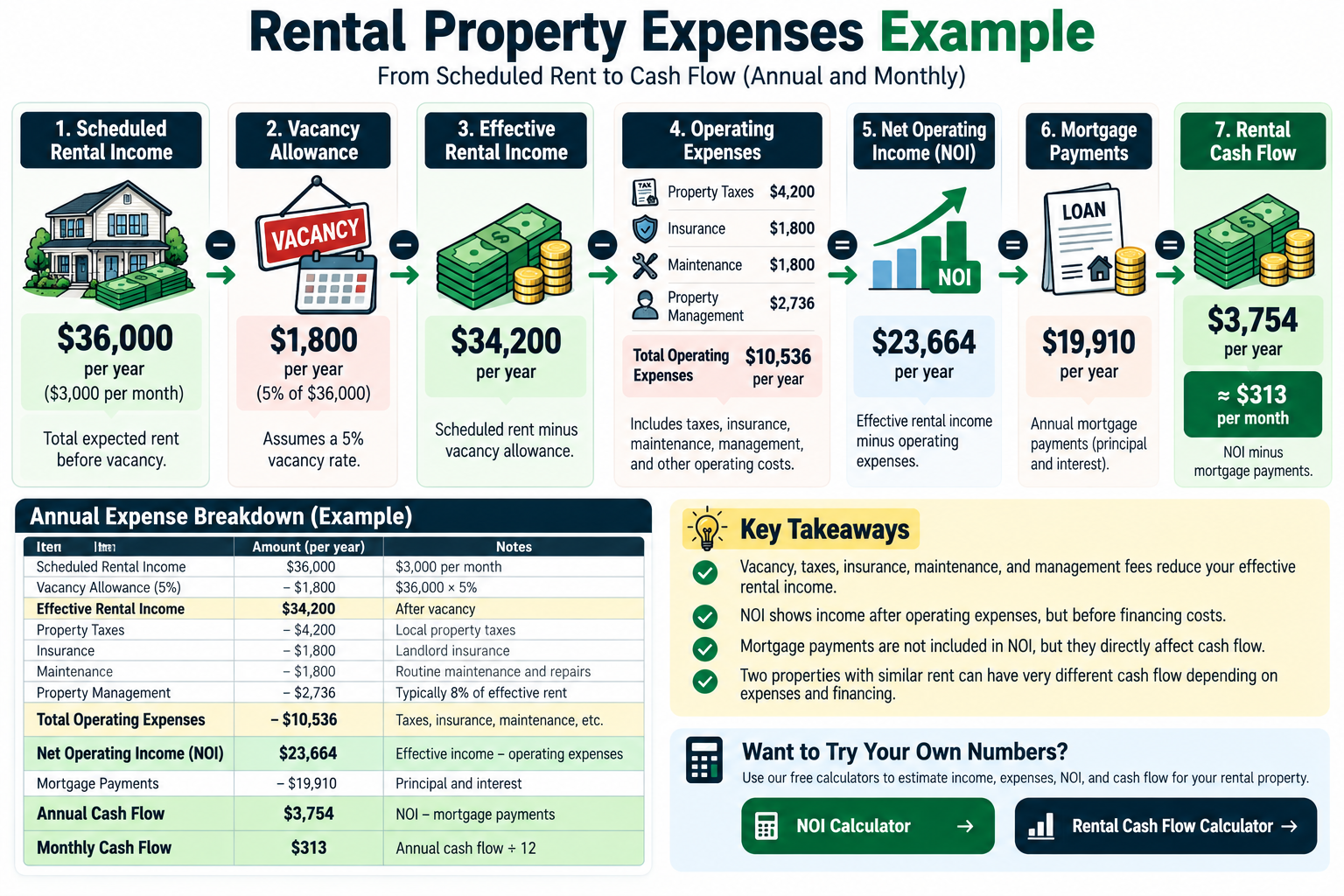
Consider a rental property producing $3,000 per month in scheduled rent, or $36,000 per year.
Assume a 5% vacancy allowance:$36,000 × 5% = $1,800
Estimated effective rental income:$36,000 − $1,800 = $34,200
Add this expense example:
Property taxes: $4,200/year
Insurance: $1,800/year
Maintenance: $1,800/year
Property management: $2,736/year
Total operating expenses: $10,536/year
Estimated NOI:
$34,200 − $10,536 = $23,664
So the property’s estimated Net Operating Income is $23,664 per year in this simplified example.
Want to calculate this automatically? Try our free NOI Calculator.
How Rental Property Expenses Affect Cash Flow
NOI does not tell the entire cash-flow story when a property has financing.
Suppose the property above has approximately $19,910 in annual mortgage payments.
$23,664 NOI − $19,910 mortgage payments = $3,754 annual cash flow
That equals approximately $313 per month.
This illustrates why two properties collecting similar rent can produce very different cash flow when their expenses and financing are different.
Calculate your property’s income, expenses, mortgage payments, and estimated cash flow with our Rental Cash Flow Calculator.
How Much Should Landlords Budget for Rental Property Expenses?
There is no single expense percentage that works for every rental property. Costs can vary significantly based on the property’s age, condition, location, type, tenants, insurance, taxes, management arrangement, utilities, and maintenance needs.Instead of relying on one universal rule, estimate the major expenses individually whenever reliable information is available.
Rental Property Expenses That Are Easy to Forget
Some expenses are obvious, such as property taxes and insurance. Others can be easier to overlook when estimating rental property profitability.
These may include vacancy periods, tenant turnover, leasing costs, pest control, landscaping, HOA fees, permits, inspections, accounting costs, legal costs, owner-paid utilities, and larger future repairs or replacements.
Not every property will have all of these costs, but considering them can produce a more realistic rental property analysis.
How to Estimate Rental Property Expenses Before Buying
Before purchasing a rental property, try to replace guesses with property-specific information wherever possible.
Check the current property-tax records, request insurance quotes, review HOA documents when applicable, examine the property’s condition, research local property-management pricing, identify landlord-paid utilities, and consider the property’s rental and vacancy history when reliable information is available.
A property inspection can also help identify existing issues, although it cannot predict every future repair or expense.
Rental Property Expenses and ROI
Higher expenses can reduce cash flow and may also reduce investment-return measures.
For example, two properties may both collect $3,000 per month in rent, but the property with higher taxes, insurance, maintenance, vacancy, or management costs may produce lower NOI and cash flow.
That is why rental income alone does not show the complete financial picture.
Use our Rental Property ROI Calculator to estimate income, expenses, cash flow, cap rate, cash-on-cash return, and other property metrics.
Frequently Asked Questions About Rental Property Expenses
What are the main expenses for a rental property?
Common expenses can include property taxes, landlord insurance, maintenance, repairs, vacancy, property management, HOA fees, owner-paid utilities, licenses, and other property-specific costs.
Is a mortgage considered a rental property operating expense?
For standard NOI calculations, mortgage principal and interest are generally not treated as property operating expenses. Financing is considered separately when moving from NOI toward cash flow.
Are repairs included in rental property expenses?
Repairs can be a cost of operating a rental property, although the accounting and tax treatment of a particular expenditure may depend on whether it is considered a repair, improvement, or another type of cost.
How do rental property expenses affect cash flow?
Generally, if expenses increase while rental income and financing remain unchanged, cash flow decreases. Tracking realistic expenses helps avoid overstating projected rental-property performance.
Calculate Your Rental Property Expenses
Understanding rental property expenses can help landlords build more realistic estimates of NOI, cash flow, and potential returns.
Instead of looking only at monthly rent, consider the property’s taxes, insurance, maintenance, repairs, vacancy, management costs, financing, and other relevant expenses.
Use Realtolic’s NOI Calculator, Rental Cash Flow Calculator, and Rental Property ROI Calculator to test your own property numbers.
Disclaimer: This article is for general educational purposes only and is not tax, legal, financial, or investment advice. Expenses and their accounting or tax treatment can vary by property and individual circumstances. Consult appropriate local authorities or qualified professionals when necessary.