Learning how to estimate rental property cash flow before buying can help you understand whether a property’s expected rental income may cover its operating expenses and financing costs. A useful estimate should consider realistic rent, vacancy, property taxes, insurance, maintenance, management costs, other operating expenses, and mortgage payments when applicable.
A cash flow estimate is not a guarantee of future income. Actual rent, vacancy, repairs, financing costs, and other expenses can differ from the amounts expected before purchase. This guide explains how to build a practical estimate using property information, local research, and a worked example.
What Is Rental Property Cash Flow Before Buying?
Rental property cash flow is the amount of money remaining after subtracting operating expenses and financing payments from rental income during a specific period. Before buying, investors use estimated numbers because the property’s future financial results are not yet known.
Rental Property Cash Flow Formula
Estimated Cash Flow = Effective Rental Income − Operating Expenses − Mortgage Payments
Effective rental income accounts for expected rent and estimated vacancy loss. Operating expenses may include property taxes, insurance, maintenance, property management, and owner-paid utilities. Mortgage payments generally include loan principal and interest. Major capital expenditures and other cash requirements should also be considered separately.
Why Estimate Cash Flow Before Purchasing a Rental Property?
A property may appear attractive when looking only at its advertised rent. However, rental income alone does not show how much money may remain after the costs of owning and operating the property. Estimating cash flow before purchase helps buyers examine those costs together.
It also allows buyers to compare different financing scenarios, test the effect of vacancy, and consider whether they have enough money available for unexpected expenses and major replacements.
For example, two properties may both rent for $2,500 per month but have different taxes, insurance premiums, maintenance needs, and mortgage payments. Their estimated cash flow can therefore be very different.
How to Estimate Rental Income Before Buying
Start by researching how much similar rental properties charge in the same area. Look for properties with comparable bedrooms, bathrooms, size, condition, and location. Advertised rents are useful starting points, but they do not guarantee the amount a tenant will pay.
1. Compare Similar Rental Listings
Review several comparable rental listings rather than relying on one property. Pay attention to differences in location, amenities, parking, property condition, and included utilities. These details can affect the rent a property may achieve.
2. Check Existing Rental Income
If the property already has tenants, ask for available lease agreements and rental payment records. Compare the existing rent with local market information, and check whether the lease terms could affect future rental income.
3. Allow for Vacancy
Do not assume the property will collect rent every month. Estimate possible vacancy using relevant local rental market information and the property’s circumstances. A vacancy allowance reduces projected rental income and can make the cash flow estimate more realistic.
How to Estimate Rental Property Expenses Before Buying
Next, research the costs of owning and operating the property. Some expenses may be available from seller records, while others require estimates or quotes. Use property-specific information whenever possible rather than assuming every rental property has the same costs.
4. Research Property Taxes
Check the property’s tax information with the relevant local authority. Remember that the tax bill may change after a sale, reassessment, or change in exemptions. Do not automatically assume the seller’s current tax amount will remain the same.
5. Request an Insurance Quote
Ask an insurance provider for an estimate based on the property’s location, condition, intended rental use, and coverage needs. Insurance costs can vary significantly between properties and insurers.
6. Estimate Maintenance and Repairs
Consider the age and condition of the roof, plumbing, electrical systems, appliances, and heating or cooling equipment. A property inspection and relevant contractor estimates may help identify potential costs, although unexpected repairs can still occur.
7. Check Management, HOA, and Utility Costs
If you plan to hire a property manager, request a breakdown of management and leasing fees. Also check applicable HOA charges and identify which utilities or services the property owner must pay. These costs can affect estimated cash flow.
How to Estimate Mortgage Payments Before Buying
If you plan to finance a rental property, estimate the mortgage payment using the expected purchase price, down payment, interest rate, and loan term. Your actual loan terms will depend on the lender, borrower, property, and financing arrangement.
8. Estimate Your Monthly Loan Payment
For a more accurate estimate, compare available financing quotes and consider whether the interest rate is fixed or variable. Remember that the principal and interest payment is only part of the property’s overall ownership cost.
9. Include Closing Costs and Cash Needed Upfront
Before buying, estimate the down payment, applicable closing costs, initial repairs, and other cash needed to complete the purchase. These amounts are important for planning the investment, although they are not normally deducted as recurring monthly operating expenses.
10. Plan for Major Replacements and Reserves
Consider possible future spending on major components such as the roof, HVAC system, and appliances. These capital expenditures are generally analyzed separately from standard NOI. A reserve can help prepare for future costs, but setting money aside is different from paying an actual expense.
Mortgage costs can vary based on the loan amount, interest rate, loan term, and other financing conditions.
Rental Property Cash Flow Estimate: Worked Example
Suppose you are considering buying a rental property and have gathered the following estimated figures. This example is for educational purposes and does not represent a specific property or investment opportunity.
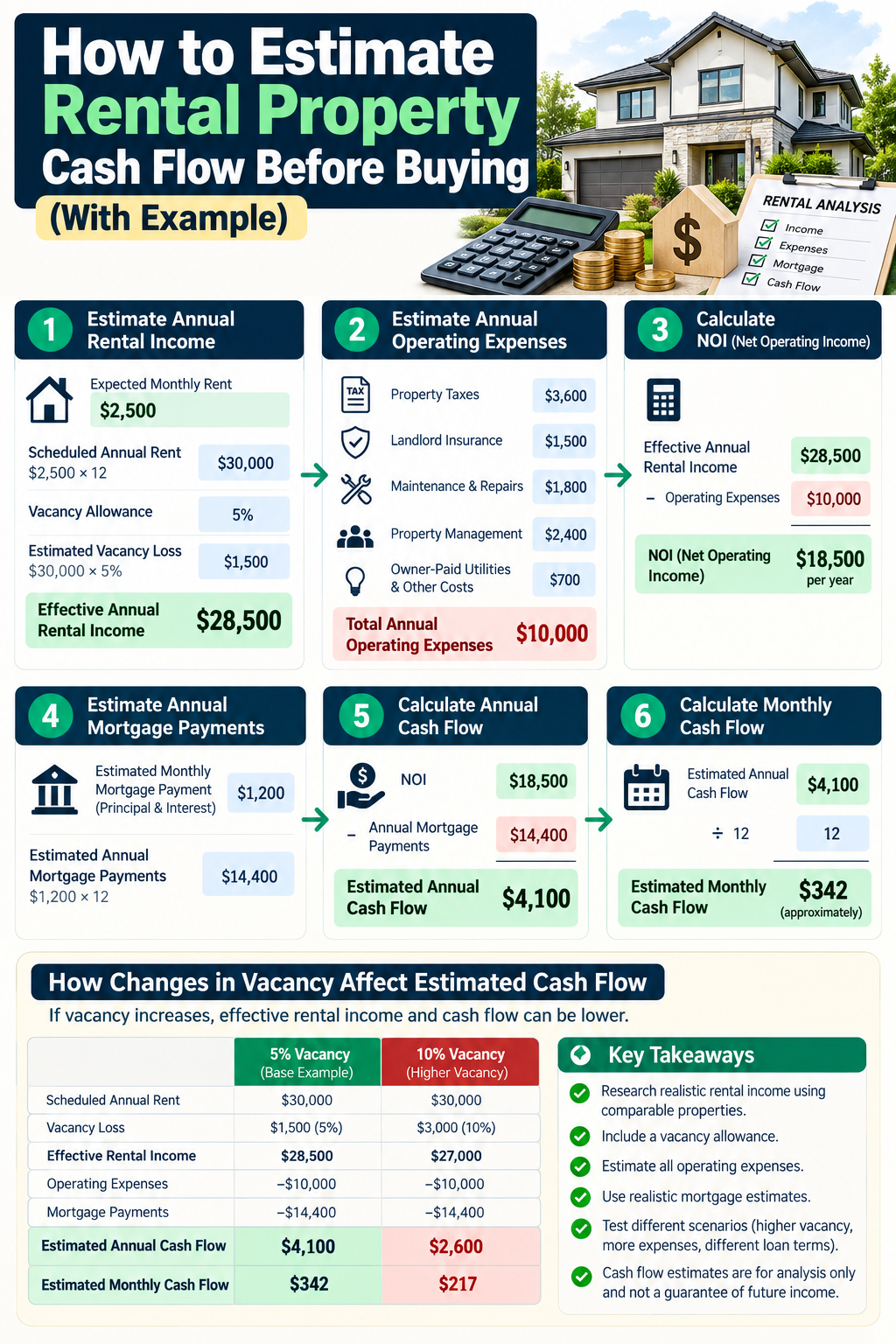
Step 1: Estimate Annual Rental Income
Expected Monthly Rent: $2,500
Scheduled Annual Rent: $2,500 × 12 = $30,000
Illustrative Vacancy Allowance: 5%
Estimated Vacancy Loss: $30,000 × 5% = $1,500
Effective Annual Rental Income = $30,000 − $1,500 = $28,500
Step 2: Estimate Annual Operating Expenses
Property Taxes: $3,600
Landlord Insurance: $1,500
Routine Maintenance: $1,800
Property Management: $2,400
Owner-Paid Utilities and Other Costs: $700
Total Annual Operating Expenses = $10,000
Step 3: Calculate Estimated NOI
NOI = $28,500 − $10,000 = $18,500 per year
We have calculated the estimated annual NOI of $18,500. Now we’ll calculate mortgage payments, cash flow, and see how changing vacancy or expenses affects the result.
Step 4: Estimate Annual Mortgage Payments
After estimating NOI, subtract the expected mortgage payments to calculate simplified cash flow before major capital expenditures and other cash outflows. Use a mortgage estimate based on your expected loan terms rather than guessing the payment.
Estimated Monthly Mortgage Principal and Interest: $1,200
Estimated Annual Mortgage Payments: $1,200 × 12 = $14,400
Step 5: Calculate Estimated Annual Cash Flow
Estimated Annual Cash Flow = NOI − Annual Mortgage Payments
$18,500 − $14,400 = $4,100
Estimated Annual Cash Flow = $4,100
Step 6: Calculate Estimated Monthly Cash Flow
Divide the estimated annual cash flow by 12 to find the average monthly amount. This is an annualized average, not a guarantee that every month will produce the same cash flow.
$4,100 ÷ 12 = $341.67
Estimated Average Monthly Cash Flow ≈ $342
In this simplified example, the property produces approximately $342 in average monthly cash flow after estimated vacancy, operating expenses, and mortgage payments. Actual results may differ, and major capital expenditures or other cash outflows could reduce the amount available to the owner.
How Changes in Vacancy Affect Estimated Cash Flow
Before buying, it can be useful to test how the numbers change if the property stays vacant longer than expected. Keep the other assumptions the same to isolate the effect of vacancy.
Example: Vacancy Increases From 5% to 10%
Scheduled Annual Rent: $30,000
Vacancy Loss at 10%: $3,000
Effective Rental Income: $27,000
Operating Expenses: −$10,000
Mortgage Payments: −$14,400
Estimated Annual Cash Flow = $2,600 (approximately $217/month)
Increasing the illustrative vacancy allowance from 5% to 10% reduces estimated annual cash flow from $4,100 to $2,600 when other assumptions remain unchanged. Buyers can also test higher maintenance costs, different mortgage payments, or lower expected rent to understand how sensitive the estimate is.
Costs Buyers Often Forget When Estimating Rental Property Cash Flow
A rental property may appear to generate positive cash flow when important costs are missing from the estimate. Before buying, review both recurring operating expenses and occasional cash requirements.
1. Tenant Turnover and Leasing Costs
When tenants move out, landlords may pay for advertising, cleaning, minor repairs, and tenant placement services. These costs can reduce cash flow, especially when tenant turnover happens frequently.
2. Unexpected Maintenance and Repairs
A property inspection can identify some problems, but it cannot predict every future repair. Plumbing leaks, appliance failures, and other unexpected issues may increase actual expenses beyond the original estimate.
3. Major Capital Expenditures
Roof replacements, major HVAC replacements, and substantial property improvements can require significant cash. These capital expenditures are generally analyzed separately from standard NOI, but actual payments still affect the owner’s available cash.
4. Property Tax and Insurance Changes
Property taxes and insurance premiums may change after purchase or during ownership. Buyers should research current information and consider how higher costs could affect future cash flow.
5. HOA Fees and Special Assessments
Some properties have homeowners association fees or special assessments. Review the association’s available documents and relevant property records to understand possible ongoing charges and additional obligations.
Rental Property Cash Flow Checklist Before Buying
Use the following checklist to review your assumptions before relying on a rental property’s estimated cash flow.
Compare rental income with similar local properties.
Check existing leases and payment records when available.
Include a realistic vacancy allowance.
Research property taxes and insurance costs.
Estimate maintenance and management expenses.
Check HOA fees and owner-paid utilities.
Use realistic mortgage payment estimates.
Consider major replacements and cash reserves.
Test lower rent, higher vacancy, and higher expense scenarios.
Completing this checklist cannot eliminate investment risk, but it can help buyers identify missing information and make their financial estimates more complete.
How to Compare Two Rental Properties Before Buying
When comparing rental properties, use the same calculation method and time period for each property. Estimate effective rental income, operating expenses, mortgage payments, and major capital spending separately.
For example, one property may have higher advertised rent but also higher property taxes, insurance costs, or maintenance needs. Another may have lower rent but fewer expected expenses. Comparing estimated cash flow alongside purchase costs, property condition, and financial risks provides more context than comparing rent alone.
Use a Rental Cash Flow Calculator Before Buying
Our free Rental Cash Flow Calculator can help you estimate rental income, vacancy, operating expenses, and mortgage payments. Review the results alongside potential capital expenditures and other costs that may not be included in the calculator.
Compare Rental Property Cash Flow Before Buying: Three Scenarios
A single cash flow estimate cannot predict exactly how a rental property will perform. Before buying, compare different assumptions to understand how changes in rental income, vacancy, and operating expenses could affect the amount of money remaining.
Scenario 1: Base Estimate
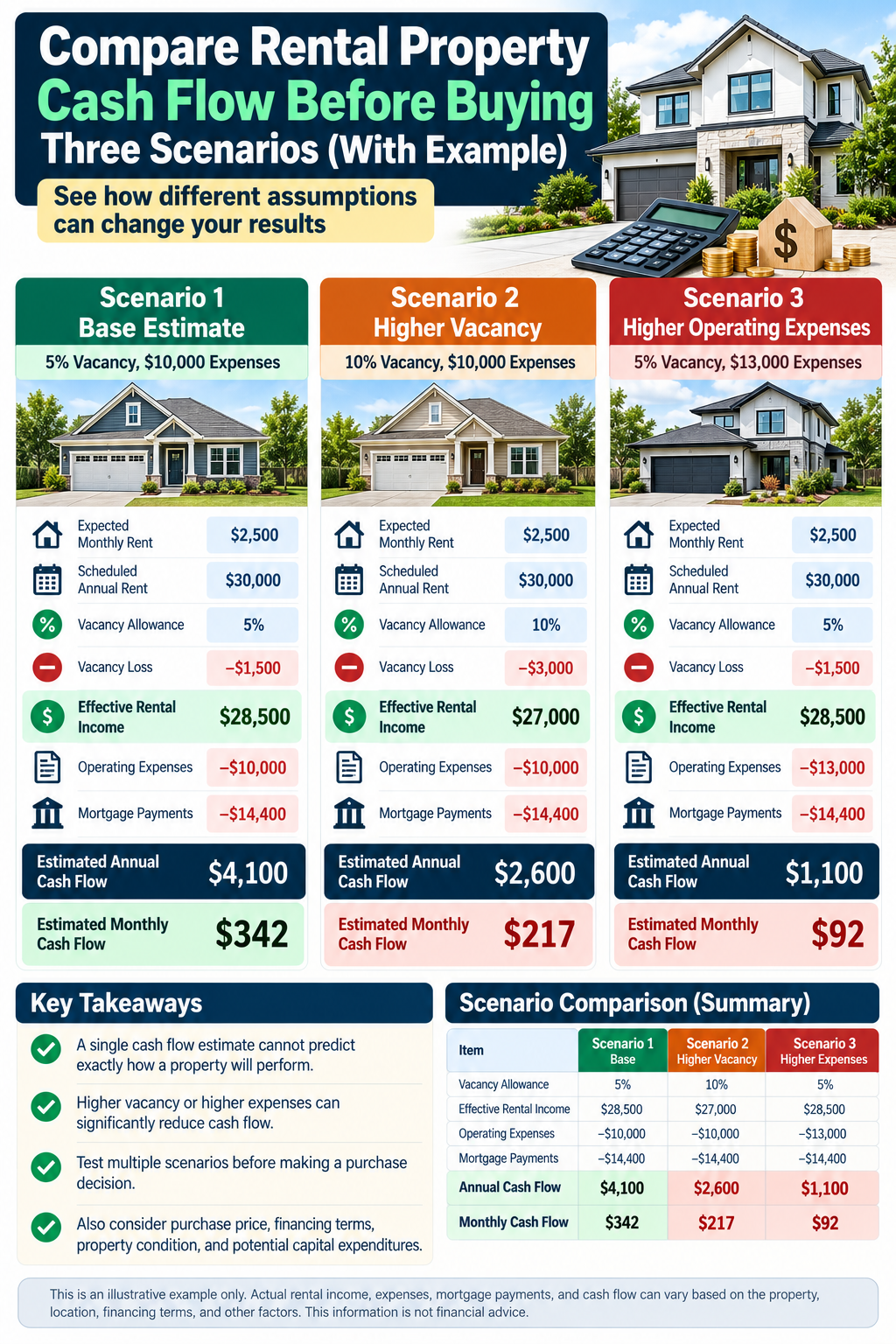
Using our earlier example, the property generates $28,500 in effective annual rental income, with $10,000 in operating expenses and $14,400 in annual mortgage payments.
Estimated Annual Cash Flow: $4,100
Estimated Average Monthly Cash Flow: $342
Scenario 2: Higher Vacancy
If the vacancy allowance increases from 5% to 10%, effective annual rental income falls to $27,000. Assuming all other costs remain unchanged:
Effective Annual Rental Income: $27,000
Operating Expenses: −$10,000
Mortgage Payments: −$14,400
Estimated Annual Cash Flow: $2,600
Estimated Average Monthly Cash Flow: $217
Scenario 3: Higher Operating Expenses
Suppose the original 5% vacancy assumption remains unchanged, but annual operating expenses increase from $10,000 to $13,000.
Effective Annual Rental Income: $28,500
Operating Expenses: −$13,000
Mortgage Payments: −$14,400
Estimated Annual Cash Flow: $1,100
Estimated Average Monthly Cash Flow: $92
What These Cash Flow Scenarios Tell You
In this illustrative example, the base estimate produces approximately $342 per month. Increasing vacancy reduces the estimate to approximately $217 per month, while increasing operating expenses reduces it to approximately $92 per month.
These comparisons show how sensitive estimated cash flow can be to changes in a property’s financial assumptions. They do not predict actual results, and none of the scenarios includes every possible cost or major capital expenditure.
Should You Rely on Estimated Cash Flow Alone?
No single financial estimate tells the complete story of a rental property. Buyers should also consider the purchase price, financing terms, property condition, cash needed upfront, possible capital expenditures, local rental demand, and their own financial circumstances.
A property with positive estimated cash flow can still experience unexpected expenses or periods without rental income. Review multiple scenarios and verify important assumptions before making a purchase decision.
For a broader explanation of income and expenses, read our Rental Property Expenses Guide.
Frequently Asked Questions About Rental Property Cash Flow Before Buying
How do you estimate rental property cash flow before buying?
Estimate potential rental income using comparable properties, subtract a realistic vacancy allowance, then subtract expected operating expenses and mortgage payments. Consider major capital expenditures and other cash requirements separately to understand the broader financial picture.
Can you calculate rental property cash flow without owning the property?
Yes. You can create an estimate using rental listings, available property records, insurance quotes, financing estimates, and information from the seller. However, the results remain projections rather than verified future income.
Should you include vacancy when estimating rental cash flow?
Yes. A vacancy allowance helps account for possible periods without rental income. The appropriate assumption depends on local market conditions and the particular property.
Does estimated cash flow include mortgage payments?
In the simplified calculation used in this guide, estimated cash flow includes deductions for mortgage principal and interest payments. Net Operating Income (NOI), by comparison, is generally calculated before financing costs.
Should closing costs be included in monthly cash flow?
Closing costs are generally upfront purchase costs rather than recurring monthly operating expenses. They should be included when calculating the cash needed to purchase the property and evaluating the overall investment.
What if the property needs a new roof or HVAC system?
Estimate the potential replacement costs and consider their effect on available cash. Major replacements are generally treated separately from standard NOI, but paying for them can substantially reduce cash flow in the year the costs occur.
Is positive estimated cash flow guaranteed after buying?
No. Actual rental income, vacancy, operating expenses, financing costs, and major repairs can differ from the estimates. Positive projected cash flow does not guarantee positive results after purchase.
Related Rental Property Guides
Learn the basic calculation in our How to Calculate Rental Property Cash Flow guide.
For information about major replacements and everyday expenses, read our Operating Expenses vs Capital Expenditures guide.
Final Thoughts
Estimating rental property cash flow before buying involves more than checking the advertised rent. Research realistic rental income, account for vacancy, estimate operating expenses, review financing terms, and consider possible major repairs and replacement costs.
Compare multiple scenarios rather than relying on one optimistic estimate. A careful analysis can help identify important questions and financial risks before purchasing a rental property.
Disclaimer: This article is for general educational purposes only and is not personalized financial, investment, tax, or legal advice. All calculations are illustrative. Actual property performance and costs may vary.