Understanding operating expenses vs capital expenditures is important when analyzing a rental property. Operating expenses are generally recurring costs of running a property, while capital expenditures are usually larger costs related to improving, replacing, or extending the useful life of major property components.
Knowing the difference can help you calculate NOI, estimate cash flow, and budget more accurately.
Operating expenses generally cover the regular costs of running and maintaining a rental property. Capital expenditures usually involve buying, replacing, or substantially improving long-lasting property components. The distinction matters because these costs are treated differently in common real estate financial calculations.
What Are Operating Expenses in Real Estate?
Operating expenses are costs associated with the normal operation and maintenance of a rental property. They are generally deducted from effective gross income when calculating NOI.
Common Rental Property Operating Expenses
Examples may include property taxes, landlord insurance, routine repairs, cleaning, landscaping, property management fees, and utilities paid by the owner. The exact expenses depend on the property and its operating arrangements.
What Are Capital Expenditures (CapEx) in Real Estate?
Capital expenditures are generally costs related to acquiring, replacing, or substantially improving long-lasting property assets. Examples may include replacing an entire roof, installing a new HVAC system, or completing a major property renovation. Whether a specific cost is classified as CapEx can depend on the nature of the work and the accounting or tax rules being applied.
For U.S. tax purposes, the treatment of property improvements can differ from ordinary repair expenses, so property owners should understand the applicable tax rules.
Operating Expenses vs Capital Expenditures: Key Differences
The main difference between operating expenses (OpEx) and capital expenditures (CapEx) is the purpose of the spending. Operating expenses generally support the property’s ongoing operations, while capital expenditures usually involve major replacements, improvements, or long-lasting assets.
OpEx vs CapEx Comparison Table
The classification of a property cost often depends on the type and extent of the work. A small repair and a major replacement can involve the same part of a building but receive different accounting treatment.
OpEx vs CapEx: Real Estate Examples Explained
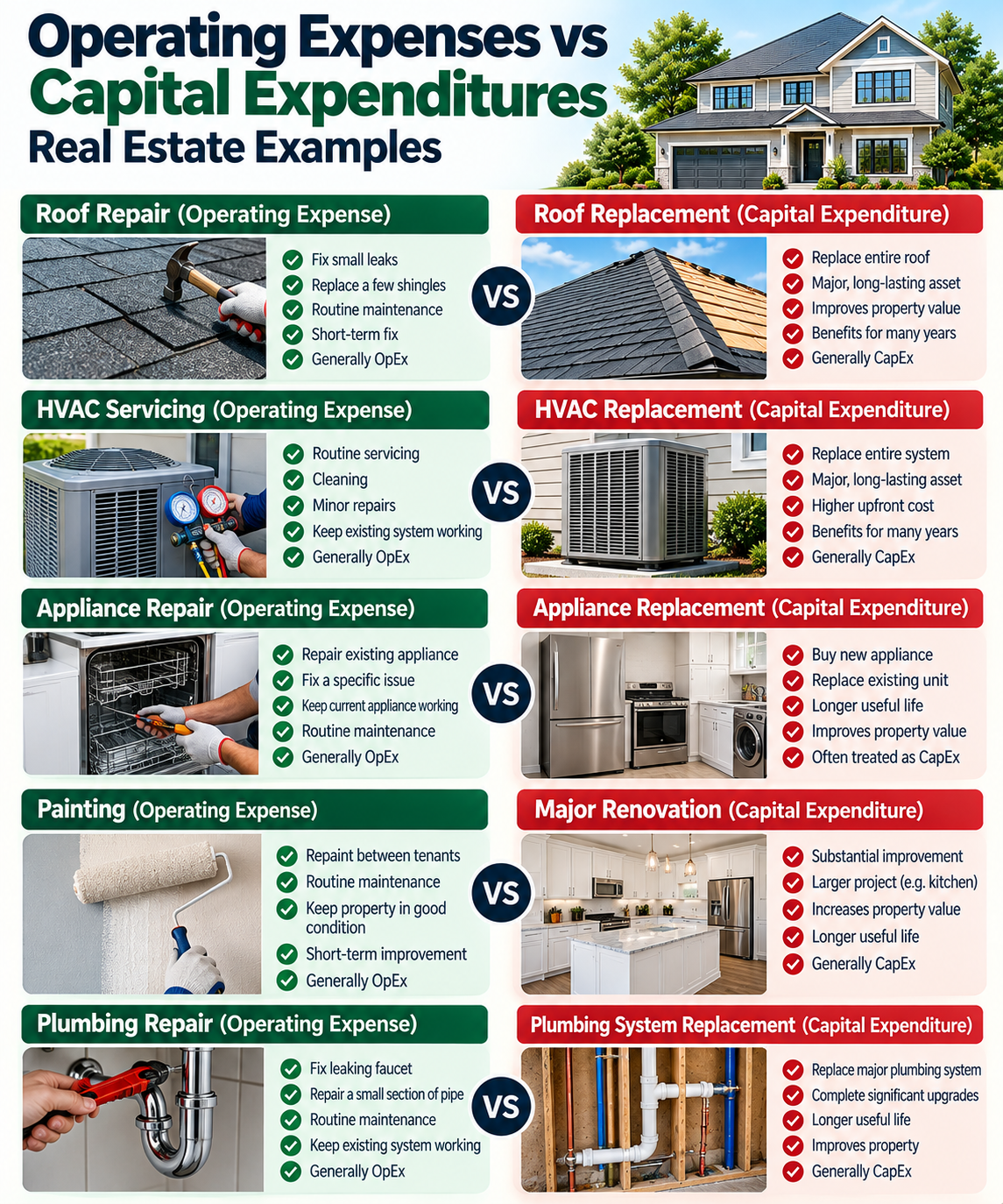
1. Roof Repair vs Roof Replacement
Fixing a small roof leak or replacing a few damaged shingles is generally routine maintenance and may be treated as an operating expense. Replacing an entire roof is usually a capital expenditure because it involves a major, long-lasting building component. The exact classification depends on the work performed and applicable accounting rules.
2. HVAC Repair vs HVAC Replacement
Routine HVAC servicing, cleaning, and minor repairs are generally operating expenses. Replacing an entire heating or cooling system is typically considered a capital expenditure because the new system is expected to provide benefits over multiple years.
3. Appliance Repair vs Appliance Replacement
Repairing an existing refrigerator or washing machine may be treated as a routine operating expense. Buying a replacement appliance may be treated as a capital asset, depending on its cost, useful life, and applicable accounting or tax rules.
4. Painting vs Major Renovation
Ordinary repainting between tenants may be a maintenance expense. However, painting performed as part of a larger renovation or improvement project may be treated differently. A major kitchen renovation that substantially improves the property is generally a capital expenditure.
5. Plumbing Repair vs Plumbing System Replacement
Fixing a leaking faucet or repairing a small section of pipe is generally routine maintenance. Replacing a major plumbing system or completing substantial upgrades may qualify as a capital expenditure.
Does the Size of an Expense Determine Whether It Is CapEx?
Not necessarily. A large bill does not automatically mean a cost is CapEx, and a smaller purchase is not automatically an operating expense. The nature of the work, expected useful life, accounting policies, and applicable tax rules can all affect the classification.
For example, an expensive emergency repair may still be a repair, while a comparatively inexpensive improvement may be capitalized under certain accounting rules. Landlords should keep clear records and seek professional guidance when classification is uncertain.
Why the Difference Between OpEx and CapEx Matters
Understanding the difference helps landlords prepare operating budgets, plan for major replacements, and interpret financial measures such as NOI and cash flow. A property can have positive NOI but still require significant cash for a major replacement. This is why operating performance and long-term capital spending should be reviewed separately.
How Operating Expenses Affect Net Operating Income (NOI)
Operating expenses are generally deducted from effective gross income when calculating a rental property’s Net Operating Income (NOI). Capital expenditures are normally analyzed separately because NOI focuses on the property’s operating performance.
Example: Calculating NOI With Operating Expenses
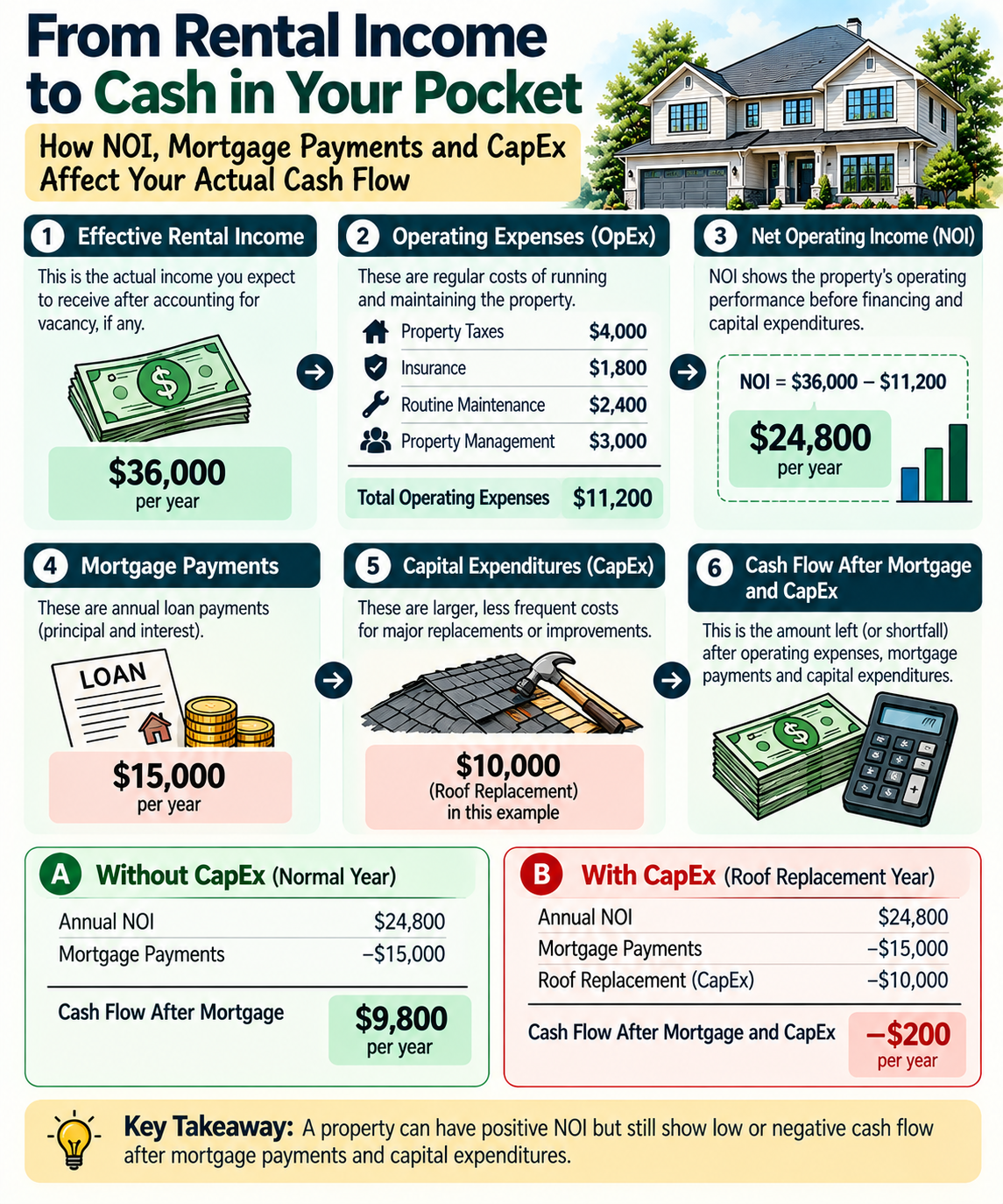
Suppose a rental property generates $36,000 in effective annual rental income. The owner pays $4,000 in property taxes, $1,800 in insurance, $2,400 in routine maintenance, and $3,000 in property management fees.
Effective Annual Rental Income: $36,000
Property Taxes: −$4,000
Insurance: −$1,800
Routine Maintenance: −$2,400
Property Management: −$3,000
Total Operating Expenses = $11,200
NOI = $36,000 − $11,200 = $24,800
In this simplified example, the property generates $24,800 in annual NOI before mortgage payments and capital expenditures.
How Capital Expenditures Affect Rental Property Cash Flow
Now suppose the same property requires a $10,000 roof replacement during the year. The roof replacement is treated as a capital expenditure in this illustrative example, so it is not deducted when calculating the property’s NOI. However, paying for the replacement reduces the cash available to the owner.
Cash Flow Example With CapEx
Assume the property also has $15,000 in annual mortgage payments and the $10,000 roof replacement is paid in cash.
Annual NOI: $24,800
Mortgage Payments: −$15,000
Roof Replacement (CapEx): −$10,000
Cash Flow After Mortgage and CapEx = −$200
Without the roof replacement, the simplified annual cash flow after mortgage payments would be $9,800. After paying $10,000 for the roof, it becomes negative $200. This demonstrates why positive NOI does not always mean positive cash flow after major capital spending.
You can estimate a property’s operating income using our NOI Calculator.
How to Budget for Capital Expenditures on a Rental Property
Major property components eventually need repairs or replacement. Because these costs can be irregular and expensive, landlords can plan ahead by estimating future capital expenditures and setting aside money over time. This is often called a CapEx reserve.
What Is a CapEx Reserve?
A CapEx reserve is money a property owner sets aside for future major replacements or improvements, such as a roof, HVAC system, or other long-lasting building components. It is a budgeting tool rather than a separate operating expense in a standard NOI calculation.
How to Estimate a CapEx Reserve
One way to plan is to list major property components, estimate their future replacement costs, and consider how many years of useful life they may have remaining. Dividing the estimated replacement cost by the remaining years provides a simple annual savings target.
Estimated Annual CapEx Reserve = Expected Replacement Cost ÷ Estimated Years Until Replacement
Example: Saving for a Future Roof Replacement
Suppose a landlord estimates that a roof replacement may cost $12,000 in six years. Ignoring inflation, investment returns, and unexpected changes in cost, the illustrative savings calculation would be:
Estimated Roof Replacement Cost: $12,000
Estimated Time Until Replacement: 6 years
Annual Savings Target: $12,000 ÷ 6 = $2,000
Monthly Savings Target: $2,000 ÷ 12 = $166.67
In this example, saving approximately $167 per month would build a $12,000 reserve over six years if contributions remain consistent and no money is withdrawn. Actual replacement costs and timing may differ.
Common OpEx vs CapEx Mistakes Landlords Should Avoid
1. Treating Every Repair as a Capital Expenditure
Not every repair is CapEx. Routine work that maintains an existing component may be an operating expense, while substantial replacements or improvements may be capital expenditures. Classification depends on the nature of the work and applicable rules.
2. Ignoring Future Replacement Costs
A property may show positive cash flow today but require major spending in future years. Ignoring possible roof, HVAC, appliance, or other replacements can make a long-term budget incomplete.
3. Confusing NOI With Cash Available to the Owner
NOI generally excludes mortgage payments and capital expenditures. Owners should consider financing costs, actual capital spending, and other relevant cash outflows separately when estimating money remaining after property costs.
4. Mixing CapEx Reserves With Actual Expenses
Setting aside money for future capital expenditures is different from paying for an actual replacement. A CapEx reserve is a budgeting allocation, while an actual roof or HVAC replacement creates a cash outflow when paid. Keep these amounts separate to avoid counting the same cost twice.
5. Assuming Tax Rules and NOI Rules Are the Same
NOI is a property performance measure, while tax reporting follows applicable tax laws. An expense’s treatment in an NOI calculation may differ from its treatment for income tax purposes. Some improvements may need to be capitalized and depreciated rather than deducted immediately. Consult a qualified tax professional when classification is uncertain.
OpEx vs CapEx Checklist for Rental Property Owners
Before classifying a property expense, consider the purpose of the work, whether it maintains an existing component or substantially improves it, and how the cost affects your operating budget and long-term financial planning.
Is this a recurring cost of operating the property?
Does the work repair or maintain an existing component?
Does it replace a major system or substantially improve the property?
Will the improvement provide benefits over multiple years?
Is this an actual payment or money being saved for future work?Have I checked the applicable accounting and tax treatment?
These questions are useful starting points, but they do not determine the correct accounting or tax classification in every situation.
How OpEx and CapEx Work Together in Rental Property Investing
Operating expenses and capital expenditures both matter when evaluating a rental property. OpEx helps determine the property’s ongoing operating performance, while CapEx planning helps estimate future replacement needs and possible cash requirements.
For example, a property may produce positive NOI every year but still require a major roof replacement or HVAC upgrade. Reviewing operating expenses, mortgage payments, and capital spending together provides a more complete picture than looking at NOI alone.
Which Rental Property Calculator Should You Use?
Use our NOI Calculator to estimate property income after operating expenses, before financing and capital expenditures.
Use our Rental Cash Flow Calculator to estimate rental income, operating expenses, and mortgage payments. Consider actual capital spending separately if the calculator does not include a dedicated CapEx field.
For a detailed list of recurring rental property costs, read our Rental Property Operating Expenses guide.
Frequently Asked Questions About OpEx vs CapEx
What is the main difference between OpEx and CapEx in real estate?
Operating expenses generally cover the ongoing costs of running and maintaining a rental property. Capital expenditures usually involve acquiring, replacing, or substantially improving long-lasting property assets.
Is replacing a roof OpEx or CapEx?
Replacing an entire roof is generally treated as a capital expenditure. Fixing a small roof leak may be considered a routine repair. The classification depends on the work performed and applicable rules.
Is HVAC replacement a capital expenditure?
Replacing an entire HVAC system is typically a capital expenditure because it involves a major property component expected to provide benefits over multiple years. Routine servicing and minor repairs are generally operating expenses.
Are capital expenditures included in NOI?
Capital expenditures are generally excluded from a standard NOI calculation. NOI measures property income after operating expenses but before financing and major capital spending.
Do capital expenditures affect rental property cash flow?
Yes. Paying for major replacements or improvements reduces the cash available to the owner. A property can have positive NOI but negative cash flow after mortgage payments and substantial capital spending.
Is a CapEx reserve an operating expense?
A CapEx reserve is money set aside for future capital spending. In a standard NOI calculation, reserve allocations are generally considered separately from actual operating expenses. However, specific financial reporting and lender calculations may use different conventions.
Are OpEx and CapEx treated differently for taxes?
They can be. Tax treatment depends on applicable laws, the nature of the expense, and the owner’s circumstances. Some improvements may need to be capitalized and depreciated. A qualified tax professional can help determine the correct treatment.
Final Thoughts
Understanding operating expenses vs capital expenditures helps rental property owners distinguish everyday operating costs from major replacements and improvements. Both affect a property’s financial performance, but they are handled differently in standard NOI calculations.
Operating expenses generally reduce NOI, while capital expenditures are typically analyzed separately. However, actual capital spending can still reduce the cash available to the owner, making long-term budgeting important.
When evaluating a rental property, review operating expenses, mortgage payments, possible capital expenditures, and future replacement needs together rather than relying on NOI alone.
Related Real Estate Guides
Learn more about recurring costs in our Rental Property Expenses Guide.
Disclaimer: This article is for general educational purposes only. Accounting classifications, tax treatment, financial reporting, and actual property expenses may vary. Consult qualified accounting, tax, or real estate professionals when appropriate.