
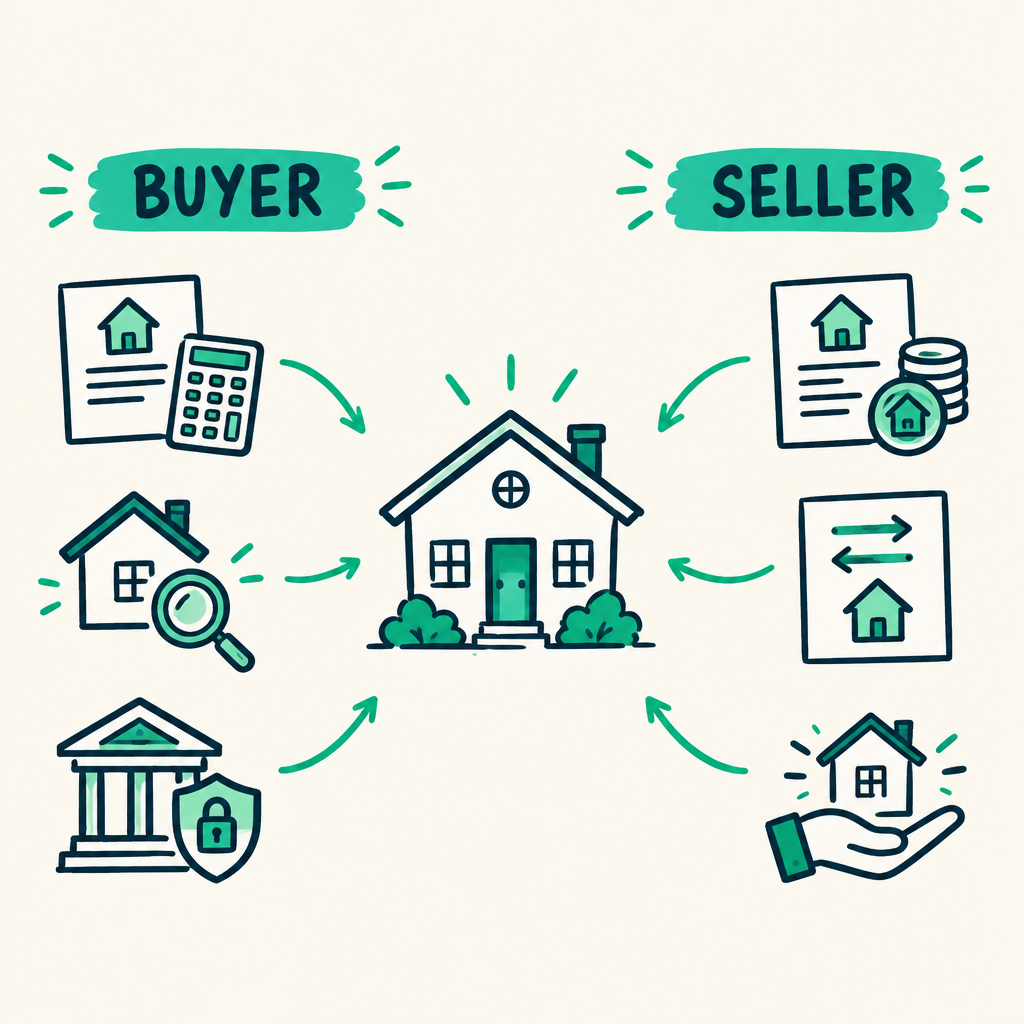
In the United States, both buyers and sellers may pay closing costs. Buyers typically cover mortgage-related fees, while sellers pay their agreed selling expenses. Title fees, transfer taxes and seller credits depend on state rules and the purchase contract.
Picture a buyer who has saved for the down payment on a $300,000 house. At the closing table, they discover another $9,000 in estimated expenses. Can they ask the seller to help? Often, yes—but the details matter. This guide breaks down which party commonly pays each fee, what you can negotiate, and how to calculate the cash you actually need.
What Are Closing Costs?
Closing costs are the fees and expenses involved in completing a property purchase or sale. They can include loan charges, appraisals, title and settlement services, government recording fees, prepaid insurance, taxes and other adjustments. They are generally separate from a buyer’s down payment. A buyer putting $60,000 down on a $300,000 home may need additional cash for closing costs. Estimate your expenses with the Realtolic Closing Cost Calculator.
Who Usually Pays Which Fees?
| Closing expense | Who commonly pays? |
|---|---|
| Mortgage origination and credit report | Buyer |
| Lender-required appraisal | Buyer |
| Lender’s title insurance | Often buyer; local practices vary |
| Owner’s title insurance | Buyer or seller, depending on agreement and location |
| Transfer taxes and recording fees | Varies by law and contract |
| Agent compensation | As agreed in applicable contracts |
| Existing mortgage payoff | Seller, generally from sale proceeds |
| Property tax adjustments | Allocated by contract and relevant dates |
| Seller credit toward buyer expenses | Seller, if negotiated and permitted |
This table describes common arrangements, not universal rules. Check your purchase contract and local requirements.
Buyer Closing Costs: What You May Need to Pay
Loan origination charges
A mortgage lender may charge to process and make the loan. Compare total costs across Loan Estimates rather than judging one fee in isolation.
Appraisal and credit report
A lender may require an appraisal to assess the property’s value and obtain credit information for underwriting.
Title and settlement services
Title services help identify ownership problems, liens and claims. Which party pays for specific title policies and settlement services varies by location and agreement.
Prepaid expenses and escrow deposits
Buyers may need to pay homeowners insurance premiums, prepaid mortgage interest and initial escrow deposits for taxes and insurance. These can increase the cash needed at closing.
Seller Closing Costs: What Comes Out of the Sale
Agreed agent compensation
Agent compensation depends on the agreements made by the relevant parties; there is no universal fixed percentage that every seller must pay.
Mortgage payoff
If a seller has an outstanding mortgage, the loan normally must be paid from sale proceeds unless a different lawful arrangement applies. The payoff reduces proceeds but is not itself the same as a closing fee.
Taxes, title and settlement charges
Depending on state law, local practice and the purchase contract, sellers may pay transfer taxes, certain title services and settlement charges. Property taxes and homeowners association expenses may be adjusted between the parties.
Can a Seller Pay the Buyer’s Closing Costs?
Quick answer: Yes, if the seller agrees and the buyer’s mortgage rules permit it. A seller credit can reduce eligible upfront expenses, but it is not the same as reducing the sale price.
| Negotiation | What changes for the buyer? |
|---|---|
| $300,000 price, no seller credit | Buyer covers all eligible buyer closing costs |
| $300,000 price, $4,000 seller credit | Up to $4,000 of eligible costs may be offset |
| $296,000 price, no seller credit | Lower purchase price, but buyer still needs cash for closing costs |
Illustrative comparison only: A lower price and a seller credit have different effects on financing and cash requirements. Ask your lender to compare the actual options.
Yes. Buyers may negotiate a seller concession or seller credit toward eligible expenses. For example, a buyer might offer $300,000 and request a $4,000 credit. If accepted and permitted by the lender, the credit can reduce upfront cash requirements. It is not necessarily free money: the seller may factor it into the negotiated price. Loan programs limit the size and permitted uses of seller contributions. Confirm those rules with the lender before relying on a credit.
Illustrative Example: Closing Costs on a $300,000 Home
Imagine two buyers looking at the same $300,000 home. One negotiates a seller credit; the other doesn’t. Their purchase price and loan terms may look similar, but the money they must bring to the closing table can be different.
Suppose the price is $300,000, the down payment is $60,000 (20%), estimated buyer closing costs are $9,000, and the buyer has already deposited $5,000 in earnest money. Without a seller credit, the remaining amount is $60,000 + $9,000 − $5,000 = $64,000. If an eligible $4,000 seller credit applies, the remaining amount becomes $60,000 + $9,000 − $4,000 − $5,000 = $60,000. The $9,000 cost assumption equals 3% of the price but is illustrative, not a guaranteed rate. Real cash-to-close calculations can include other credits, prorations and adjustments. Try the Closing Cost Calculator and compare estimates with your lender’s official figures.
Closing Costs vs. Cash to Close
Closing costs are transaction expenses. Cash to close is the amount the buyer actually needs to provide at closing, taking account of the down payment, deposits, credits and other adjustments. A simplified formula is: cash to close = down payment + buyer closing costs − deposits − applicable credits ± adjustments. Someone with $8,000 in closing costs may need much more than $8,000 at closing because the down payment is also due.
How to Lower Buyer Closing Costs Without Guesswork
Before negotiating, ask the lender which fees are fixed, which you can shop for, and whether a seller credit is allowed. That gives you a realistic savings target instead of a vague request to “waive the fees.”
Compare mortgage offers
Request Loan Estimates from multiple lenders and compare interest rates, loan charges, lender credits and overall borrowing costs. Lower upfront fees sometimes come with a higher interest rate.
Shop for services when permitted
Buyers may be able to compare certain title and settlement providers. Ask which services you can choose.
Negotiate seller credits
A seller may agree to cover eligible expenses, subject to lender limits and the purchase agreement.
Review the Closing Disclosure
For most covered mortgages, the buyer must receive the Closing Disclosure at least three business days before closing. Compare it with the latest Loan Estimate and ask about unfamiliar charges before signing.
Questions to Ask Before You Sign a Purchase Agreement
- Which transfer taxes, title policies and settlement charges are customarily paid by each party in this county?
- Which charges are fixed by law, and which can we negotiate?
- Does my mortgage program allow the seller credit I plan to request?
- What is the estimated cash to close after earnest money and seller credits?
- Which fees can change between the Loan Estimate and Closing Disclosure, and why?
Ask the settlement agent for an itemized estimate. For lender charges, compare the same loan type and interest-rate assumptions across offers.
Do Buyer and Seller Closing Costs Change by State?
Yes. Transfer taxes, recording charges, title insurance customs, and attorney or settlement requirements vary by state and locality. Two homes with the same purchase price may have different closing expenses. Use nationwide estimates only as a starting point and verify local costs.
Do Cash Buyers Pay Closing Costs?
Yes. A cash purchase can still involve title services, inspections, recording fees, transfer-related charges and settlement services. However, a cash buyer generally avoids mortgage origination fees and lender-required mortgage appraisal charges. The precise costs depend on the transaction.
What Sellers Should Check Before Closing
Review the estimated net proceeds, not just the selling price. For example, a $300,000 sale less a $180,000 mortgage payoff, $18,000 of agreed selling expenses and a $4,000 seller credit produces $98,000 in estimated proceeds before other adjustments or charges. The final settlement statement determines the actual amount.
How We Prepared This Guide
By Realtolic Editorial Team. This U.S.-focused educational guide uses general mortgage-closing concepts and official Consumer Financial Protection Bureau resources. Dollar examples are hypothetical calculations, not actual customer transactions, fee quotes or professional mortgage advice. Closing charges and contract rules differ by location and loan program; confirm details with your lender, title company or settlement agent.
Frequently Asked Questions
Does the buyer always pay closing costs?
No. Buyers generally pay mortgage-related expenses, but responsibility for other charges varies, and sellers may contribute through negotiated credits.
Can the seller pay all the buyer’s closing costs?
Sometimes the seller can cover all eligible buyer closing costs, but mortgage-program rules can limit the amount and what it may pay for. A down payment may still be required.
Are closing costs part of the down payment?
No. Closing costs and the down payment are separate items that can both affect cash to close.
Who pays title insurance?
It depends on the type of policy, location and agreement. A lender’s policy and an owner’s policy protect different interests.
Can closing costs be negotiated?
Some lender and service-provider charges can be compared or negotiated; certain government charges are fixed.
Before You Sign: A Quick Closing-Cost Checklist
- Ask for a detailed estimate of buyer or seller closing costs.
- Check who pays transfer taxes, title fees and settlement charges in your location.
- If using a mortgage, compare Loan Estimates and review the Closing Disclosure.
- Confirm any seller concession is written into the contract and accepted by the lender.
- Calculate cash to close or estimated seller proceeds—not just the fees.
Final Thoughts
Both buyers and sellers can pay closing expenses. Buyers commonly pay mortgage-related fees and prepaid expenses, while sellers pay their agreed selling costs and any negotiated concessions. Always check your contract, local requirements, Loan Estimate and Closing Disclosure. For related help, read Mortgage Basics and use the Closing Cost Calculator.