
Learning how to calculate rental property income correctly requires more than simply looking at the monthly rent. To estimate how much income a rental property may actually produce, you should consider scheduled rent, vacancy, and other income the property may generate.
Calculating rental property income can help landlords and investors build more realistic estimates before calculating operating expenses, Net Operating Income (NOI), cash flow, and return metrics.
In this guide, you’ll learn how to calculate rental property income step by step using a simple worked example.
What Is Rental Property Income?
Rental property income is the money generated by a rental property. The main source is usually rent paid by tenants, but some properties may also generate other income from parking, storage, laundry, pet fees, or other applicable sources.
It is useful to separate scheduled rental income from effective rental income because vacancy or unpaid rent can reduce the amount actually collected.
How to Calculate Rental Property Income Step by Step
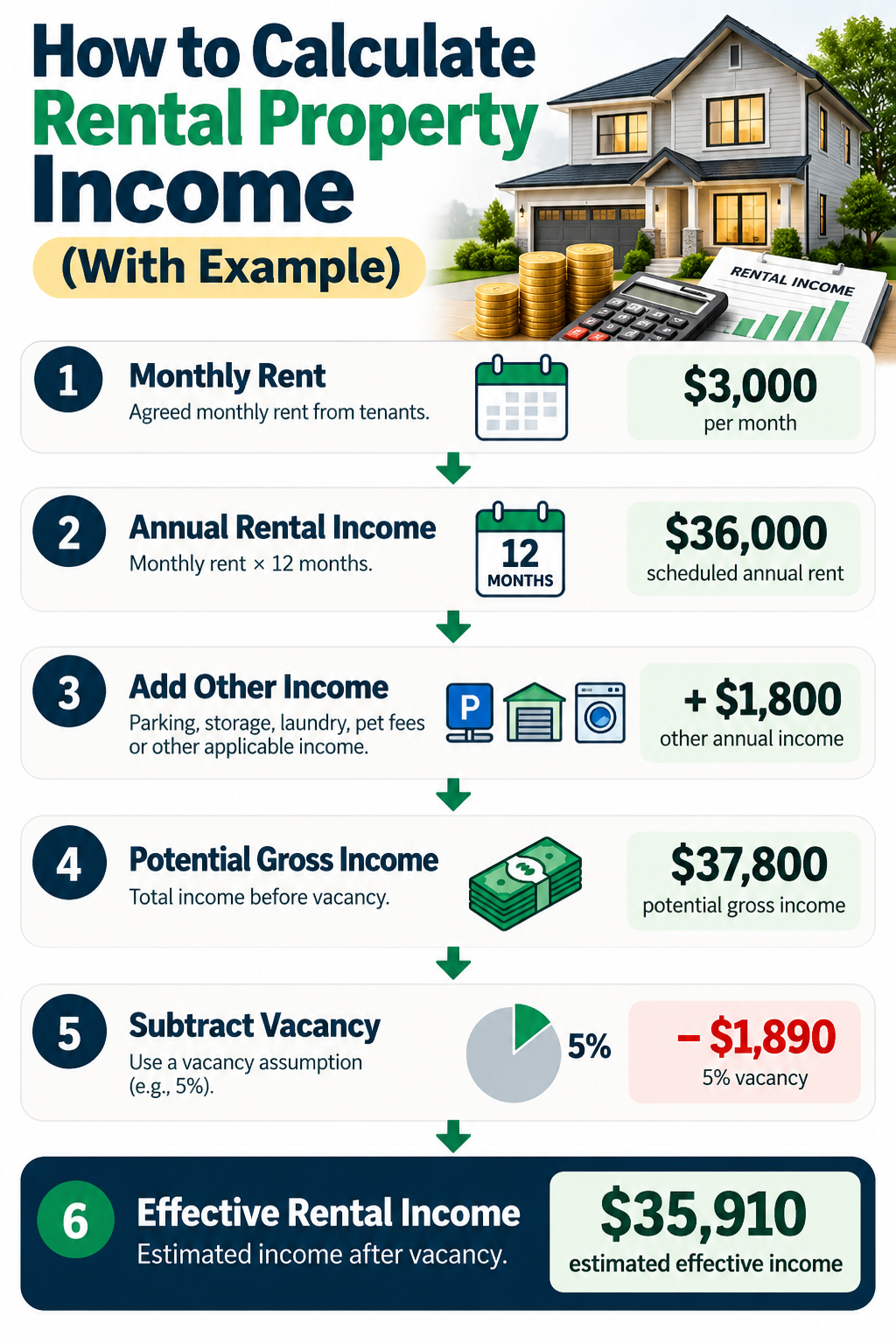
Monthly Rent × 12 = Scheduled Annual Rental Income
Monthly Rent: $3,000
$3,000 × 12 = $36,000
Scheduled Annual Rental Income
In this illustrative example, a property renting for $3,000 per month has $36,000 of scheduled annual rental income if it is rented at that amount for all 12 months.
Step 1: Add Other Rental Property Income
Some rental properties generate income in addition to monthly rent. Depending on the property, this could include parking fees, storage fees, laundry income, pet-related fees, or other permitted charges.
Scheduled Annual Rent: $36,000
Parking Income: +$1,200
Other Income: +$600
Gross Income: $37,800
Only include additional income that reasonably applies to the property. Do not add income simply to make an investment projection look stronger.
Step 2: Account for Rental Vacancy
A property may not remain occupied and fully paid for every day of the year. A vacancy assumption can therefore be used when estimating effective rental income. The appropriate assumption varies by property and market, so use local information whenever possible.
Using a 5% illustrative vacancy assumption:
$37,800 × 5% = $1,890
$37,800 − $1,890 = $35,910
Estimated Effective Rental Income: $35,910
Learn more in our Rental Property Vacancy Rate guide
Step 3: Calculate Effective Rental Income
Effective rental income is an estimate of the rental income remaining after accounting for vacancy or similar income loss assumptions.
Potential Gross Income − Vacancy Allowance = Effective Rental Income
Potential Gross Income: $37,800
Vacancy Allowance (5%): −$1,890
Effective Rental Income: $35,910 per year
The $35,910 figure is not profit. Operating expenses and financing costs have not yet been deducted.
Step 4: Calculate Average Monthly Rental Income
Effective Annual Rental Income ÷ 12 = Average Monthly Effective Rental Income
$35,910 ÷ 12 = $2,992.50 per month
Although scheduled rent is $3,000 per month in this example, additional income and the vacancy assumption change the average effective monthly income estimate.
Rental Income vs Rental Property Expenses
Rental income tells you how much revenue the property may generate. Rental property expenses tell you how much it may cost to operate the property. You need both numbers before you can estimate NOI or cash flow.
How to Calculate Rental Property Expenses (With Example)
Rental Income vs Net Operating Income (NOI)
Rental income and NOI are not the same. Effective rental income is part of the income side of the calculation. NOI is calculated after subtracting applicable operating expenses.
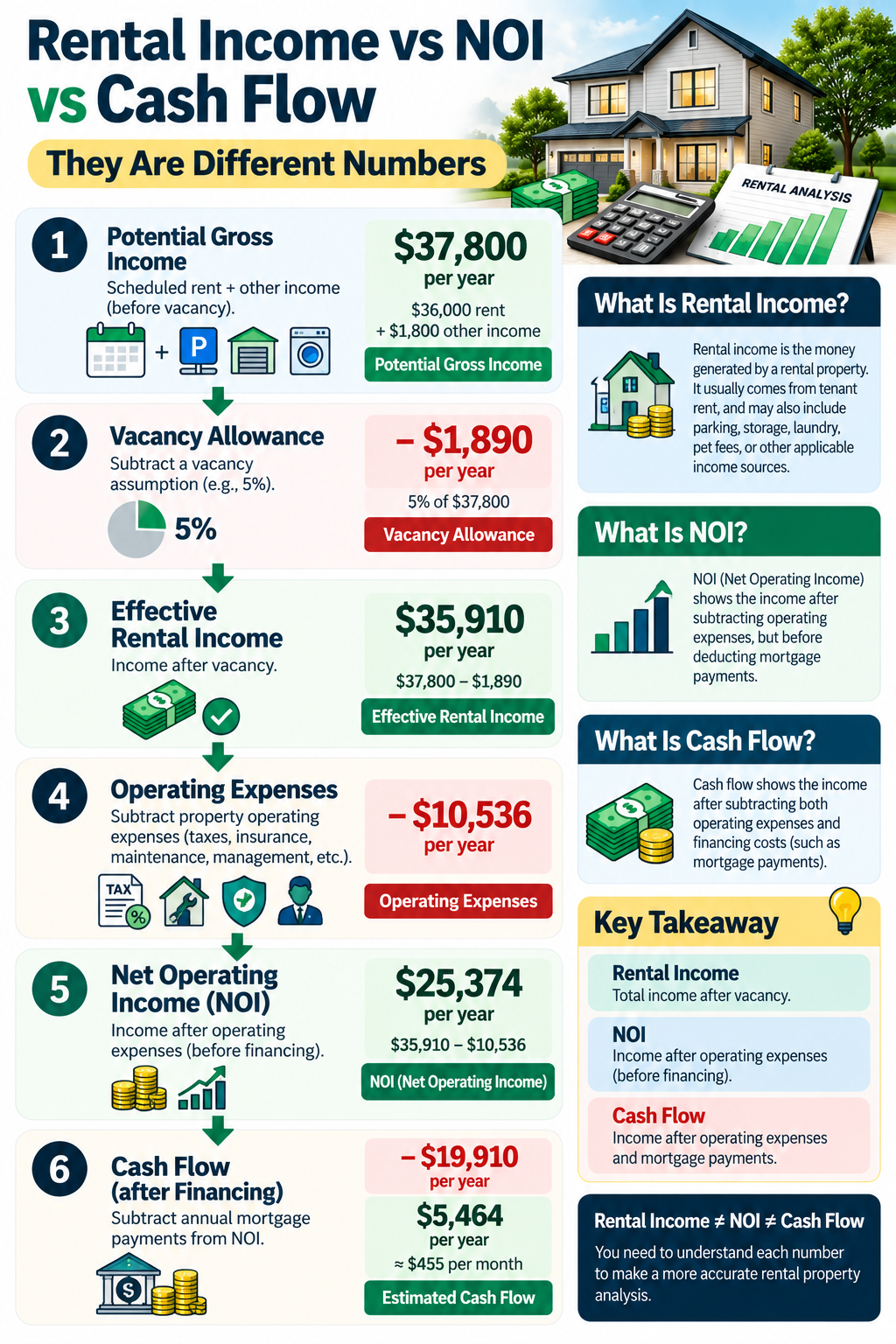
NOI = Effective Rental Income − Operating Expenses
For example, if effective rental income is $35,910 and annual operating expenses are $10,536:
$35,910 − $10,536 = $25,374
Estimated NOI: $25,374
Mortgage payments are generally kept separate from operating expenses when calculating NOI. You can use our NOI Calculator to test your own property numbers.
Rental Income vs Cash Flow
Rental income and cash flow measure different parts of a property’s financial performance. Rental income shows revenue generated by the property, while cash flow considers expenses and financing costs. A simplified calculation is:
Cash Flow = NOI − Financing Costs
NOI: $25,374
Annual Mortgage Payments: −$19,910
Estimated Annual Cash Flow: $5,464
Estimated Monthly Cash Flow: ≈ $455
This is an illustrative example only. Actual mortgage payments, expenses, vacancy and rental income will depend on the specific property and financing.
What Income Should You Include for a Rental Property?
Depending on the property, potential income sources may include monthly rent, parking fees, storage fees, laundry income, pet-related fees, and other permitted property income.
For U.S. rental properties, the IRS provides guidance on rental income and expenses in Publication 527.
Common Rental Income Calculation Mistakes
Using monthly rent as profit — Rent is revenue before expenses and financing.
Ignoring vacancy — Assuming full occupancy may overstate effective rental income.
Adding unrealistic extra income — Only include income the property can reasonably generate.
Confusing income with NOI — NOI accounts for operating expenses.
Confusing NOI with cash flow — Financing can further change the amount remaining.
Frequently Asked Questions
How do you calculate annual rental income?
Multiply monthly rent by 12. For example, $3,000 × 12 = $36,000 in scheduled annual rental income before vacancy or additional income adjustments.
What is effective rental income?
Effective rental income is an estimate of property income after accounting for vacancy or similar income-loss assumptions and may also include applicable additional property income.
Is rental income the same as profit?
No. Rental income represents revenue. Operating expenses and, depending on the metric being calculated, financing and other costs still need to be considered.
Should I include vacancy when calculating rental income?
Including a reasonable vacancy assumption can provide a more realistic estimate than assuming the property will always generate its full scheduled rent. The appropriate assumption varies by property and market.
What is the formula for calculating rental property income?
A simple starting formula is:
Scheduled Rental Income − Vacancy Loss + Other Property Income = Effective Rental Income
For a property renting for $3,000 per month, scheduled annual rental income would be $36,000 before adjusting for vacancy or other property income.
Calculate Your Rental Property Numbers
Understanding rental property income is the first step toward analyzing NOI, cash flow and potential returns. Start with scheduled rent, add applicable additional income, account for vacancy, and then evaluate expenses and financing separately.
You can continue your analysis with Realtolic’s NOI Calculator, Rental Cash Flow Calculator, and Rental Property ROI Calculator.
Disclaimer: This article is for general educational and informational purposes only. It is not financial, investment, tax, legal, real estate, lending, or accounting advice. All examples and calculations are illustrative only. Actual rental income, vacancy, expenses, financing costs, property values, and investment results can vary by property, market, and circumstances. Verify important information independently and consider consulting appropriately qualified professionals before making financial or real estate decisions.