
Calculating rental property expenses is an important step when evaluating a potential investment or reviewing the performance of a property you already own.
Monthly rent alone does not tell you how much income the property may actually produce. Property taxes, insurance, maintenance, repairs, vacancy, property management, utilities, HOA fees, and other costs can reduce rental income. Estimating these expenses more carefully can help you calculate Net Operating Income (NOI) and rental property cash flow more realistically.
In this guide, you’ll learn how to calculate rental property expenses step by step, with a simple worked example you can use as a starting point for analyzing your own property.
How to Calculate Rental Property Expenses
A simple rental property expense calculation starts by identifying each recurring cost, converting the costs to the same time period, and adding them together.You can use this basic formula:
Total Rental Property Expenses = Property Taxes + Insurance + Maintenance + Management + Owner-Paid Utilities + HOA Fees + Other Operating Expenses
It is usually easier to calculate everything annually first. For monthly estimates, divide the annual total by 12.
Annual Operating Expenses ÷ 12 = Average Monthly Operating Expenses
For U.S. rental properties, the IRS provides guidance on rental expenses and deductible costs in Publication 527.
Step 1: Calculate Your Rental Income
Start with the property’s scheduled rental income.
For example, suppose a rental property charges:
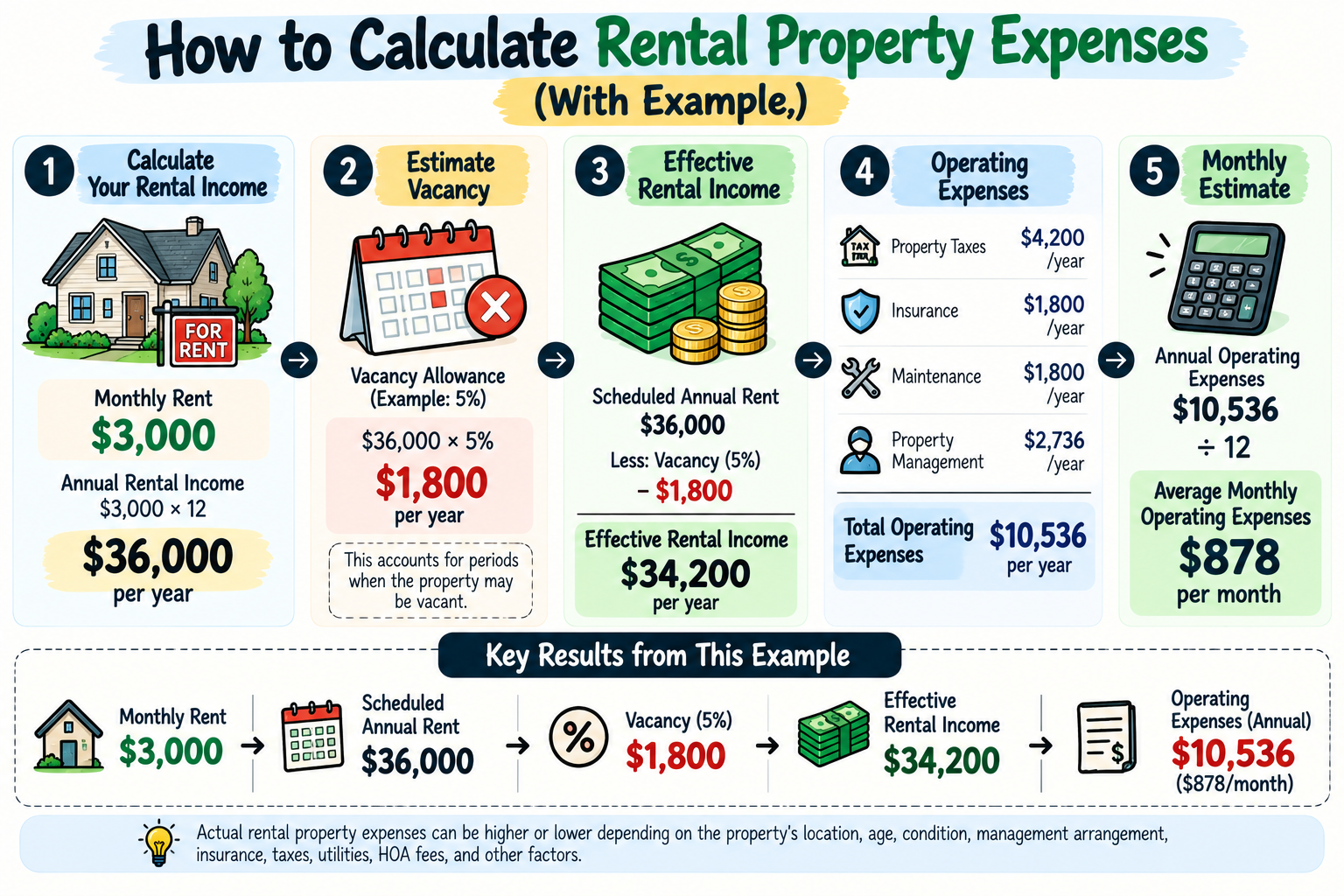
Monthly Rent: $3,000
$3,000 × 12 = $36,000
Scheduled annual rental income = $36,000
Step 2: Estimate Vacancy
A property may not remain occupied and fully paying rent every day of every year. A vacancy allowance can help account for periods when rental income may not be collected.
For this example, assume a 5% vacancy allowance:$36,000 × 5% = $1,800
Estimated effective rental income:$36,000 − $1,800 = $34,200
Learn more about estimating vacancy in our Rental Property Vacancy Rate guide.
Step 3: List Your Rental Property Operating Expenses
Next, list the recurring operating expenses associated with the property. Use property-specific numbers whenever possible instead of relying only on general rules or percentages.
Property taxes: $4,200/year
Landlord insurance: $1,800/year
Maintenance: $1,800/year
Property management: $2,736/year
$4,200 + $1,800 + $1,800 + $2,736 = $10,536
Estimated annual operating expenses = $10,536
Estimated average monthly operating expenses:
$10,536 ÷ 12 = $878
In this simplified example, the property has approximately $10,536 in annual operating expenses, or an average of $878 per month.
Your actual rental property costs may be higher or lower depending on the property’s location, age, condition, management arrangement, insurance, taxes, utilities, HOA fees, and other factors.
For a broader checklist of costs to consider, see our Rental Property Expenses: Complete List for Landlords guide.
You can also use our NOI Calculator to enter rental income and operating expenses and estimate Net Operating Income.
Step 4: Calculate Net Operating Income (NOI)
After estimating effective rental income and operating expenses, you can calculate Net Operating Income (NOI).
A simplified formula is:
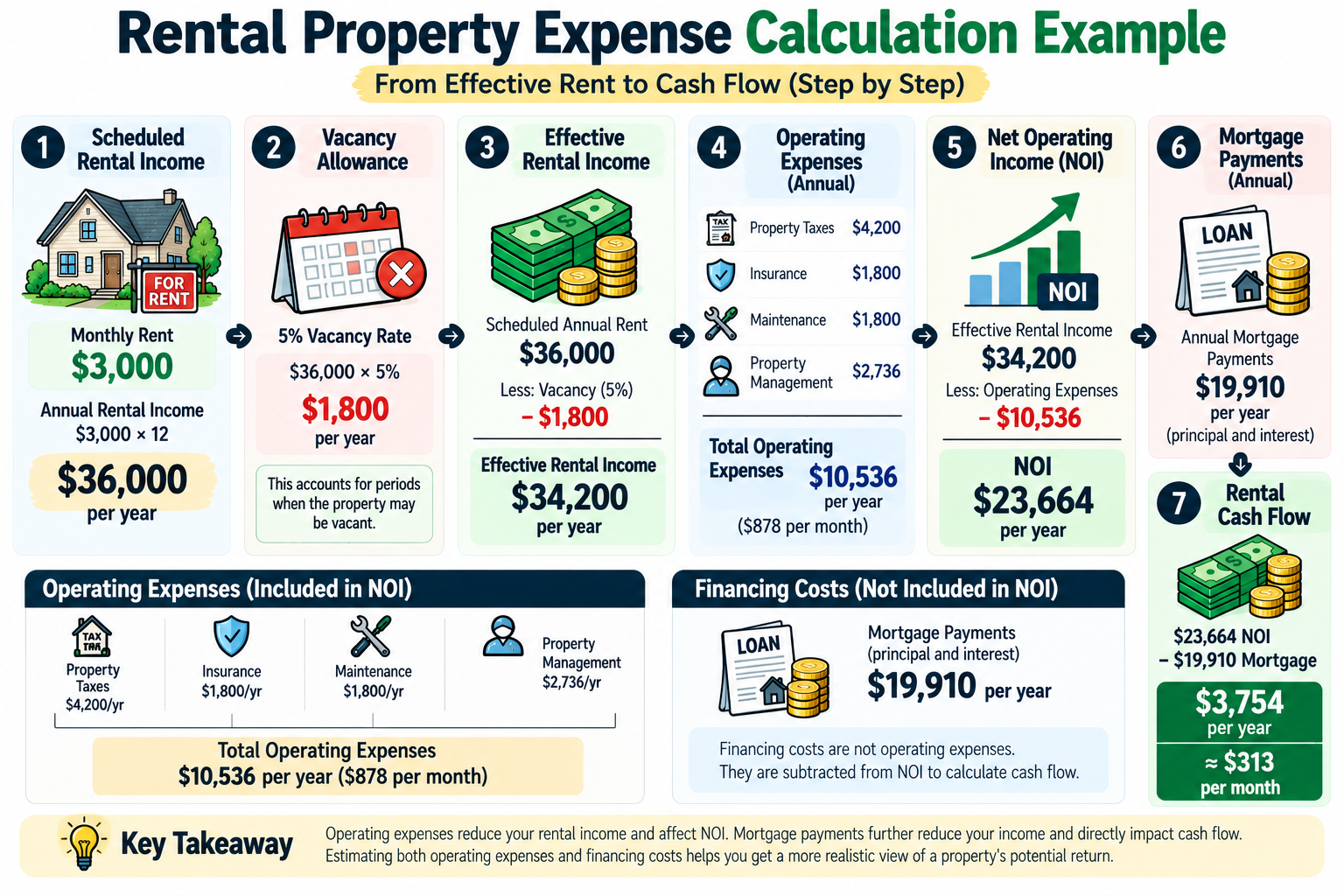
NOI = Effective Rental Income − Operating Expenses
Effective Rental Income: $34,200
Operating Expenses: −$10,536
Estimated NOI: $23,664 per year
NOI helps show how much income the property produces after operating expenses but before financing costs in this simplified analysis.
Step 5: Add Mortgage Payments to Estimate Cash Flow
Mortgage payments are important for cash flow, but they are generally kept separate from operating expenses when calculating NOI.
Suppose this property has estimated annual mortgage payments of $19,910.
$23,664 NOI − $19,910 Mortgage Payments = $3,754 Annual Cash Flow
$3,754 ÷ 12 ≈ $313 Monthly Cash Flow
In this simplified example, the rental property produces approximately $3,754 per year, or $313 per month, in pre-tax cash flow.
Use our Rental Cash Flow Calculator to estimate income, expenses, mortgage payments, and cash flow.
Monthly vs Annual Rental Property Expenses
Rental property expenses may be quoted monthly, quarterly, or annually. Before adding them together, convert them to the same time period.For example:
$350 monthly property tax × 12 = $4,200/year
$150 monthly insurance × 12 = $1,800/year
$228 monthly management cost × 12 = $2,736/year
Using one time period helps prevent calculation mistakes.
Fixed vs Variable Rental Property Expenses
Some rental property costs may be relatively predictable for a period, while others can fluctuate.
More predictable costs may include property taxes, insurance premiums, HOA fees, and certain management charges.
Variable costs can include repairs, maintenance, utilities, turnover costs, and other expenses that change over time.
Even relatively predictable expenses can change, so landlords should review their actual costs periodically.
Don’t Confuse Operating Expenses With Every Property Cost
A down payment, mortgage principal and interest, closing costs, major capital improvements, and selling costs should not automatically be combined with normal operating expenses.
Different real estate calculations treat these costs differently. Separating them helps produce clearer estimates of NOI, cash flow, cash-on-cash return, and ROI.
If you want to evaluate more than expenses, use our Rental Property ROI Calculator to estimate rental income, expenses, NOI, cash flow, cap rate, cash-on-cash return, and other property metrics.
Common Mistakes When Calculating Rental Property Expenses
Rental property calculations can look attractive when important costs are missing. Before relying on projected cash flow or returns, check whether your estimate includes the expenses that reasonably apply to the property.
Ignoring vacancy — Assuming 12 months of full rent every year may overstate effective rental income.
Forgetting maintenance and repairs — Even a property in good condition can require ongoing maintenance or unexpected repairs.
Using inaccurate property taxes — Tax bills can vary by location and may change after reassessment or other local changes.
Leaving out insurance — Landlord insurance can be an important recurring operating expense.
Ignoring management costs — Even self-managed properties require time, while professional management can create additional fees.
Mixing mortgage payments with NOI expenses — Financing costs should generally be separated when calculating NOI.
How to Make Your Rental Expense Estimate More Accurate
Whenever possible, use information specific to the property instead of relying only on general percentages.
Review property-tax records, obtain insurance quotes, inspect the property’s condition, check HOA documents, identify owner-paid utilities, review management agreements, and examine available rental or expense history.
Keep your assumptions documented. This makes it easier to update your analysis when rent, taxes, insurance, maintenance costs, or financing changes.
Why Rental Property Expenses Matter for Investors
Rental income is only one part of a property’s financial picture. Two properties charging the same monthly rent can produce very different NOI and cash flow because their expenses may be different.
Understanding rental property expenses can help investors compare properties more consistently and avoid relying on gross rent alone.
Frequently Asked Questions
How do you calculate monthly rental property expenses?
Add the applicable annual operating expenses and divide the total by 12. For example, annual operating expenses of $10,536 ÷ 12 = $878 per month on average.
What expenses should I include for a rental property?
Depending on the property, expenses may include property taxes, insurance, maintenance, repairs, management fees, owner-paid utilities, HOA fees, vacancy-related costs, licenses, and other recurring costs.
Is vacancy a rental property expense?
Vacancy is often modeled as a reduction in expected rental income rather than a bill paid to someone. Including a vacancy assumption can help produce a more realistic estimate of effective rental income.
Is the mortgage included in rental property expenses?
Mortgage payments affect cash flow, but principal and interest are generally kept separate from operating expenses when calculating NOI.
What is the difference between NOI and cash flow?
NOI measures property income after operating expenses but before financing in a standard simplified analysis. Cash flow can then account for mortgage payments or other financing costs.
Calculate Your Rental Property Numbers
Calculating rental property expenses carefully can give you a clearer picture of a property’s potential financial performance. Start with rental income, account for vacancy, list realistic operating expenses, calculate NOI, and then consider financing when estimating cash flow.
Use Realtolic’s NOI Calculator, Rental Cash Flow Calculator, and Rental Property ROI Calculator to test different property numbers and assumptions.
Disclaimer: This article is for general educational purposes only and is not financial, investment, tax, or legal advice. Actual rental income, expenses, financing costs, and investment results vary by property and circumstances.