
Learning how to calculate cap rate on a rental property can help you compare income-producing properties using net operating income (NOI) and property value. Cap rate is one of the most common metrics used in rental property analysis, but it is only useful when the income and operating expenses used in the calculation are realistic. In this guide, we will calculate rental property cap rate step by step using a simple worked example.
What Is Cap Rate in Real Estate?
Cap rate, short for capitalization rate, measures a property’s annual net operating income (NOI) relative to its value or purchase price. It is usually expressed as a percentage.
Cap Rate Formula
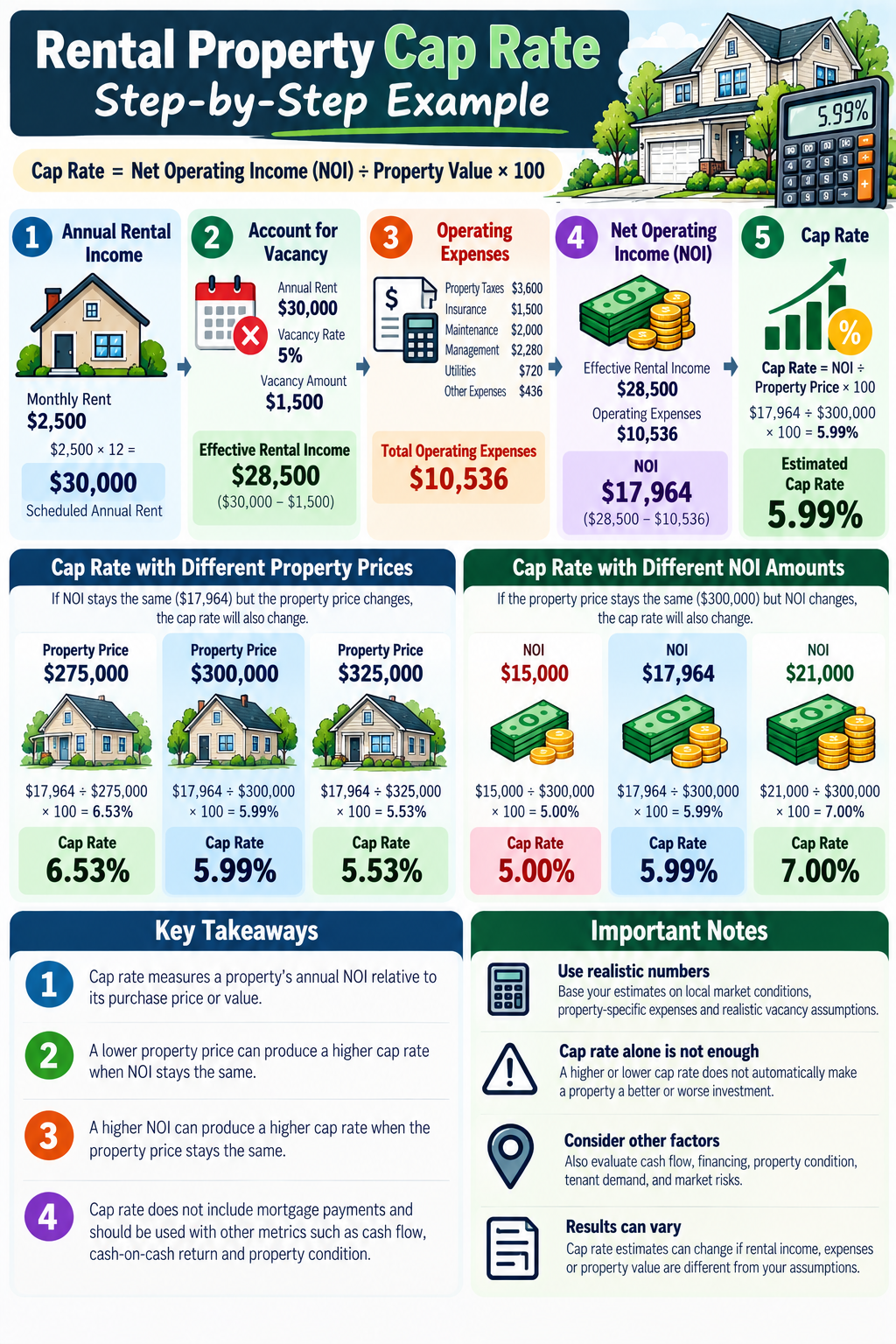
Cap Rate = Net Operating Income (NOI) ÷ Property Value × 100
For example, if a $300,000 rental property produces $18,000 of annual NOI:
$18,000 ÷ $300,000 × 100 = 6%
Cap Rate = 6%
This does not mean the investor receives a 6% cash return. Cap rate looks at property operating income relative to property value and generally does not include mortgage financing.
Cap Rate Example for a Rental Property
We will use this illustrative property throughout the guide:
Property Purchase Price: $300,000
Monthly Rent: $2,500
Scheduled Annual Rent: $30,000
Vacancy Assumption: 5%
Annual Operating Expenses: $10,536
We will calculate the property’s effective rental income first, then NOI, and finally its cap rate.
Step 1: Calculate Annual Rental Income
Start with the expected monthly rent:
Monthly Rent = $2,500
$2,500 × 12 = $30,000
Scheduled Annual Rental Income = $30,000
If you want a more detailed explanation of rental income, read our How to Calculate Rental Property Income guide.
Step 2: Account for Rental Property Vacancy
Rental properties may experience periods without a paying tenant. Including a vacancy assumption can make your income estimate more realistic.
Calculate the Vacancy Allowance
For our example, we will use an illustrative 5% vacancy assumption.
Scheduled Annual Rent = $30,000
$30,000 × 5% = $1,500
Estimated Vacancy Allowance = $1,500
Calculate Effective Rental Income
Effective Rental Income = Scheduled Annual Rent − Vacancy Allowance
$30,000 − $1,500 = $28,500
Effective Rental Income = $28,500/year
The appropriate vacancy assumption can vary by property and market. Research local conditions instead of automatically using the same percentage for every rental property.
Learn more about estimating vacancy in our Rental Property Vacancy Rate guide.
Step 3: Estimate Rental Property Operating Expenses
Next, estimate the recurring expenses required to operate the rental property.
Common Operating Expenses
For our example:
Property Taxes: $3,600/year
Insurance: $1,500/year
Maintenance and Repairs: $2,000/year
Property Management: $2,280/year
Owner-Paid Utilities: $720/year
Other Operating Expenses: $436/year
Total Estimated Operating Expenses = $10,536/year
Operating expenses can vary considerably between properties. Whenever possible, use property-specific tax records, insurance estimates, management costs, maintenance information, and other relevant expenses.
For a complete expense breakdown, read our How to Calculate Rental Property Expenses guide.
For U.S. rental properties, the IRS provides additional guidance on rental income and expenses in Publication 527.
Do Mortgage Payments Count as Operating Expenses?
Mortgage principal and interest are generally not included as operating expenses when calculating NOI and cap rate. This allows cap rate to evaluate the property’s operating performance separately from the investor’s financing.
Step 4: Calculate Net Operating Income (NOI)
NOI = Effective Rental Income − Operating Expenses
$28,500 − $10,536 = $17,964
Estimated NOI = $17,964/year
NOI is the key income figure used in the cap rate formula. A higher NOI generally produces a higher cap rate when the property value stays the same.
You can calculate this number using our NOI Calculator.
Step 5: Calculate the Rental Property Cap Rate
Now that we know the property’s NOI and purchase price, we can calculate its estimated cap rate.
Cap Rate Formula
Cap Rate = NOI ÷ Property Price × 100
NOI = $17,964
Property Price = $300,000
$17,964 ÷ $300,000 × 100 = 5.99%
Estimated Cap Rate = 5.99%
This means the property’s annual NOI is approximately 5.99% of its $300,000 purchase price based on the assumptions in our example.
It does not mean the investor is guaranteed to earn 5.99%, and it does not represent the investor’s actual cash flow after mortgage payments.
Calculate Cap Rate With Your Own Numbers
Instead of calculating everything manually, you can enter your property value, rental income, vacancy, and operating expenses into our Cap Rate Calculator.
How Property Price Changes the Cap Rate
If NOI remains the same but the property purchase price changes, the cap rate also changes.
Example: $275,000 Property Price
Keep the same NOI of $17,964, but suppose the property price is $275,000:
$17,964 ÷ $275,000 × 100 = 6.53%
Estimated Cap Rate = 6.53%
Example: $325,000 Property Price
Using the same $17,964 NOI:
$17,964 ÷ $325,000 × 100 = 5.53%
Estimated Cap Rate = 5.53%
Why Does the Cap Rate Change?
When NOI stays the same, a lower purchase price produces a higher cap rate, while a higher purchase price produces a lower cap rate.
In our example:
$275,000 Property → 6.53% Cap Rate
$300,000 Property → 5.99% Cap Rate
$325,000 Property → 5.53% Cap Rate
However, a higher cap rate does not automatically make one property a better investment. Property condition, location, tenant demand, expenses, financing, and other risks also matter.
How NOI Changes the Cap Rate
Property price is only one side of the formula. Changes in rental income or operating expenses can change NOI and therefore change the cap rate.
Example: Lower NOI
Suppose the property still costs $300,000, but NOI falls to $15,000:
$15,000 ÷ $300,000 × 100 = 5%
Estimated Cap Rate = 5.00%
Example: Higher NOI
Now suppose NOI increases to $21,000:
$21,000 ÷ $300,000 × 100 = 7%
Estimated Cap Rate = 7.00%
With the property price fixed at $300,000:
$15,000 NOI → 5.00% Cap Rate
$17,964 NOI → 5.99% Cap Rate
$21,000 NOI → 7.00% Cap Rate
This is why accurate rental-income and operating-expense estimates are important. Small changes in the assumptions can change the calculated cap rate.
What Is a Good Cap Rate for a Rental Property?
There is no single cap rate that is automatically “good” for every rental property, investor, or market.
Cap rates can differ because properties have different locations, conditions, tenant demand, expenses, growth expectations, property types, and risks.
Higher Cap Rate Does Not Automatically Mean Better
A higher cap rate can result from stronger NOI relative to the property’s price, but it can also appear on properties with different risks or market characteristics.
Lower Cap Rate Does Not Automatically Mean Worse
A lower cap rate may occur in a different market or property situation. The cap rate alone does not tell you whether a property fits your goals or whether its assumptions are realistic.
Use cap rate as one part of a broader rental property analysis rather than making a purchase decision from one percentage alone.
Cap Rate vs Cash Flow
Cap rate and cash flow are related to rental-property performance, but they measure different things.
Cap Rate
Cap Rate = NOI ÷ Property Value × 100
Using our example:
$17,964 ÷ $300,000 × 100 = 5.99%
Cap rate evaluates the property’s NOI relative to its value without using the investor’s mortgage payments in the calculation.
Cash Flow
Cash flow looks at how much money may remain after the expenses and financing costs included in the calculation.
Suppose our example property has annual mortgage payments of $15,600:
Annual Cash Flow = NOI − Annual Mortgage Payments
$17,964 − $15,600 = $2,364
Estimated Annual Pre-Tax Cash Flow = $2,364
$2,364 ÷ 12 = $197
Estimated Monthly Pre-Tax Cash Flow = $197
A property can therefore have a 5.99% cap rate while producing only $197 per month of estimated pre-tax cash flow under this particular financing example.
Use our Rental Cash Flow Calculator to test your own income, expenses, and financing assumptions.
Cap Rate vs Cash-on-Cash Return
Cash-on-cash return measures annual pre-tax cash flow relative to the amount of cash invested in the property.
Cash-on-Cash Return Formula
Cash-on-Cash Return = Annual Pre-Tax Cash Flow ÷ Total Cash Invested × 100
Using the same example:
Annual Pre-Tax Cash Flow = $2,364
Total Cash Invested = $85,000
$2,364 ÷ $85,000 × 100 = 2.78%
Estimated Cash-on-Cash Return = 2.78%
Our example now shows three different measurements:
NOI = $17,964/year
Cap Rate = 5.99%
Cash-on-Cash Return = 2.78%
These numbers answer different questions, which is why investors should avoid treating cap rate, cash flow, and cash-on-cash return as interchangeable.
For a broader return calculation, read our How to Calculate Rental Property ROI guide.
Cap Rate vs Rental Property ROI
Cap rate and ROI can both help evaluate a rental property, but they measure the investment from different perspectives.
Cap Rate Focuses on Property Operations
Cap rate compares NOI with the property’s purchase price or value:
Cap Rate = NOI ÷ Property Value × 100
It generally does not account for the investor’s mortgage structure, down payment, or other financing choices.
ROI Focuses on Investment Return
ROI can be calculated in different ways depending on what is included. A simple cash-based version can compare annual pre-tax cash flow with the investor’s initial cash investment.
Using our example:
Annual Pre-Tax Cash Flow = $2,364
Initial Cash Invested = $85,000
$2,364 ÷ $85,000 × 100 = 2.78%
So the same example property can show:
Cap Rate = 5.99%
First-Year Cash-Flow ROI = 2.78%
The percentages are different because the formulas measure different things. Do not compare them as though they represent the same return.
When Is Cap Rate Useful?
Cap rate can be useful when comparing income-producing properties using a consistent method.
Comparing Similar Rental Properties
If two similar properties are evaluated using consistent income and expense assumptions, cap rate can help show how their NOI compares with their respective prices.
Evaluating Property Operating Performance
Because mortgage financing is generally excluded, cap rate can help separate the property’s operating performance from an individual investor’s financing structure.
Testing Different Purchase Prices
Cap rate can also help you see how the same NOI would relate to different potential purchase prices, as our earlier $275,000, $300,000, and $325,000 examples demonstrated.
Limitations of Cap Rate
Cap rate is useful, but it does not provide a complete picture of a rental property investment. Important factors such as financing, cash invested, future repairs, changes in rent or expenses, property condition, taxes, market conditions, and potential changes in property value may require separate analysis.
Cap Rate Does Not Include Mortgage Payments
Mortgage principal and interest are generally not part of the cap rate calculation. Two investors could therefore calculate the same cap rate for a property while having very different financing and cash-flow results.
Cap Rate Does Not Predict Future Property Value
Cap rate is based on property value and NOI used in the calculation. It does not tell you whether the property’s market value will increase or decrease in the future.
Cap Rate Depends on Your Assumptions
If estimated rent is too high, vacancy is too low, or operating expenses are incomplete, the calculated NOI and cap rate may give a misleading picture.
Common Cap Rate Mistakes to Avoid
1. Using Gross Rental Income Instead of NOI
Cap rate should generally use Net Operating Income, not gross rent.
For example:
Annual Rent = $30,000
is not the same as:
NOI = $17,964
Using $30,000 instead of $17,964 would significantly change the result.
2. Ignoring Vacancy
Assuming full occupancy can overstate effective rental income. Include a reasonable vacancy assumption based on the property and market.
3. Leaving Out Operating Expenses
Property taxes, insurance, maintenance, management, owner-paid utilities, HOA costs when applicable, and other recurring operating expenses can affect NOI and therefore the cap rate.
4. Including Mortgage Payments in NOI
Do not subtract mortgage principal and interest when calculating NOI for a standard cap-rate calculation. Financing should be evaluated separately.
5. Using an Unrealistic Property Value
Be clear about whether your calculation uses the purchase price, current property value, or another valuation basis. Changing the denominator changes the cap rate.
6. Assuming a Higher Cap Rate Is Always Better
A higher calculated cap rate does not automatically mean a property is the better investment. Differences in location, property condition, tenant demand, management needs, and risk can matter.
A useful cap-rate calculation depends on realistic rental income, complete operating expenses, an appropriate property value, and consistent assumptions.
Rental Property Cap Rate Checklist
Before relying on a cap rate, review the numbers and assumptions used in the calculation.
Rental Income
✓ Research comparable rents
✓ Estimate realistic monthly rent
✓ Calculate scheduled annual rent
✓ Include a reasonable vacancy assumption
✓ Calculate effective rental income
Operating Expenses
✓ Property taxes
✓ Landlord insurance
✓ Maintenance and repairs
✓ Property management costs
✓ Owner-paid utilities
✓ HOA fees when applicable
✓ Other recurring operating expenses
NOI and Property Value
✓ Calculate effective rental income
✓ Subtract operating expenses
✓ Calculate NOI
✓ Verify the property price or value being used
✓ Apply the same method when comparing properties
Review More Than the Cap Rate
✓ Estimate rental cash flow
✓ Review financing costs
✓ Calculate cash-on-cash return when relevant
✓ Consider property condition
✓ Estimate major repairs
✓ Research the local rental market
✓ Test different assumptions
A cap rate becomes more useful when the underlying income, expenses, and property value are based on realistic information.
Frequently Asked Questions About Cap Rate
How do you calculate cap rate on a rental property?
Divide the property’s annual Net Operating Income by its purchase price or value and multiply by 100.
Cap Rate = NOI ÷ Property Value × 100
For example:
$17,964 ÷ $300,000 × 100 = 5.99%
What is a good cap rate for a rental property?
There is no single cap rate that is appropriate for every property or market. Cap rates can vary based on location, property type, condition, tenant demand, expenses, growth expectations, and risk.
Does cap rate include mortgage payments?
Generally, no. Mortgage principal and interest are kept separate from NOI in a standard cap-rate calculation, allowing the property’s operating performance to be considered independently from financing.
Does cap rate include property taxes?
Property taxes are generally treated as an operating expense when calculating NOI, so they can affect the resulting cap rate.
Does cap rate include vacancy?
Vacancy can affect cap rate indirectly because it reduces effective rental income. Lower effective income can reduce NOI, which can then reduce the calculated cap rate.
Does cap rate include repairs and maintenance?
Routine maintenance and repair expenses are generally considered operating expenses when calculating NOI. Major capital improvements may be treated differently depending on the analysis.
Is cap rate the same as ROI?
No. Cap rate compares NOI with property value, while ROI measures investment return using a method that depends on what gains, costs, and investment amount are included.
Can cap rate change over time?
Yes. Cap rate can change if the property’s NOI or value changes. Changes in rent, vacancy, operating expenses, or property value can therefore affect the calculated cap rate.
Final Thoughts on Rental Property Cap Rate
Cap rate is a useful way to compare a rental property’s Net Operating Income with its purchase price or value.
In our example, the property generated an estimated
$17,964 of annual NOI on a $300,000 purchase price:
$17,964 ÷ $300,000 × 100 = 5.99%
Estimated Cap Rate = 5.99%
But the example also showed why the percentage should not be viewed alone. Changing the property price or NOI changed the cap rate significantly.
A useful analysis should therefore start with realistic rental income, vacancy, and operating expenses before calculating NOI and cap rate.
Cap rate can help compare rental properties, but it should be used alongside cash flow, financing, cash-on-cash return, property condition, market research, and other relevant factors.
Calculate Your Rental Property Cap Rate
Want to test your own property? Use our Cap Rate Calculator to estimate cap rate using your property’s income, expenses, and value.
You can also use our Rental Property ROI Calculator for a broader rental-property analysis.
Disclaimer
This article is for general educational and informational purposes only. It is not financial, investment, tax, legal, real estate, lending, or accounting advice.
All property figures, percentages, calculations, and scenarios in this article are illustrative examples. Actual rental income, vacancy, operating expenses, NOI, property values, cap rates, financing costs, investment returns, and other results can vary by property, market, and circumstances. Verify important information independently and consider consulting appropriately qualified professionals before making a real estate or investment decision.