Rental property ROI helps you understand how much return a rental property may generate compared with the money invested. But calculating ROI is not always as simple as dividing profit by the property price.
A useful rental property analysis should consider rental income, vacancy, operating expenses, financing costs, cash invested, and other important numbers.
In this guide, we will calculate rental property ROI step by step using a simple example so you can understand where each number comes from.
What Is Rental Property ROI?
Rental property ROI, or return on investment, is a percentage used to compare an investment’s return with the amount of money invested.
The exact ROI calculation can vary depending on what you include as the investment and what type of return you are measuring.
For that reason, investors should clearly understand the assumptions behind an ROI percentage instead of looking at the percentage alone.
Basic Rental Property ROI Formula
ROI = Return ÷ Amount Invested × 100
For example, if an investment produced a $5,000 return on $100,000 invested:
$5,000 ÷ $100,000 × 100 = 5%
This simple formula explains the idea of ROI, but rental properties usually require a more detailed calculation.
Rental Property ROI Example
We will use the following illustrative rental property throughout this guide:
Property Price: $300,000
Monthly Rent: $2,500
Down Payment: $75,000
Closing Costs: $6,000
Initial Repairs: $4,000
Vacancy Assumption: 5%
Annual Operating Expenses: $10,536
Annual Mortgage Payments: $15,600
These numbers are only an educational example. Actual property expenses, financing terms, vacancy, taxes, insurance, repairs, and rental income vary.
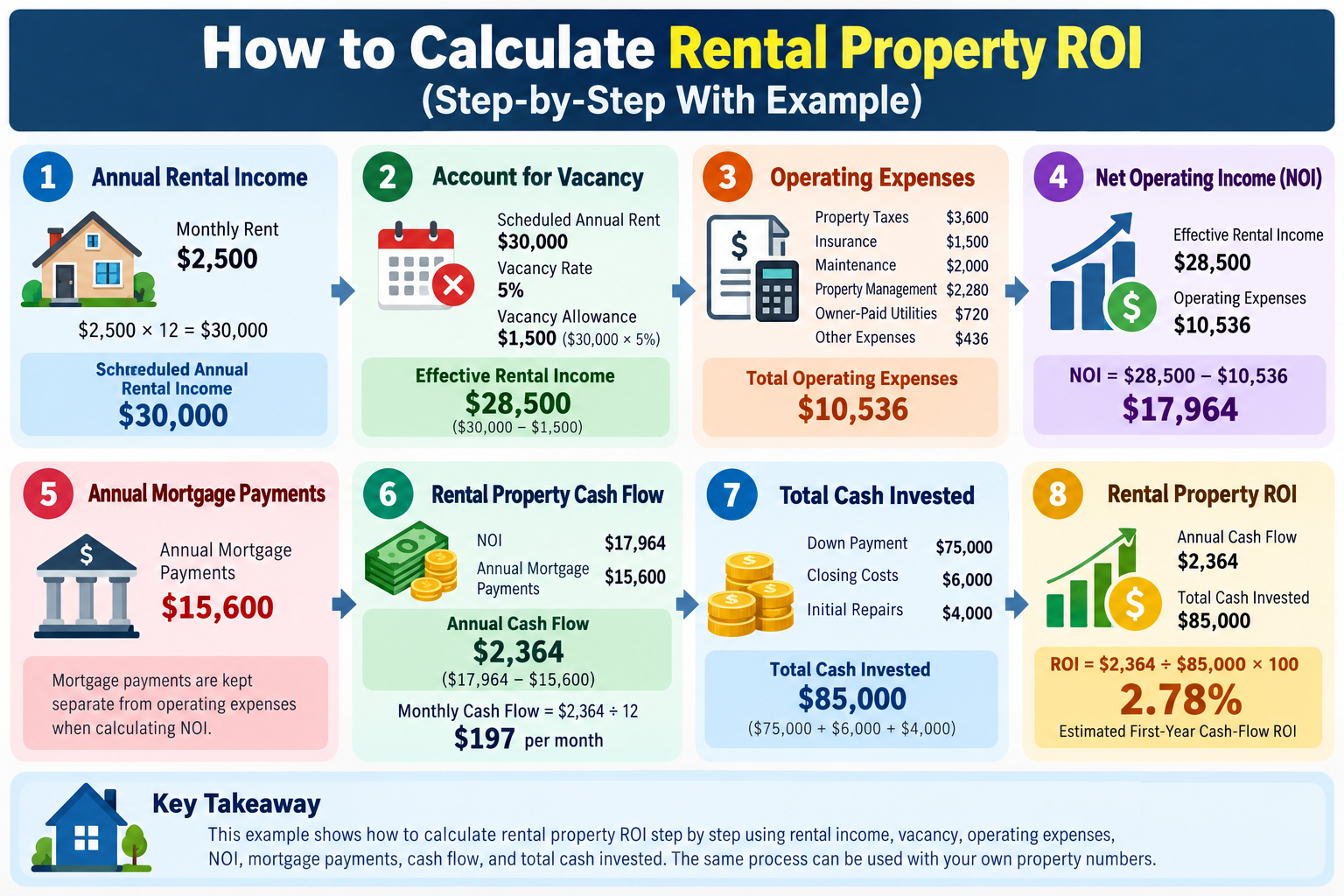
Step 1: Calculate Annual Rental Income
Start with the property’s expected monthly rent.
Monthly Rent = $2,500$
2,500 × 12 = $30,000
Scheduled Annual Rental Income = $30,000
Step 2: Account for Rental Property Vacancy
A rental property may not stay occupied every day of the year. Including a vacancy assumption can make the income estimate more realistic.
Calculate the Vacancy Allowance
For our example, we will use an illustrative 5% vacancy assumption.
Scheduled Annual Rent = $30,000
Vacancy Allowance = $30,000 × 5%
Vacancy Allowance = $1,500
Calculate Effective Rental Income
Effective Rental Income = Scheduled Annual Rent − Vacancy Allowance
$30,000 − $1,500 = $28,500
Effective Rental Income = $28,500/year
Vacancy varies by property and market, so research local rental conditions rather than assuming the same percentage for every property.
Learn more about estimating vacancy in our Rental Property Vacancy Rate guide.
Step 3: Estimate Operating Expenses
Next, estimate the recurring costs required to own and operate the rental property.
Common Rental Property Operating Expenses
Property Taxes: $3,600/year
Insurance: $1,500/year
Maintenance and Repairs: $2,000/year
Property Management: $2,280/year
Owner-Paid Utilities: $720/year
Other Operating Expenses: $436/year
Total Estimated Operating Expenses = $10,536/year
What Is Not Included in Operating Expenses?
Mortgage principal and interest are generally kept separate when calculating Net Operating Income (NOI). This allows the property’s operating performance to be viewed separately from its financing.
For a more detailed breakdown of property costs, see our guide on How to Calculate Rental Property Expenses.
Step 4: Calculate Net Operating Income (NOI)
Net Operating Income shows the property’s income after estimated operating expenses but before financing costs.
NOI Formula
NOI = Effective Rental Income – Operating Expenses
$28,500 − $10,536 = $17,964
Estimated NOI = $17,964/year
We will use this NOI in the next calculations to work out cash flow and ultimately estimate the rental property’s return on investment.
You can also use our NOI Calculator to estimate net operating income using your own rental income and expenses.
Step 5: Calculate Annual Mortgage Payments
If the rental property is financed, mortgage payments affect the amount of cash the property may produce for the investor.
Annual Mortgage Payments = $15,600
We are keeping financing separate from operating expenses because mortgage payments are not included in our NOI calculation.
Step 6: Calculate Rental Property Cash Flow
Now subtract the annual mortgage payments from NOI to estimate annual pre-tax cash flow.
Rental Property Cash Flow Formula
Annual Pre-Tax Cash Flow = NOI − Annual Mortgage Payments
$17,964 − $15,600 = $2,364
Annual Pre-Tax Cash Flow = $2,364
Calculate Monthly Cash Flow
$2,364 ÷ 12 = $197
Estimated Monthly Pre-Tax Cash Flow = $197
Positive estimated cash flow means the example produces more income than the operating expenses and mortgage payments included in our calculation. It does not guarantee that unexpected costs will not occur.
Want to test your own numbers? Use our Rental Cash Flow Calculator to estimate monthly and annual cash flow.
Step 7: Calculate Your Total Cash Invested
When financing a property, the purchase price is different from the amount of cash the investor initially puts into the deal.
Add the Initial Cash Costs
Down Payment: $75,000
Closing Costs: $6,000
Initial Repairs: $4,000
Total Cash Invested = $75,000 + $6,000 + $4,000
Total Cash Invested = $85,000
Step 8: Calculate Rental Property ROI
For this simplified example, we will compare the estimated annual pre-tax cash flow with the initial cash invested.
Rental Property ROI Formula
ROI = Annual Pre-Tax Cash Flow ÷ Total Cash Invested × 100
$2,364 ÷ $85,000 × 100 = 2.78%
Estimated First-Year Cash-Flow ROI = 2.78%
You can also enter your own property numbers in our Rental Property ROI Calculator to estimate ROI, cash flow, NOI, cap rate, and other key metrics.
Step 9: Understand What the 2.78% ROI Means
In our example, the property produces an estimated 2.78% first-year cash-flow ROI based on $2,364 of annual pre-tax cash flow and $85,000 of initial cash invested.
This percentage should not automatically be labeled “good” or “bad.” The result needs to be considered alongside the property’s risks, financing, condition, location, expected expenses, and the investor’s goals.
ROI Does Not Tell the Whole Story
A rental property’s return can involve more than annual cash flow. Depending on how ROI is defined, investors may also consider changes in property value, loan principal reduction, additional capital expenses, and eventual selling costs.
Step 10: Understand ROI vs Cash-on-Cash Return
ROI and cash-on-cash return are related, but they should not always be treated as exactly the same measurement.
Cash-on-Cash Return Formula
Cash-on-Cash Return = Annual Pre-Tax Cash Flow ÷ Total Cash Invested × 100
Using our example:
$2,364 ÷ $85,000 × 100 = 2.78%
In this simplified first-year example, our cash-flow ROI and cash-on-cash return are the same because both calculations use annual pre-tax cash flow and the same $85,000 initial cash investment.
Why ROI Can Be Different
A broader ROI calculation may include additional gains or costs beyond rental cash flow. That is why you should always check what has been included before comparing ROI percentages from different properties.
Step 11: Consider Property Appreciation Carefully
A property’s market value may rise or fall over time. Appreciation can affect the overall investment return, but future property prices cannot be known with certainty.
Illustrative Appreciation Example
Suppose a $300,000 property increased in value by an illustrative 3% over one year:
$300,000 × 3% = $9,000
Illustrative Increase in Property Value = $9,000
This does not mean the investor automatically receives $9,000 in cash. Property value is generally unrealized until a sale or another transaction converts some of that equity into cash, and transaction costs may apply.
Step 12: Consider Mortgage Principal Paydown
Part of a mortgage payment may reduce the outstanding loan principal. That can increase the owner’s equity, but principal paydown is different from spendable rental cash flow.
Why Principal Paydown Matters
As the loan balance decreases, the owner’s equity may increase. However, the amount of principal paid depends on the loan terms and payment schedule.
For a complete analysis, keep cash flow, property appreciation, and principal paydown separate so you can clearly understand where the potential return comes from.
Step 13: Include Major Repairs and Capital Expenses
A property can show positive cash flow and still require expensive repairs. Roof replacement, HVAC systems, plumbing work, appliances, and other major items can reduce the actual return.
Example of an Unexpected Major Repair
Suppose the property produces:
Annual Pre-Tax Cash Flow = $2,364
But during the year it requires an unexpected:
Major Repair = $3,000
$2,364 − $3,000 = −$636
This simple example shows why investors should not evaluate a rental property using expected rent alone.
For a detailed breakdown of recurring property costs, read our How to Calculate Rental Property Expenses guide.
Step 14: Test Different ROI Scenarios
Rental property analysis is based on assumptions. Instead of calculating only one result, test what happens when rent, vacancy, expenses, repairs, or financing change.
Scenario 1: Higher Vacancy
Suppose vacancy increases from 5% to 10%
Scheduled Annual Rent = $30,000
10% Vacancy Allowance = $3,000
Effective Rental Income = $27,000
If operating expenses remain $10,536:
$27,000 − $10,536 = $16,464 NOI
After $15,600 of annual mortgage payments:
$16,464 − $15,600 = $864 Annual Pre-Tax Cash Flow
Using the same $85,000 initial cash investment:
$864 ÷ $85,000 × 100 = 1.02%
Estimated First-Year Cash-Flow ROI = 1.02%
In this illustrative scenario, increasing the vacancy assumption from 5% to 10% reduces the estimated first-year cash-flow ROI from 2.78% to 1.02%.
Learn how vacancy affects rental income in our Rental Property Vacancy Rate guide.
Scenario 2: Higher Operating Expenses
Now suppose annual operating expenses increase from $10,536 to $12,000, while effective rental income remains $28,500.
Effective Rental Income = $28,500
Operating Expenses = $12,000
$28,500 − $12,000 = $16,500 NOI
Now subtract the same annual mortgage payments:
$16,500 − $15,600 = $900 Annual Pre-Tax Cash Flow
Using the same $85,000 initial cash investment:
$900 ÷ $85,000 × 100 = 1.06%
Estimated First-Year Cash-Flow ROI = 1.06%
This shows how higher operating expenses can significantly reduce the estimated return even when the property’s rent does not change.
Compare the Three ROI Scenarios
Original Example: 2.78%
Higher Vacancy Scenario: 1.02%
Higher Operating Expense Scenario: 1.06%
Testing multiple scenarios can help you understand how sensitive a property’s return may be to changes in the assumptions.
You can test different income and expense assumptions using our Rental Property ROI Calculator.
What Is a Good ROI on a Rental Property?
There is no single rental property ROI percentage that is automatically good for every investor or every property.
A return that looks attractive in one market may involve different risks, financing terms, property conditions, management requirements, or growth expectations in another market.
Do Not Judge a Property by ROI Alone
Before making a decision, consider the ROI together with:
Cash Flow
NOI
Cap Rate
Cash-on-Cash Return
Vacancy
Property Condition
Financing Terms
Potential Major Repairs
A higher projected ROI can also come from assumptions that are too optimistic. Always check how the result was calculated.
Rental Property ROI vs Cap Rate
ROI and cap rate measure different parts of a rental property’s financial performance.
Cap Rate
Cap rate compares a property’s NOI with its value or purchase price and generally looks at the property before financing.
Cap Rate = NOI ÷ Property Price × 100
Using our example:
$17,964 ÷ $300,000 × 100 = 5.99%
Estimated Cap Rate = 5.99%
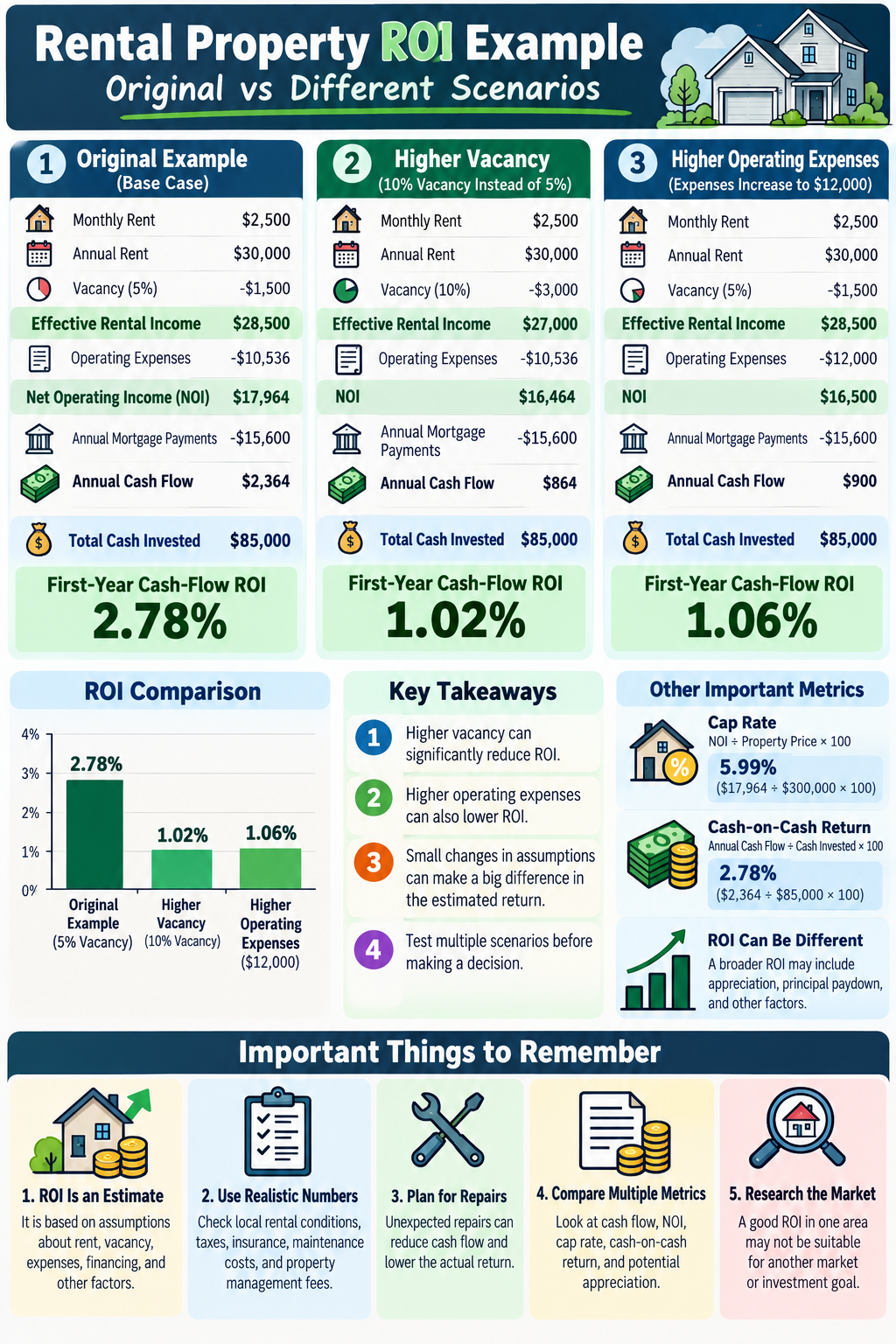
The 5.99% cap rate and 2.78% first-year cash-flow ROI are different because they measure different things.
ROI
Our simplified first-year ROI calculation compares annual pre-tax cash flow with the amount of cash initially invested.
First-Year Cash-Flow ROI = Annual Pre-Tax Cash Flow ÷ Total Cash Invested × 100
Cap rate is useful for looking at property operating performance before financing, while this ROI calculation considers the cash invested and mortgage payments used in our example.
Rental Property ROI vs Cash-on-Cash Return
Cash-on-cash return focuses specifically on annual pre-tax cash flow compared with the cash invested in the property.
Cash-on-Cash Return = Annual Pre-Tax Cash Flow ÷ Total Cash Invested × 100
In our example:
$2,364 ÷ $85,000 × 100 = 2.78%
Because our simplified first-year ROI uses the same annual cash flow and initial cash investment, both results happen to equal 2.78%.
A broader ROI calculation can be different if it includes other changes in investment value, such as appreciation or principal paydown.
Common Rental Property ROI Mistakes
1. Using Gross Rent as Profit
Rental income is not the same as profit. Vacancy, taxes, insurance, maintenance, management, utilities, financing, and other applicable costs can reduce the amount remaining.
2. Ignoring Vacancy
Assuming a property will remain occupied all year can overstate expected income. Use a reasonable assumption based on the property and local rental market.
3. Underestimating Operating Expenses
Leaving out expenses can make an ROI calculation appear stronger than the underlying assumptions justify. Research the property’s likely costs instead of relying only on a simple percentage rule.
4. Forgetting Initial Cash Costs
When calculating a cash-based return, consider relevant upfront cash costs such as the down payment, closing costs, and initial repairs rather than using the down payment alone.
5. Ignoring Major Repairs
A roof replacement, HVAC failure, plumbing problem, or other major repair can significantly reduce the return from a rental property.
Consider both routine maintenance and possible larger capital expenses when evaluating the property.
6. Mixing NOI With Cash Flow
NOI and cash flow are not the same. NOI is calculated before financing costs, while cash flow can account for mortgage payments.
NOI = Effective Rental Income − Operating Expenses
Cash Flow = NOI − Mortgage Payments
Use our NOI Calculator to estimate net operating income from your property’s income and operating expenses.
7. Assuming Property Appreciation Is Guaranteed
Property values can increase or decrease. Do not make a purchase decision that depends entirely on an assumed future appreciation rate.
8. Looking at ROI Alone
ROI is only one measurement. A more complete rental property analysis can also include NOI, cash flow, cap rate, cash-on-cash return, DSCR, vacancy, property condition, and financing.
Rental Property ROI Checklist
Before relying on an estimated ROI, check the main assumptions used in your calculation.
Rental Income
✓ Research comparable rents
✓ Estimate realistic monthly rent
✓ Calculate annual scheduled rent
✓ Include an appropriate vacancy assumption
✓ Calculate effective rental income
Operating Expenses
✓ Property taxes
✓ Landlord insurance
✓ Maintenance and repairs
✓ Property management
✓ Owner-paid utilities
✓ HOA fees when applicable
✓ Other recurring operating costs
Financing and Cash Invested
✓ Down payment
✓ Closing costs
✓ Initial repairs
✓ Mortgage payments
✓ Other relevant upfront cash costs
Property Condition and Risk
✓ Inspect the property’s condition
✓ Estimate immediate repairs
✓ Consider major future replacements
✓ Review existing leases when applicable
✓ Check HOA or rental restrictions
✓ Research relevant local requirements
Test Different Scenarios
✓ Higher vacancy
✓ Lower rental income
✓ Higher operating expenses
✓ Unexpected repairs
✓ Different financing costs
If the investment only appears attractive under perfect assumptions, test more conservative numbers before making a decision.
Frequently Asked Questions About Rental Property ROI
How do you calculate ROI on a rental property?
One simple cash-based method is to divide annual pre-tax cash flow by the initial cash invested and multiply by 100. However, broader ROI calculations may include additional gains or costs, so always check what the calculation includes.
What is a good ROI on a rental property?
There is no single ROI percentage that is suitable for every rental property or investor. Consider the estimated return alongside risk, cash flow, financing, property condition, market conditions, and your investment goals.
Is rental property ROI the same as cap rate?
No. Cap rate generally compares NOI with the property’s value or purchase price before financing, while a cash-based ROI can compare cash flow with the investor’s actual cash invested.
Is ROI the same as cash-on-cash return?
Not always. Cash-on-cash return specifically compares annual pre-tax cash flow with cash invested. A broader ROI calculation may include other changes in investment value.
Should mortgage payments be included in rental property ROI?
They can affect a cash-flow-based ROI because financing affects the cash remaining for the investor. Mortgage payments are generally kept separate from operating expenses when calculating NOI.
Should I include vacancy when calculating rental property ROI?
Yes, when vacancy is relevant to the property. Assuming full occupancy throughout the year can overstate expected rental income. Research a reasonable assumption for the property and local market.
Does property appreciation count toward ROI?
It can be included in some broader ROI calculations, but future appreciation is uncertain. An increase in estimated property value is also different from cash received, and selling or transaction costs may eventually affect the realized return.
Can rental property ROI change over time?
Yes. Rental income, vacancy, operating expenses, financing costs, repairs, and property value can change over time, so an ROI estimate can also change.
How can I improve the accuracy of a rental property ROI estimate?
Use property-specific information whenever possible. Research comparable rents, actual property taxes, insurance estimates, expected maintenance, management costs, financing terms, and the property’s physical condition.
Can a rental property have positive cash flow but a low ROI?
Yes. A property may produce positive cash flow but still have a relatively low cash-based ROI if a large amount of cash was required to purchase and prepare the property.
Final Thoughts on Rental Property ROI
Calculating rental property ROI can help you understand how an investment’s estimated return compares with the money you put into the property.
But the ROI percentage should not be viewed by itself. Start by estimating realistic rental income, vacancy, operating expenses, and financing costs. Then calculate NOI, cash flow, total cash invested, and the appropriate return metric.
In our illustrative example, the property produced $2,364 in annual pre-tax cash flow from $85,000 of initial cash invested, resulting in an estimated 2.78% first-year cash-flow ROI.
When we changed the assumptions, the result changed substantially. Increasing vacancy to 10% reduced the estimated ROI to 1.02%, while increasing annual operating expenses to $12,000 resulted in approximately 1.06%.
That is why scenario testing is important. A calculation based only on the best-case assumptions may give an incomplete picture of the investment.
The goal is not to find one “perfect” ROI percentage. The goal is to understand where the return comes from, test realistic assumptions, identify risks, and compare properties using consistent calculations.
Calculate Your Own Rental Property ROI
Want to test your own property numbers? Use our Rental Property ROI Calculator to estimate ROI, NOI, cash flow, cap rate, cash-on-cash return, and other useful rental property metrics.
You can also use our Rental Cash Flow Calculator to estimate monthly and annual rental property cash flow.
Disclaimer
This article is for general educational and informational purposes only. It is not financial, investment, tax, legal, real estate, lending, or accounting advice.
All calculations and property figures shown in this article are illustrative examples. Actual rental income, vacancy, expenses, financing terms, taxes, insurance, repairs, property values, investment returns, and other results can vary significantly by property, market, borrower, and circumstances. Past or estimated performance does not guarantee future results.
Before purchasing or financing a rental property, verify important information independently and consider consulting appropriately qualified professionals for advice relevant to your situation.