Learning how to analyze a rental property before buying can help you estimate its income, expenses, cash flow, and potential returns before making a decision.
A property may generate rental income, but vacancy, operating expenses, financing costs, repairs, and major replacements can significantly change its financial results.
A step-by-step rental property analysis can help you organize these numbers before making a purchase decision. This guide explains how to research rental income, estimate expenses, calculate NOI and cash flow, review investment metrics, and test different financial scenarios.
What Does It Mean to Analyze a Rental Property?
Rental property analysis is the process of estimating a property’s potential income, expenses, financing costs, and financial performance. Because the property has not yet produced future results, many numbers used before purchase are estimates rather than guarantees.
The goal is not to predict the future perfectly. Instead, the analysis helps you understand how the property could perform under different assumptions and identify information that needs further research.
Step 1: Research the Property and Local Rental Market
Start by understanding the property itself and the rental market around it. Review its location, size, number of bedrooms and bathrooms, condition, amenities, parking, and other features that may influence rental demand.
Compare several similar rental properties in the same area. Look at asking rents, property characteristics, and how closely each comparable matches the property you are analyzing. Advertised rent can provide useful information, but it does not guarantee the rent you will actually collect.
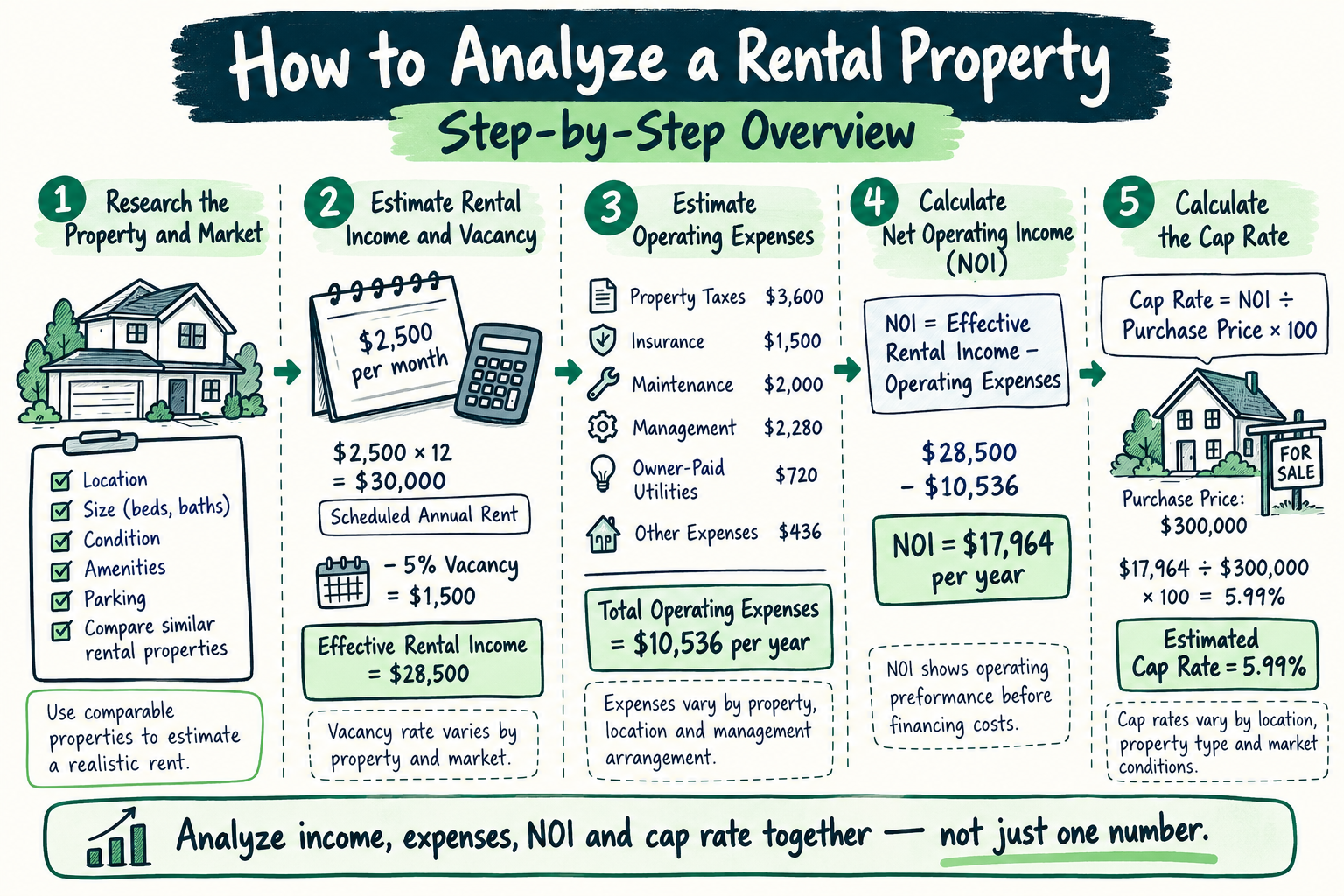
Step 2: Estimate Rental Income and Vacancy
The next step is to estimate how much rental income the property may generate. Do not rely only on the rent advertised by the seller or listing agent. Research comparable rental properties in the same area to build a more realistic estimate.
Research Comparable Rental Properties
Look for rentals with similar bedrooms, bathrooms, size, condition, location, parking, and amenities. Comparing several similar properties can give you a better starting point for estimating potential monthly rent.
Calculate Scheduled Annual Rent
Suppose comparable properties suggest that the home could rent for $2,500 per month.
$2,500 × 12 = $30,000 Scheduled Annual Rent
Include an Estimated Vacancy Allowance
A rental property may not remain occupied every day of the year. Include a vacancy assumption based on the property and relevant local market information instead of assuming that all scheduled rent will be collected.
Scheduled Annual Rent: $30,000
Illustrative Vacancy Rate: 5%
Estimated Vacancy Loss: $30,000 × 5% = $1,500
Effective Rental Income = $30,000 − $1,500 = $28,500
The 5% vacancy rate above is only an illustrative assumption. Actual vacancy can be higher or lower depending on the property, location, tenant demand, and market conditions.
Learn more about vacancy calculations in our Rental Property Vacancy Rate guide.
Step 3: Estimate Operating Expenses
Operating expenses are the ongoing costs of owning and operating a rental property. Estimating these expenses carefully is important because rental income alone does not show how much money the property may actually produce.
Common Rental Property Operating Expenses
Operating expenses may include property taxes, landlord insurance, maintenance, repairs, property management, owner-paid utilities, HOA fees, landscaping, licenses, and other recurring property costs.
The exact expenses vary by property, location, property type, and management arrangement.
Estimate Annual Operating Expenses
Suppose the property has the following estimated annual operating expenses:
Property Taxes: $3,600
Insurance: $1,500
Maintenance and Repairs: $2,000
Property Management: $2,280
Owner-Paid Utilities: $720
Other Operating Expenses: $436
Total Estimated Operating Expenses = $10,536 per year
These numbers are only an illustrative example. Before buying a property, research the actual taxes, insurance quotes, management fees, maintenance needs, utilities, HOA charges, and other costs that may apply.
Do Not Mix Financing Costs With Operating Expenses
Mortgage principal and interest are generally kept separate from operating expenses when calculating Net Operating Income (NOI). Financing costs can be considered later when estimating the property’s cash flow.
Step 4: Calculate Net Operating Income (NOI)
Net Operating Income (NOI) estimates how much income a rental property produces after subtracting its operating expenses from its effective rental income. NOI does not generally include mortgage principal and interest.
Net Operating Income Formula
NOI = Effective Rental Income − Operating Expenses
Using the example above, the estimated effective rental income is $28,500 per year and the estimated operating expenses are $10,536 per year.
Effective Rental Income: $28,500
Operating Expenses: −$10,536
Net Operating Income: $17,964 per year
In this illustrative example, the property produces an estimated NOI of $17,964 per year before financing costs.
Why NOI Is Useful
NOI helps you evaluate the property’s operating performance before considering how the purchase is financed. It can also be used when calculating other real estate metrics, such as the capitalization rate.
Remember that NOI is based on the income and expense numbers used in the calculation. If your rent, vacancy, or expense estimates change, the estimated NOI will also change.
Learn more about this calculation in our Net Operating Income (NOI) guide.
Step 5: Calculate the Cap Rate
The capitalization rate, or cap rate, helps you compare a rental property’s net operating income with its purchase price. It shows the property’s estimated annual NOI as a percentage of its value or purchase price.
Cap Rate Formula
Cap Rate = Net Operating Income ÷ Property Purchase Price × 100
Suppose the rental property has a $300,000 purchase price.
$17,964 ÷ $300,000 × 100 = 5.99%
Estimated Cap Rate = 5.99%
In this illustrative example, the property has an estimated cap rate of about 5.99%. This does not automatically mean the property is a good or bad investment.
What Is a Good Cap Rate?
There is no single cap rate that is right for every rental property. Cap rates can vary by location, property type, market conditions, property condition, risk, and investor goals.
Instead of looking at the cap rate alone, compare the property with similar properties in the same market and review its income, expenses, condition, financing, and potential risks.
Learn more in our How to Calculate Cap Rate on a Rental Property article.
Step 6: Calculate Rental Property Cash Flow
After calculating NOI, the next step is to consider financing. Rental property cash flow estimates how much money may remain after operating expenses and mortgage payments are accounted for.
Rental Property Cash Flow Formula
Cash Flow = NOI − Annual Mortgage Payments
Suppose the property has estimated annual mortgage payments of $15,600.
Net Operating Income: $17,964
Annual Mortgage Payments: −$15,600
Estimated Annual Cash Flow: $2,364
$2,364 ÷ 12 = $197 Estimated Monthly Cash Flow
In this illustrative example, the property produces an estimated $2,364 in annual pre-tax cash flow, or about $197 per month.
Positive vs Negative Cash Flow
Positive cash flow means the estimated property income is greater than the operating expenses and financing payments included in the analysis.
Negative cash flow means those estimated costs are greater than the property income. Cash flow can change if rent, vacancy, expenses, interest rates, loan terms, or other assumptions change.
Use our Rental Cash Flow Calculator to test your own property numbers.
For a detailed explanation, read our How to Calculate Rental Property Cash Flow article
Step 7: Calculate Cash-on-Cash Return
Cash-on-cash return compares the annual pre-tax cash flow from a rental property with the amount of cash you invested. This can be useful when a property is purchased with mortgage financing.
Calculate Your Total Cash Invested
Suppose the $300,000 property requires the following upfront cash:
Down Payment (25%): $75,000
Closing Costs: $6,000
Initial Repairs: $4,000
Total Cash Invested: $85,000
Cash-on-Cash Return Formula
Cash-on-Cash Return = Annual Pre-Tax Cash Flow ÷ Total Cash Invested × 100
$2,364 ÷ $85,000 × 100 = 2.78%
In this illustrative example, the estimated cash-on-cash return is about 2.78%. This percentage should not be considered alone when deciding whether to buy a property.
Why Cash-on-Cash Return Is Different From Cap Rate
Cap rate compares NOI with the property price and does not include mortgage financing. Cash-on-cash return focuses on annual pre-tax cash flow compared with the actual cash invested, so financing can significantly affect the result.
Learn more in our What Is Cash-on-Cash Return? article.
Step 8: Check the Debt Service Coverage Ratio (DSCR)
Debt Service Coverage Ratio (DSCR) compares a property’s Net Operating Income with its debt payments. It can help show whether the property’s estimated operating income is sufficient to cover its debt service.
DSCR Formula
DSCR = Net Operating Income ÷ Annual Debt Service
Net Operating Income: $17,964
Annual Debt Service: $15,600
$17,964 ÷ $15,600 = 1.15
Estimated DSCR = 1.15
In this illustrative example, the property produces about $1.15 of NOI for every $1.00 of annual debt service.
What Does the DSCR Tell You?
A DSCR above 1.00 means the estimated NOI is greater than the debt service used in the calculation. A DSCR below 1.00 means the estimated NOI is not enough to fully cover that debt service.
Lender requirements can vary, so there is no single DSCR requirement that applies to every loan, lender, or property.
Learn more in our What Is DSCR in Real Estate? article.
Test your property numbers with our DSCR Calculator.
Step 9: Test Different Rental Property Scenarios
A rental property may look profitable when you use your original assumptions, but the actual numbers can change. Before buying, test what happens if rent is lower, vacancy is higher, expenses increase, or financing costs change.
Test a Higher Vacancy Rate
Our example used a 5% vacancy assumption. Now imagine vacancy increases to 10%.
Scheduled Annual Rent: $30,000
10% Vacancy Allowance: −$3,000
Effective Rental Income: $27,000
Compared with the original $28,500 effective rental income, the higher vacancy assumption reduces estimated annual income by $1,500.
Test Higher Operating Expenses
You should also test what happens if maintenance, insurance, property taxes, management fees, or other operating costs are higher than expected.
For example, if annual operating expenses increase from $10,536 to $12,000 while effective rental income remains $28,500:
$28,500 − $12,000 = $16,500 Estimated NOI
That is lower than the original estimated NOI of $17,964. Because NOI affects other calculations, higher expenses can also change cap rate, DSCR, cash flow, and investment returns.
Do Not Rely on the Best-Case Scenario
Try several realistic scenarios before buying. A more conservative analysis can include lower rent, higher vacancy, higher maintenance costs, unexpected repairs, or different financing assumptions. The goal is to understand how sensitive the property is when your assumptions change.
Learn more about vacancy in our Rental Property Vacancy Rate article.
Test different assumptions with our Rental Property ROI Calculator.
Step 10: Inspect the Property and Estimate Major Repairs
Financial calculations are only part of rental property analysis. Before buying, you should also investigate the physical condition of the property and estimate repairs or replacements that may be needed.
Check Major Property Components
Review the condition and expected remaining life of major property components. A professional property inspection can help identify visible issues and areas that may require further evaluation.
Roof
Heating and cooling systems
Plumbing
Electrical systems
Foundation and structure
Windows and doors
Water heater
Major appliances
The condition of these items can affect both your upfront costs and future rental property expenses.
Separate Routine Maintenance From Major Repairs
Routine maintenance and major replacements are not always the same. Small recurring maintenance costs may already be included in your operating-expense estimate, while a large roof, HVAC, plumbing, or structural project may require separate planning.
Estimate Repairs Before You Buy
If the property needs work immediately, estimate those costs before completing your analysis. Whenever possible, use property-specific information and professional estimates instead of relying only on a general percentage.
Suppose the property may require:
Interior Repairs: $4,000
Appliance Replacement: $1,500
Other Initial Work: $2,000
Estimated Initial Repairs: $7,500
In this example, the additional $7,500 would increase the amount of cash needed to purchase and prepare the property. That can also change calculations such as cash-on-cash return.
Do not treat an inspection as a guarantee that every future problem will be discovered. The purpose is to gather better information before making your purchase decision.
Step 11: Verify Property Costs, Rules, and Documents
Before buying a rental property, verify the important costs, rules, and documents that could affect ownership or rental income. Do not rely only on estimates from the property listing.
Verify Property Taxes
Research the property’s current tax information and whether the tax amount could change after a sale. Property-tax rules vary by location, so use information from the relevant local authority when possible.
Get an Insurance Estimate
Get an insurance estimate for the specific property rather than assuming every rental property has similar insurance costs. Location, property characteristics, coverage, deductibles, and other factors can affect the premium.
Review HOA Fees and Rules
If the property belongs to a homeowners association, review its fees and relevant rules. Check whether there are rental restrictions, additional charges, or other requirements that could affect your plans for the property.
Review Existing Leases and Rental Information
If tenants already occupy the property, review available lease documents, rent amounts, lease dates, deposits, payment information, and other relevant records. Confirm which obligations may continue after ownership changes.
Check Local Rental Requirements
Rental requirements vary by location. Depending on the property, there may be licenses, registrations, inspections, zoning rules, safety requirements, or other local obligations to research before buying.
When a legal, tax, insurance, or contractual issue is unclear, consider getting information from the relevant government authority or an appropriately qualified professional.
✓ Property taxes checked
✓ Insurance estimate obtained
✓ HOA fees and rules reviewed
✓ Existing leases reviewed, if applicable
✓ Local rental requirements researched
Step 12: Review the Complete Rental Property Analysis
After researching the property, estimating income and expenses, reviewing financing, and checking the property’s condition, bring the important numbers together. Looking at the complete picture can be more useful than focusing on one metric alone.
Review Your Main Numbers
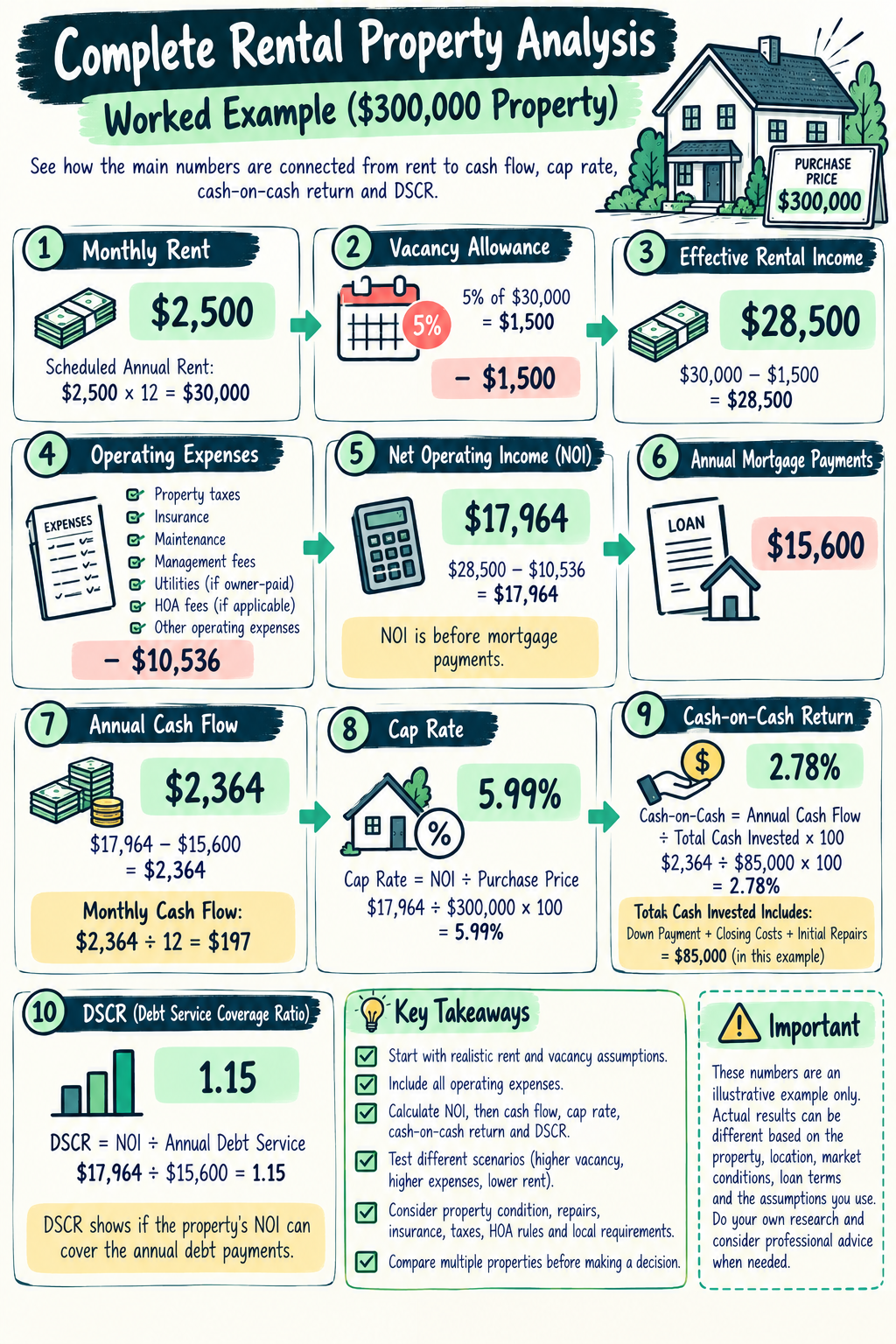
Using our illustrative example, the original analysis produced the following estimates:
Purchase Price: $300,000
Monthly Rent: $2,500
Scheduled Annual Rent: $30,000
Vacancy Assumption: 5%
Effective Rental Income: $28,500
Operating Expenses: $10,536
NOI: $17,964
Cap Rate: 5.99%
Annual Mortgage Payments: $15,600
Annual Pre-Tax Cash Flow: $2,364
Monthly Pre-Tax Cash Flow: $197
Cash-on-Cash Return: 2.78%
DSCR: 1.15
These numbers are connected. For example, a change in rent, vacancy, operating expenses, or financing can affect several of the results at the same time.
Compare More Than One Property
If you are considering several rental properties, analyze them using a consistent method. Compare their prices, realistic rental income, expenses, property condition, financing assumptions, cash requirements, and financial metrics.
Do Not Choose a Property Based on One Metric
A higher cap rate, positive cash flow, or stronger cash-on-cash return does not tell you everything about a property. The numbers should be considered alongside property condition, location, financing, tenant situation, potential repairs, local requirements, and the assumptions used in your analysis.
Decide Which Assumptions Need More Research
Before making a purchase decision, identify any numbers that are still uncertain. You may need better rent comparables, an insurance quote, property-tax information, repair estimates, financing details, lease documents, or additional property inspections.
The goal of rental property analysis is not to predict the future perfectly. It is to make your assumptions visible, test the numbers, identify risks, and gather better information before making a decision.
Rental Property Analysis Checklist Before Buying
Before buying a rental property, review your research and calculations one more time. This checklist can help you make sure you have considered the major parts of the analysis.
Income and Market Research
✓ Research comparable rental properties
✓ Estimate realistic monthly rent
✓ Calculate scheduled annual rent
✓ Include a vacancy assumption
✓ Calculate effective rental income
Property Expenses
✓ Research property taxes
✓ Get an insurance estimate
✓ Estimate maintenance and repairs
✓ Include property management costs when applicable
✓ Check HOA fees and owner-paid utilities
✓ Consider other recurring operating expenses
Financial Analysis
✓ Calculate NOI
✓ Calculate cap rate
✓ Estimate mortgage payments
✓ Calculate annual and monthly cash flow
✓ Calculate cash-on-cash return when relevant
✓ Review DSCR when financing is involved
Property Due Diligence
✓ Review the property’s physical condition
✓ Estimate immediate repairs
✓ Consider major future replacements
✓ Review existing leases when applicable
✓ Check HOA rules and rental restrictions
✓ Research applicable local rental requirements
Test Your Assumptions
✓ Test a lower rental-income scenario
✓ Test higher vacancy
✓ Test higher operating expenses
✓ Review different financing assumptions when relevant
✓ Compare the property with other available opportunities
If changing one assumption significantly changes the results, investigate that assumption carefully before relying on the analysis.
A rental property analysis is only as useful as the information and assumptions used to build it.
Common Rental Property Analysis Mistakes to Avoid
Rental property analysis can become misleading when important costs are missed or assumptions are too optimistic. Watch for these common mistakes when reviewing a potential investment property.
Using the Advertised Rent Without Research
The rent shown in a property listing may not represent what the property will actually rent for. Compare several similar rental properties in the same area and consider differences in size, condition, amenities, and location.
Assuming Zero Vacancy
Assuming the property will remain occupied and collect full rent throughout the year can overstate expected income. Use a vacancy assumption supported by relevant property and local market information.
Underestimating Operating Expenses
Property taxes, insurance, maintenance, repairs, management, owner-paid utilities, HOA fees, and other operating costs can significantly affect the property’s results. Research each expense instead of focusing only on rent.
Mixing Mortgage Payments With NOI
Mortgage principal and interest are generally not included as operating expenses when calculating NOI. Keep financing separate when calculating NOI, then account for debt payments when estimating cash flow.
Ignoring Major Repairs
A property may appear attractive on paper but require expensive repairs or replacements. Consider the condition of the roof, HVAC system, plumbing, electrical system, structure, appliances, and other major components before buying.
Looking at Only One Metric
Cap rate, cash flow, cash-on-cash return, and DSCR measure different parts of a rental property’s financial picture. Do not rely on one number without considering the assumptions and other relevant information.
Using Only a Best-Case Scenario
Test what happens if rent is lower, vacancy is higher, expenses increase, or financing costs change. Scenario testing can show which assumptions have the greatest effect on your estimated results.
Good rental property analysis combines realistic assumptions, financial calculations, property research, and due diligence rather than relying on a single formula.
Frequently Asked Questions About Rental Property Analysis
How do you analyze a rental property before buying?
Start by researching realistic rental income, vacancy, and operating expenses. Then calculate metrics such as NOI, cap rate, cash flow, cash-on-cash return, and DSCR when relevant. Also review the property’s condition, financing, taxes, insurance, leases, HOA rules, and applicable local requirements before making a decision.
What numbers should I look at when buying a rental property?
Important numbers may include purchase price, expected rent, vacancy, effective rental income, operating expenses, NOI, cap rate, mortgage payments, cash flow, cash invested, cash-on-cash return, and DSCR. Which metrics matter most can depend on the property and how it is financed.
How do I know if a rental property will be profitable?
Estimate realistic rental income and subtract vacancy, operating expenses, and relevant financing costs to understand potential cash flow. Then test different scenarios. No calculation can guarantee future profitability because actual rent, expenses, vacancies, repairs, and market conditions can change.
What expenses should I include when analyzing a rental property?
Common operating expenses can include property taxes, landlord insurance, maintenance, repairs, property management, owner-paid utilities, HOA fees, landscaping, licenses, and other recurring property costs. The exact expenses depend on the property.
Should mortgage payments be included in NOI?
Mortgage principal and interest are generally kept separate from operating expenses when calculating NOI. Financing payments can then be considered when estimating the property’s cash flow.
What is a good cap rate for a rental property?
There is no single cap rate that is appropriate for every rental property. Cap rates can vary by market, location, property type, condition, and risk. Compare the property with relevant market information rather than relying on one universal percentage.
How much vacancy should I assume for a rental property?
There is no vacancy percentage that fits every property. Research relevant local vacancy information and the property’s rental history when available. You can also test multiple vacancy assumptions to see how they affect income and cash flow.
Is rental property analysis accurate?
Rental property analysis is an estimate based on the information and assumptions you enter. It can help you organize and compare potential outcomes, but it cannot predict future rent, vacancy, expenses, repairs, financing costs, or property values with certainty.
Final Thoughts on Analyzing a Rental Property
Analyzing a rental property before buying means looking beyond the purchase price and advertised rent. Start with realistic rental-income estimates, account for vacancy and operating expenses, and calculate the property’s NOI.
If financing is involved, review mortgage payments, cash flow, cash-on-cash return, and DSCR. Compare these numbers with the property’s purchase price, condition, repair needs, and the amount of cash required.
Remember that every calculation depends on assumptions. Rent can change, properties can remain vacant, expenses can increase, repairs can occur, and financing terms can vary.
Testing several realistic scenarios can help you understand how changes in those assumptions may affect the property’s estimated financial results.
Financial calculations should also be combined with property due diligence. Review taxes, insurance, HOA information when applicable, existing leases, property condition, and relevant local rental requirements.
The goal is not to find a property with one perfect number. The goal is to understand the property, test your assumptions, identify uncertainties, and make a more informed purchase decision.
Analyze Your Own Rental Property
Instead of calculating every metric manually, you can use Realtolic’s free rental property calculators to test your own numbers and compare different scenarios.
Try our Rental Property ROI Calculator.
You can also use our Rental Cash Flow Calculator to estimate income, expenses, and potential cash flow.
Use the results as estimates and verify important property, financing, tax, insurance, legal, and repair information before making a purchase decision.