
DSCR in real estate is a financial metric that compares a property’s Net Operating Income (NOI) with its debt service. DSCR, or Debt Service Coverage Ratio, helps show how much operating income is available relative to the property’s required debt payments. It is commonly used when analyzing income-producing properties and real estate financing.
DSCR is commonly used when analyzing income-producing properties and real estate financing. Understanding it can help investors see how rental income, operating expenses, and loan payments work together.
What Does DSCR Mean in Real Estate?
DSCR stands for Debt Service Coverage Ratio. It compares a property’s Net Operating Income (NOI) with its total debt service for the same period.
DSCR Formula
DSCR = Net Operating Income (NOI) ÷ Total Debt Service
Net Operating Income (NOI) is the income remaining after normal property operating expenses are deducted from operating income, before financing costs.
Debt Service is the amount required for debt payments during the period being analyzed. For a typical amortizing property loan, this commonly includes required principal and interest payments.
DSCR Calculation Example
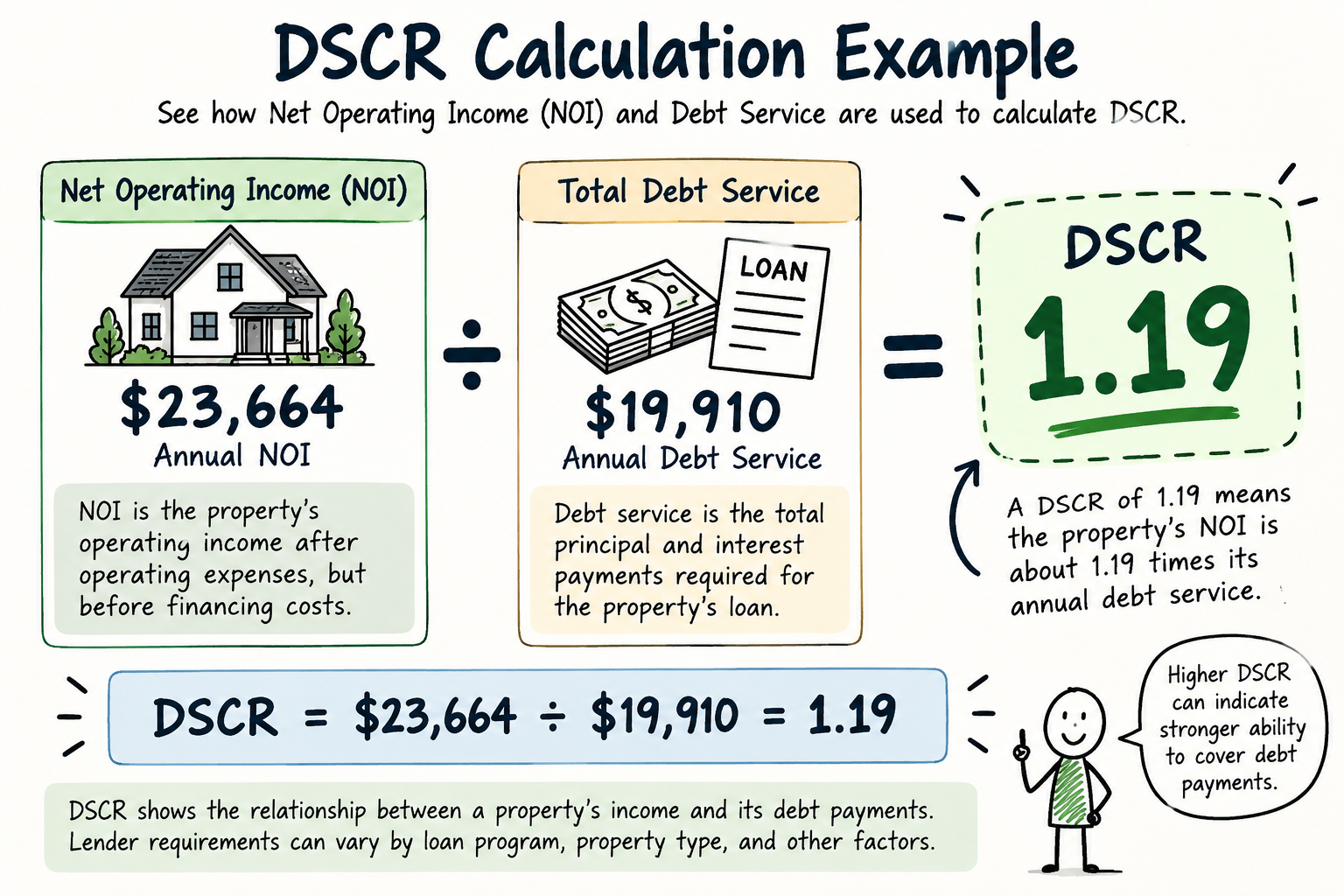
Suppose a rental property generates $23,664 in annual NOI and has $19,910 in annual debt service.
DSCR = $23,664 ÷ $19,910
DSCR ≈ 1.19
A 1.19 DSCR means the property’s NOI is approximately 1.19 times its annual debt service in this example.
This number describes the relationship between property income and debt obligations. It should not automatically be interpreted as approval or rejection for a loan because lender requirements can vary.
What Does a DSCR Number Mean?
A DSCR number shows how a property’s net operating income compares with its debt service. A ratio above 1.00 means NOI is greater than the debt service used in the calculation. A ratio of 1.00 means they are equal, while a ratio below 1.00 means NOI is less than the required debt service.
Example: DSCR Above 1.00
If annual NOI is $30,000 and annual debt service is $24,000, the DSCR is 1.25. In this example, NOI is 1.25 times the annual debt service.
Example: DSCR of 1.00
If annual NOI and annual debt service are both $24,000, the DSCR is 1.00. The NOI equals the debt service in this simplified example.
Example: DSCR Below 1.00
If annual NOI is $21,600 and annual debt service is $24,000, the DSCR is 0.90. In this example, NOI is less than the annual debt service.
Important: There is no single DSCR requirement that applies to every real estate loan. Lender requirements can vary based on the lender, loan program, property type, borrower, and other factors.
What Can Affect a Property’s DSCR?
Rental income: Changes in rent collected can change NOI.
Vacancy: Higher vacancy can reduce effective rental income.
Operating expenses: Property taxes, insurance, maintenance, management fees, and other operating costs can affect NOI.
Interest rate: Financing terms can change required debt payments.
Loan amount: A larger loan can result in higher debt service, depending on its terms.
Loan term and amortization: These can also change required payments and therefore affect DSCR.
DSCR vs NOI: What’s the Difference?
NOI measures the property’s operating income after operating expenses but before financing costs.
DSCR takes NOI one step further by comparing it with the property’s debt service.
For example, a property might have $23,664 NOI, but DSCR cannot be calculated from NOI alone. You also need the property’s debt service.
DSCR vs Cash Flow
DSCR and cash flow are related, but they answer different questions. DSCR expresses the relationship between NOI and debt service as a ratio. Cash flow shows the amount remaining after relevant expenses and financing payments in the calculation.
Using our earlier simplified example:
NOI: $23,664
Annual Debt Service: $19,910
Annual Cash Flow: $3,754
DSCR: 1.19
Why DSCR Matters in Rental Property Analysis
DSCR provides another way to understand the relationship between property operations and financing. Instead of looking only at rental income or cash flow, it shows how NOI compares with required debt service. Investors can use it alongside metrics such as NOI, cash flow, cap rate, and cash-on-cash return to understand different parts of a property’s financial picture.
Calculate Your Property’s DSCR →
Use our free DSCR Calculator to estimate NOI, debt service, and DSCR.
Lending requirements and underwriting standards can vary depending on the loan program and property type.
Common DSCR Calculation Mistakes
Using gross rental income instead of NOI: DSCR generally uses Net Operating Income, not gross scheduled rent.
Including financing costs inside NOI: Mortgage debt service is normally kept separate from NOI because DSCR compares NOI with debt service.
Mixing monthly and annual numbers: If you use annual NOI, use annual debt service too.
Ignoring vacancy and operating expenses: Overestimating NOI can also overstate the calculated DSCR.
Assuming every lender uses the same requirement: Lenders and loan programs may use different underwriting standards and calculation methods.
Frequently Asked Questions About DSCR
What does DSCR stand for in real estate?
DSCR stands for Debt Service Coverage Ratio. It compares a property’s Net Operating Income with its debt service.
How do you calculate DSCR?
Divide the property’s NOI by its debt service for the same period.
DSCR = NOI ÷ Debt Service
What does a DSCR of 1.25 mean?
A DSCR of 1.25 means the NOI used in the calculation is 1.25 times the debt service for the same period. Whether that meets a financing requirement depends on the lender and loan program.
Can DSCR be below 1.00?
Yes. A DSCR below 1.00 means the NOI used in the calculation is less than the debt service for that period.
Does DSCR include mortgage payments?
DSCR uses debt service in the denominator. For a typical amortizing property loan, debt service commonly includes required principal and interest payments. The exact treatment can depend on the financing structure and lender methodology.
Is DSCR the same as cash flow?
No. DSCR is a ratio comparing NOI with debt service. Cash flow is generally expressed as an amount of money remaining after the costs included in the calculation.
Related Real Estate Calculators
DSCR Calculator
NOI Calculator
Rental Cash Flow Calculator
Cap Rate Calculator
Cash-on-Cash Return Calculator
Final Thoughts
DSCR is a useful metric for understanding how a property’s Net Operating Income compares with its debt payments. The formula itself is simple, but accurate inputs matter. Rental income, vacancy, operating expenses, and financing terms can all affect the result.
Instead of relying on DSCR alone, consider it alongside other property metrics such as NOI, cash flow, cap rate, and cash-on-cash return.
Disclaimer: This article and Realtolic calculators are provided for educational and informational purposes only. They are not financial, investment, lending, tax, or legal advice. Loan requirements and calculation methods can vary by lender and loan program.