Rental property investing means buying real estate and renting it to tenants to generate income. A rental property can produce monthly cash flow and may also increase in value over time, but it comes with costs and risks that should be understood before investing. In this simple guide, you will learn how rental income, operating expenses, cash flow, net operating income (NOI), cap rate, and return on investment (ROI) work. We will also walk through a simple rental property example.
How Does a Rental Property Investment Work?
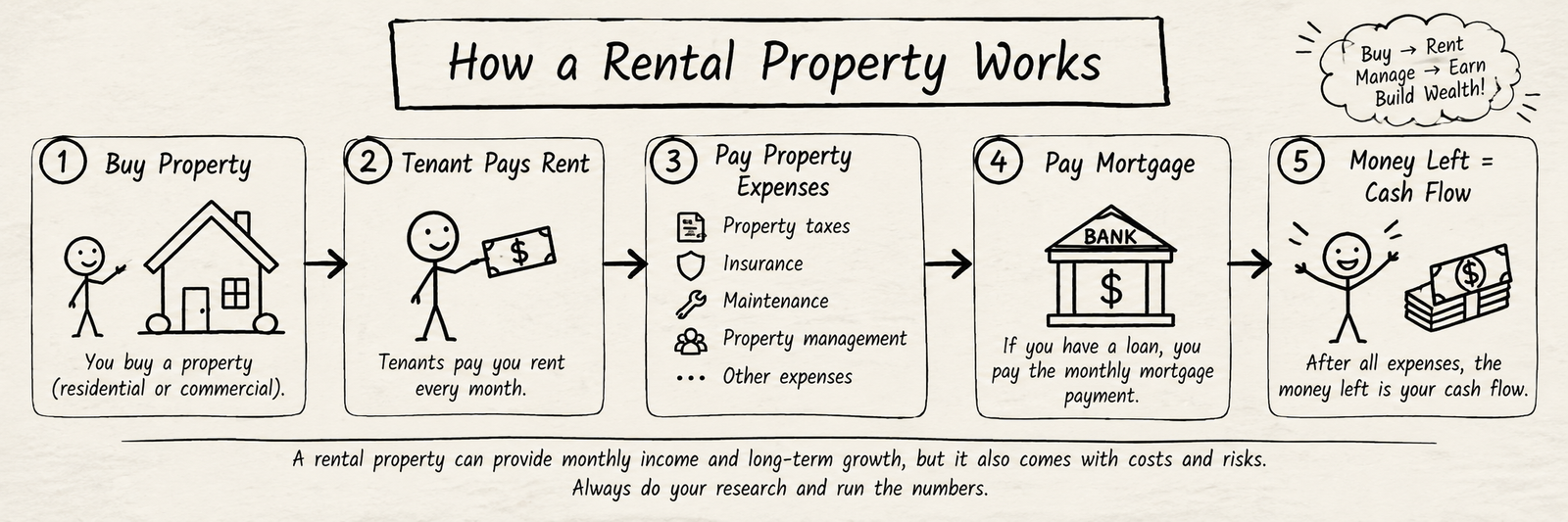
The basic idea is simple. You buy a property and rent it to tenants. The rent becomes your rental income. From that income, you may need to pay property taxes, insurance, maintenance, property management, vacancy costs, HOA fees, utilities, and other expenses. If the property is financed, you may also have a mortgage payment. After income and relevant expenses are considered, the money remaining can help you understand the property’s cash flow.
Rental Income and Operating Expenses
Rental income is the money a property earns from tenants. The main source is usually monthly rent, but some properties may also earn income from parking, storage, laundry, pet fees, or other services.
Common Rental Property Expenses
A rental property can have several operating expenses, including property taxes, homeowners or landlord insurance, repairs and maintenance, property management fees, HOA fees, owner-paid utilities, landscaping, and other recurring property costs.
Vacancy
A rental property may not stay occupied every month of the year. Vacancy is the period when the property does not have a paying tenant. Investors often include an estimated vacancy rate when calculating expected rental income so the numbers are more realistic.
What Is Rental Property Cash Flow?
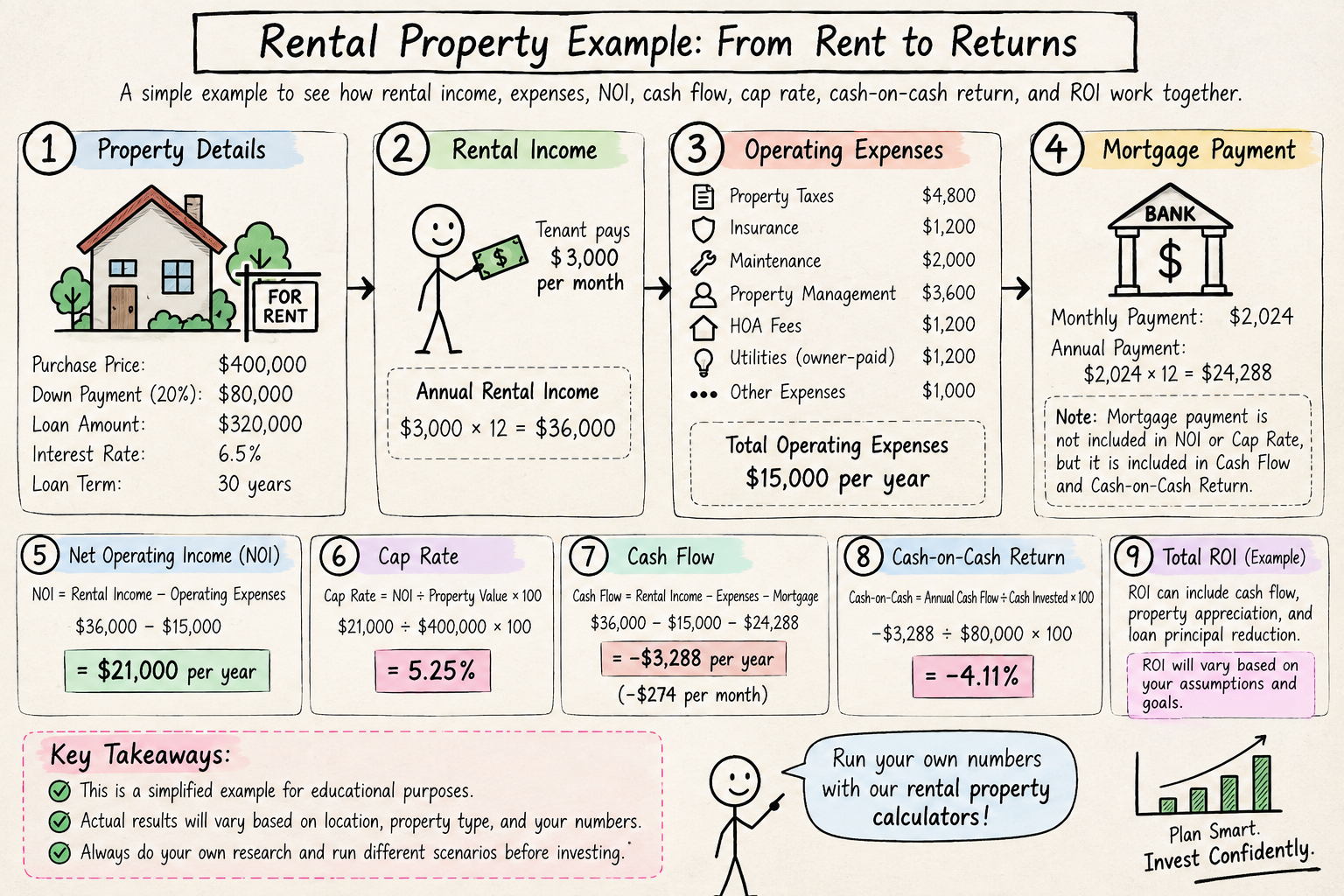
Cash flow is the money left after rental income and the property’s relevant expenses and debt payments are considered. For example, if a property receives $3,000 per month in rent and the combined expenses and mortgage payments are $2,500, the estimated monthly cash flow is $500. Positive cash flow means the property brings in more money than those costs, while negative cash flow means those costs are greater than the rental income.
What Is Net Operating Income (NOI)?
Net Operating Income (NOI) shows how much income a rental property generates after its operating expenses are subtracted from its effective rental income. Mortgage principal and interest payments are not included when calculating NOI. A simple way to understand it is: NOI = Effective Gross Income − Operating Expenses. For example, if a property generates $34,200 in effective annual income and has $10,536 in annual operating expenses, its NOI is $23,664.
What Is Cap Rate?
Capitalization rate, or cap rate, compares a property’s annual NOI with its value or purchase price. The basic formula is: Cap Rate = NOI ÷ Property Value × 100. For example, a property with $24,000 in NOI and a $400,000 value has a 6% cap rate.
What Is Cash-on-Cash Return?
Cash-on-cash return compares your annual pre-tax cash flow with the amount of cash you invested in the property. The formula is: Cash-on-Cash Return = Annual Pre-Tax Cash Flow ÷ Total Cash Invested × 100. This can be useful when a rental property is purchased using financing.
What Is Rental Property ROI?
Return on investment (ROI) is a broader way to measure an investment’s return compared with the money invested. Different ROI calculations may include cash flow, changes in property value, loan principal reduction, and other factors, so it is important to understand exactly what a particular ROI calculation includes.
How to Analyze a Rental Property Before Buying
Before buying a rental property, look at the complete financial picture instead of focusing only on monthly rent. Estimate the property’s income, vacancy, operating expenses, financing costs, and the cash you need to invest. Running several scenarios can help you see what happens if rent is lower than expected, expenses increase, the property stays vacant for longer, or financing costs change. This can give you a more realistic view of the potential return and risk.
Use Realtolic Rental Property Calculators
You do not need to calculate everything manually. Realtolic provides free calculators that can help you estimate rental income, expenses, cash flow, NOI, cap rate, cash-on-cash return, and other important property numbers.
Frequently Asked Questions
What is a good ROI on a rental property?
There is no single ROI that is good for every rental property. Expected returns can vary based on the market, property type, financing, expenses, risk, and an investor’s goals. Compare the expected return with the property’s costs and risks rather than relying on one percentage alone.
What is the difference between NOI and cash flow?
NOI measures property income after operating expenses but before mortgage principal and interest payments. Cash flow goes further by considering debt payments and other relevant cash costs, which helps estimate how much money may remain for the investor.
Does mortgage payment count as an operating expense?
No. Mortgage principal and interest are financing costs rather than property operating expenses, so they are not included when calculating NOI. However, mortgage payments are important when estimating the property’s actual cash flow.
What expenses should I include when analyzing a rental property?
Common expenses can include property taxes, insurance, maintenance and repairs, property management fees, HOA fees, owner-paid utilities, landscaping, and other recurring property costs. You should also account for possible vacancy when estimating rental income.
How do you calculate rental property cash flow?
Start with the property’s rental income, account for vacancy and other income, then subtract operating expenses and relevant debt payments. The amount remaining is the property’s estimated cash flow.
What is a good cap rate for a rental property?
There is no single cap rate that is good for every property. Cap rates can differ by location, property type, condition, market conditions, and risk. Cap rate is most useful when comparing properties using consistent assumptions.
What is the difference between cap rate and cash-on-cash return?
Cap rate compares NOI with the property’s value and does not include mortgage financing. Cash-on-cash return compares annual pre-tax cash flow with the amount of cash you invested, so financing can affect the result.
How do you calculate cash-on-cash return?
Divide the property’s annual pre-tax cash flow by the total cash invested, then multiply by 100. Total cash invested may include the down payment, closing costs, initial repairs, and other upfront cash costs included in your analysis.
What vacancy rate should I use for a rental property?
There is no vacancy rate that fits every property. Vacancy can vary by location, property type, rent level, demand, and market conditions. Using a realistic local estimate can make your rental property analysis more useful.
Can a rental property have negative cash flow?
Yes. Negative cash flow happens when the relevant property expenses and debt payments are greater than the rental income being received. This is why estimating costs carefully before buying a rental property is important.
Does property appreciation count as rental cash flow?
No. Appreciation is an increase in the property’s value over time, while cash flow measures money coming in and going out from the property’s operations and financing. Appreciation is not guaranteed and should be considered separately from monthly cash flow.
Related Rental Property Calculators
Rental Property ROI Calculator
Estimate rental income, expenses, cash flow, cap rate, cash-on-cash return, and ROI using your own property numbers.
Rental Cash Flow Calculator
Estimate monthly and annual rental cash flow after property expenses and mortgage payments.
NOI Calculator
Calculate Net Operating Income using rental income, vacancy, and operating expenses.
Cap Rate Calculator
Calculate a property’s capitalization rate using its Net Operating Income and property value.
Important Note
This guide and Realtolic calculators are provided for educational and estimation purposes only. Actual rental income, expenses, financing costs, property values, taxes, insurance, vacancy, and investment returns can vary. Always verify property-specific information and consider professional advice before making an investment decision.