Real estate investing means using property to potentially generate income or build value over time. Investors may buy homes, apartments, rental properties, commercial buildings, or other types of real estate depending on their goals and budget. Real estate can generate returns in different ways, including rental income, property appreciation, and profits from improving and selling a property. But every investment also has expenses and risks, so understanding the numbers before investing is important. In this beginner-friendly guide, we will explain how real estate investing works, common investment strategies, important property numbers, financing, potential risks, and how Realtolic calculators can help you analyze a property.
How Does Real Estate Investing Work?
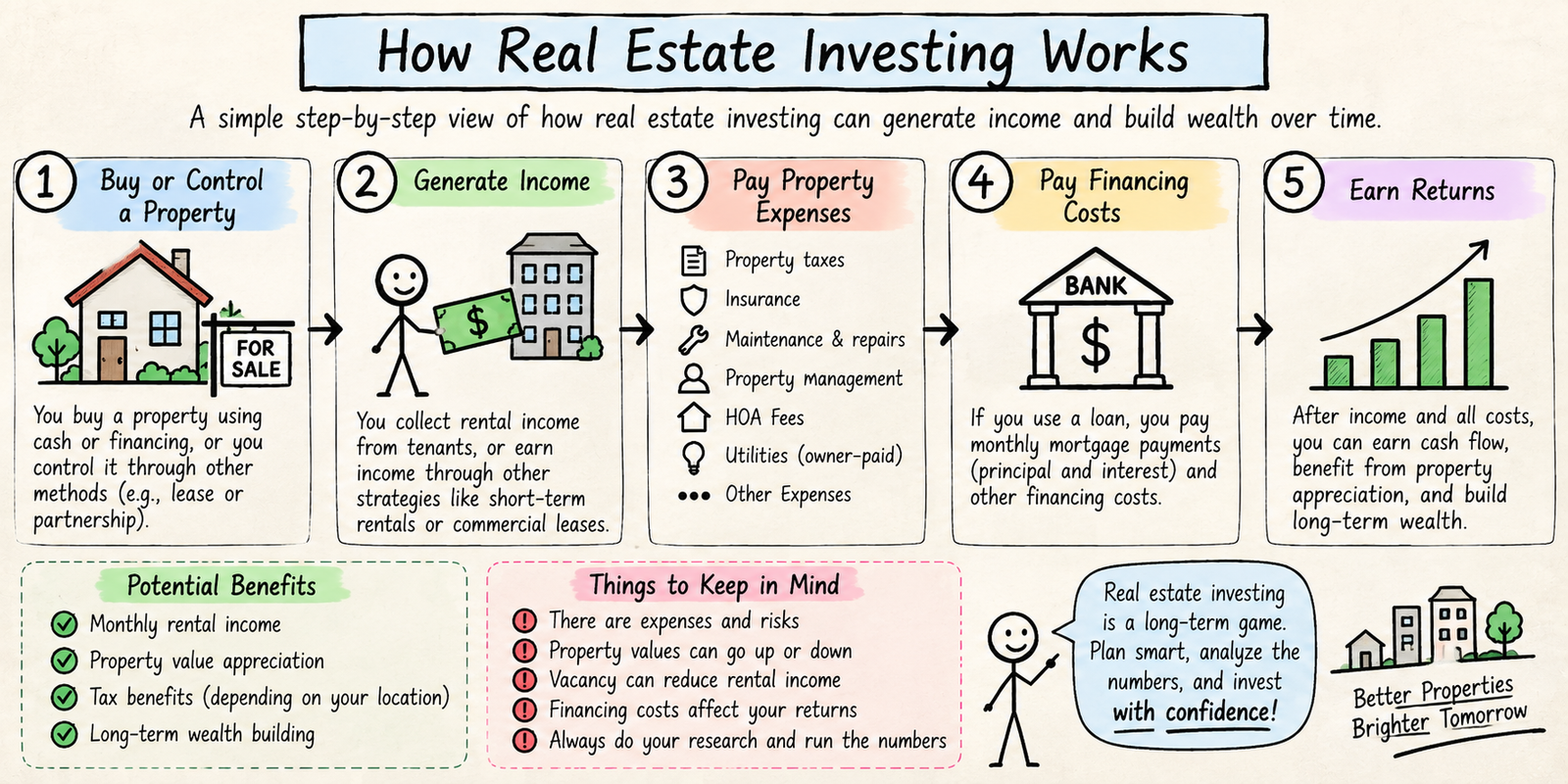
The basic idea is to buy or control a property that may produce financial value. For example, an investor might buy a house and rent it to tenants. The rent creates income, while expenses such as property taxes, insurance, maintenance, management, and financing reduce the money remaining. Some investors focus on monthly rental cash flow, while others focus on long-term property appreciation or buying, improving, and reselling properties. The numbers and risks can be different for each strategy. A simple rental investment can be viewed as: Buy Property → Collect Rental Income → Pay Property Expenses → Pay Financing Costs → Calculate Cash Flow and Returns.
Common Ways to Invest in Real Estate
Rental Properties
Rental property investing involves buying a property and renting it to tenants. Investors may earn rental income while the property may also increase or decrease in value over time. The final return depends on income, expenses, financing, vacancy, and other costs.
House Flipping
House flipping involves buying a property, improving or renovating it, and attempting to sell it for more than the total amount invested. Purchase price, renovation costs, holding costs, selling costs, and the final sale price can all affect the result.
Commercial Real Estate
Commercial real estate can include offices, retail spaces, warehouses, and other properties used for business purposes. Income may come from tenants, while expenses and lease structures can be different from residential properties.
REITs (Real Estate Investment Trusts)
REITs allow investors to gain exposure to real estate without directly buying and managing a property. REITs can own or finance income-producing real estate, and their value and distributions can rise or fall.
How Do Real Estate Investors Make Money?
Real estate investors can potentially make money in several ways. The most common include rental income, positive cash flow, property appreciation, and profit from selling a property. Each method has different costs and risks.
Rental Income
Rental income is money collected from tenants for using a property. Some properties may also generate income from parking, storage, laundry, pet fees, or other services. Rental income alone does not equal profit because property expenses still need to be paid.
Cash Flow
Cash flow is the money remaining after the income and relevant expenses of the property are considered. For example, if a rental property brings in $3,000 per month and the modeled expenses and mortgage payments total $2,500, the estimated monthly cash flow is $500.
Property Appreciation
Appreciation means an increase in a property’s value over time. For example, a property bought for $300,000 that later becomes worth $350,000 has increased in value by $50,000. Property values can also fall, so appreciation is not guaranteed.
Profit From Selling
An investor may also make a profit by selling a property for more than the total costs associated with buying, improving, holding, and selling it. House flippers often focus on this strategy, but unexpected renovation, financing, and selling costs can reduce or eliminate the expected profit.
Numbers Every Real Estate Investor Should Understand
Net Operating Income (NOI)
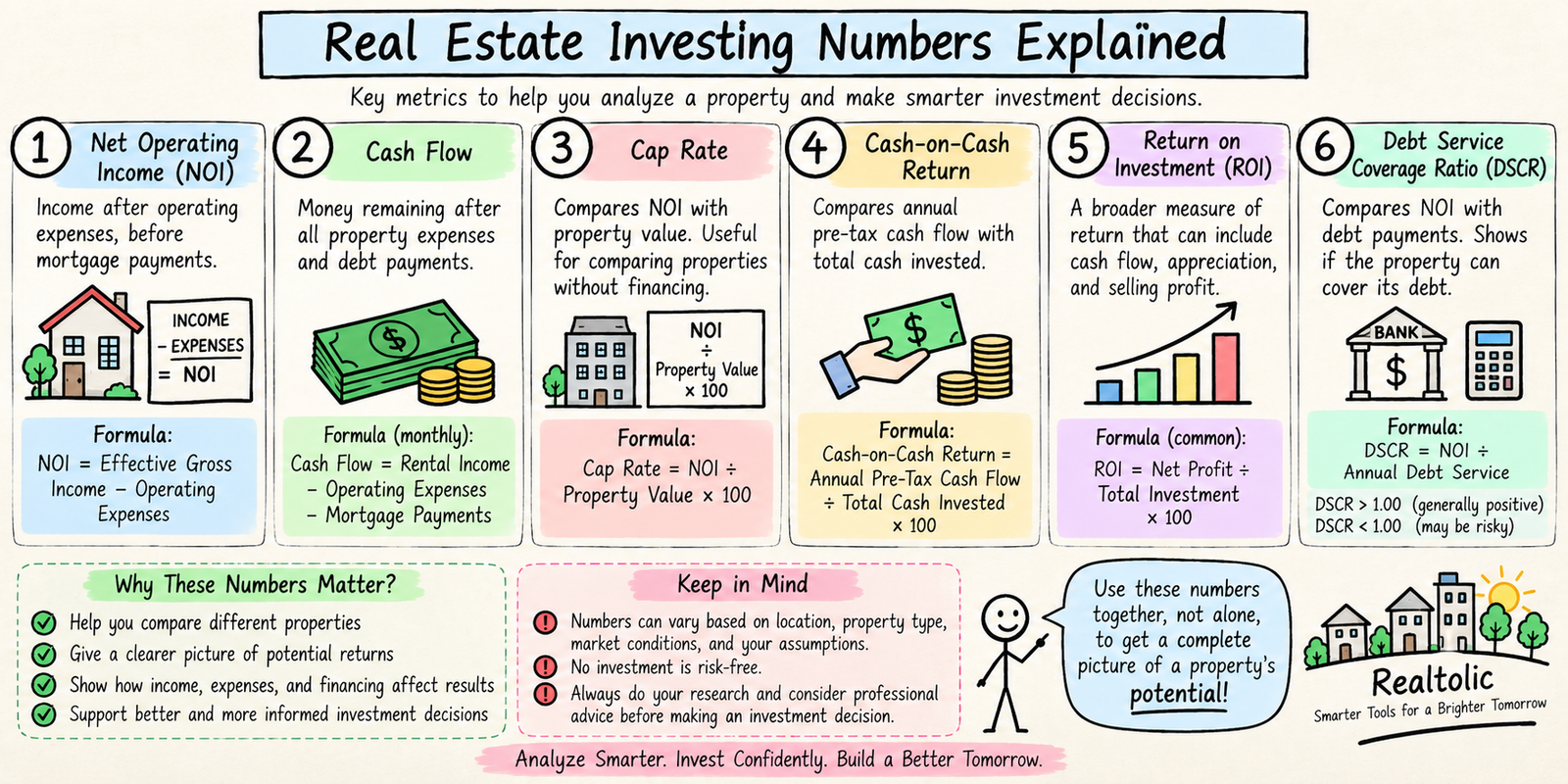
Net Operating Income is the income a property generates after subtracting operating expenses, but before mortgage principal and interest. A simple formula is: NOI = Effective Gross Income − Operating Expenses.
Cash Flow
Cash flow helps show how much money may remain after the property’s relevant expenses and debt payments are considered. Positive cash flow means the modeled income is greater than those costs, while negative cash flow means the modeled costs are greater than the income.
Cap Rate
Capitalization rate compares a property’s NOI with its value. The basic formula is: Cap Rate = NOI ÷ Property Value × 100. Investors commonly use it to compare income-producing properties without including mortgage financing in the calculation.
Cash-on-Cash Return
Cash-on-cash return compares annual pre-tax cash flow with the total cash invested in the property. The formula is: Cash-on-Cash Return = Annual Pre-Tax Cash Flow ÷ Total Cash Invested × 100.
Return on Investment (ROI)
ROI is a broader way to evaluate an investment’s return relative to the money invested. Depending on the calculation method, an analysis may consider cash flow, appreciation, selling profit, or other gains and costs. Always check what is included when comparing ROI figures.
Debt Service Coverage Ratio (DSCR)
DSCR compares a property’s NOI with its debt payments. The basic formula is: DSCR = NOI ÷ Annual Debt Service. A result above 1.00 means NOI is greater than the modeled debt service, while a result below 1.00 means NOI is lower than the modeled debt service.
These numbers measure different parts of a real estate investment. Looking at several metrics together can provide a clearer picture than relying on only one number.
Real Estate Investment Example
Suppose an investor buys a rental property for $350,000 and makes a 20% down payment of $70,000. The remaining $280,000 is financed with a mortgage. Suppose the property generates $3,200 per month in rent, or $38,400 per year. After accounting for vacancy, assume effective annual rental income is $36,480. If annual operating expenses such as property taxes, insurance, maintenance, and management total $12,000, the property’s estimated NOI would be $24,480 per year. Using the $350,000 purchase price, the estimated cap rate would be about 6.99%: $24,480 ÷ $350,000 × 100. Now suppose the mortgage and other modeled debt payments total $21,000 per year. Estimated annual cash flow would be $3,480, or about $290 per month. If the investor’s total upfront cash investment were $80,000, the estimated cash-on-cash return would be about 4.35%: $3,480 ÷ $80,000 × 100. This simplified example shows why investors should look beyond the purchase price and monthly rent. Income, vacancy, operating expenses, financing, and upfront cash can all materially change the investment results.
Risks of Real Estate Investing
Real estate can provide income and long-term growth opportunities, but every property investment involves risk. Understanding these risks before investing can help you make more informed decisions.
Property Values Can Fall
Property prices do not always increase. Local economic conditions, interest rates, housing supply, neighborhood changes, and other factors can cause a property’s value to decrease.
Vacancy Risk
A rental property may remain vacant between tenants. During a vacancy, rental income can decrease or stop while expenses such as mortgage payments, taxes, insurance, and maintenance may continue.
Unexpected Repairs and Expenses
Repairs can sometimes cost more than expected. Roof problems, plumbing, electrical work, appliances, HVAC systems, and other maintenance can reduce your investment returns.
Financing and Interest Rate Risk
Financing affects both the cost and cash flow of an investment. Interest rates, loan terms, down payment requirements, and refinancing costs can change the numbers significantly.
Tenant and Management Risk
Rental properties require management. Late payments, property damage, tenant turnover, legal requirements, and management fees can affect income and expenses.
Market and Location Risk
Real estate performance can vary significantly between markets and neighborhoods. Employment, population changes, new construction, local demand, taxes, insurance costs, and regulations can affect a property’s performance. Before investing, research the property and local market carefully and test different income, vacancy, expense, and financing assumptions instead of relying only on an optimistic scenario.
Analyze a Property With Realtolic
Real estate investment analysis can involve many different numbers. Realtolic provides free calculators that can help you estimate property income, expenses, financing, cash flow, and potential returns using your own assumptions.
Rental Property ROI Calculator
Estimate rental income, expenses, cash flow, cap rate, cash-on-cash return, and ROI.
Cap Rate Calculator
Calculate a property’s capitalization rate using its Net Operating Income and property value.
Cash-on-Cash Return Calculator
Estimate cash-on-cash return using annual pre-tax cash flow and total cash invested.
Rental Cash Flow Calculator
Estimate monthly and annual rental cash flow after property expenses and mortgage payments.
DSCR Calculator
Estimate the relationship between a property’s Net Operating Income and its annual debt payments.
NOI Calculator
Calculate Net Operating Income using property income, vacancy, and operating expenses.
Frequently Asked Questions
How much money do I need to start investing in real estate?
The amount depends on the property, financing method, location, and investment strategy. Your upfront costs may include a down payment, closing costs, inspections, repairs, and cash reserves.
Is real estate investing profitable?
Real estate can generate income or gains, but profit is not guaranteed. Results depend on the purchase price, rental income, expenses, financing, property value changes, and selling costs.
What is cash flow in real estate?
Cash flow is the money remaining after the property’s relevant income, expenses, and debt payments are considered. Positive cash flow means the modeled income is greater than those costs.
What is ROI in real estate?
ROI means return on investment. It compares the return from an investment with the amount invested. The exact calculation can vary depending on which gains and costs are included.
What is a good cap rate?
There is no single cap rate that is good for every property. Cap rates vary by location, property type, market conditions, and risk. They are often most useful when comparing similar properties using consistent assumptions.
Can I invest in real estate with a mortgage?
Yes. Many investors use financing to purchase properties. However, interest rates, loan terms, down payments, and mortgage payments can significantly affect cash flow and investment returns.
What should I check before buying a rental property?
Review expected rent, vacancy, property taxes, insurance, maintenance, management costs, financing, local market conditions, and other property-specific expenses. Running several scenarios can help you understand how changes in these assumptions affect the results.
What are the main risks of real estate investing?
Risks can include falling property values, vacancies, unexpected repairs, financing costs, tenant problems, changing market conditions, and difficulty selling a property. Different investments can have different levels and types of risk.
Important Note
This guide and Realtolic calculators are provided for educational and estimation purposes only. Real estate investments involve risk, and actual income, expenses, financing costs, property values, taxes, insurance, and investment returns can vary. Always research the property and local market, verify your assumptions, and consider qualified financial, tax, legal, lending, or real estate advice when appropriate before making an investment decision.