
What Is Property Appreciation?
Property appreciation is an increase in a property’s value over time. For example, if a home is worth $400,000 today and later becomes worth $450,000, its value has increased by $50,000. Property values can also decrease, so appreciation is not guaranteed.
How Does the Property Appreciation Calculator Work?
The Realtolic Property Appreciation Calculator estimates a property’s future value using its current value, an assumed annual appreciation rate, and the number of years. It applies compound growth, meaning each year’s estimated change is based on the property’s value after the previous year’s change.
Property Appreciation Formula
Future Property Value = Current Property Value × (1 + Annual Appreciation Rate) ^ Number of Years
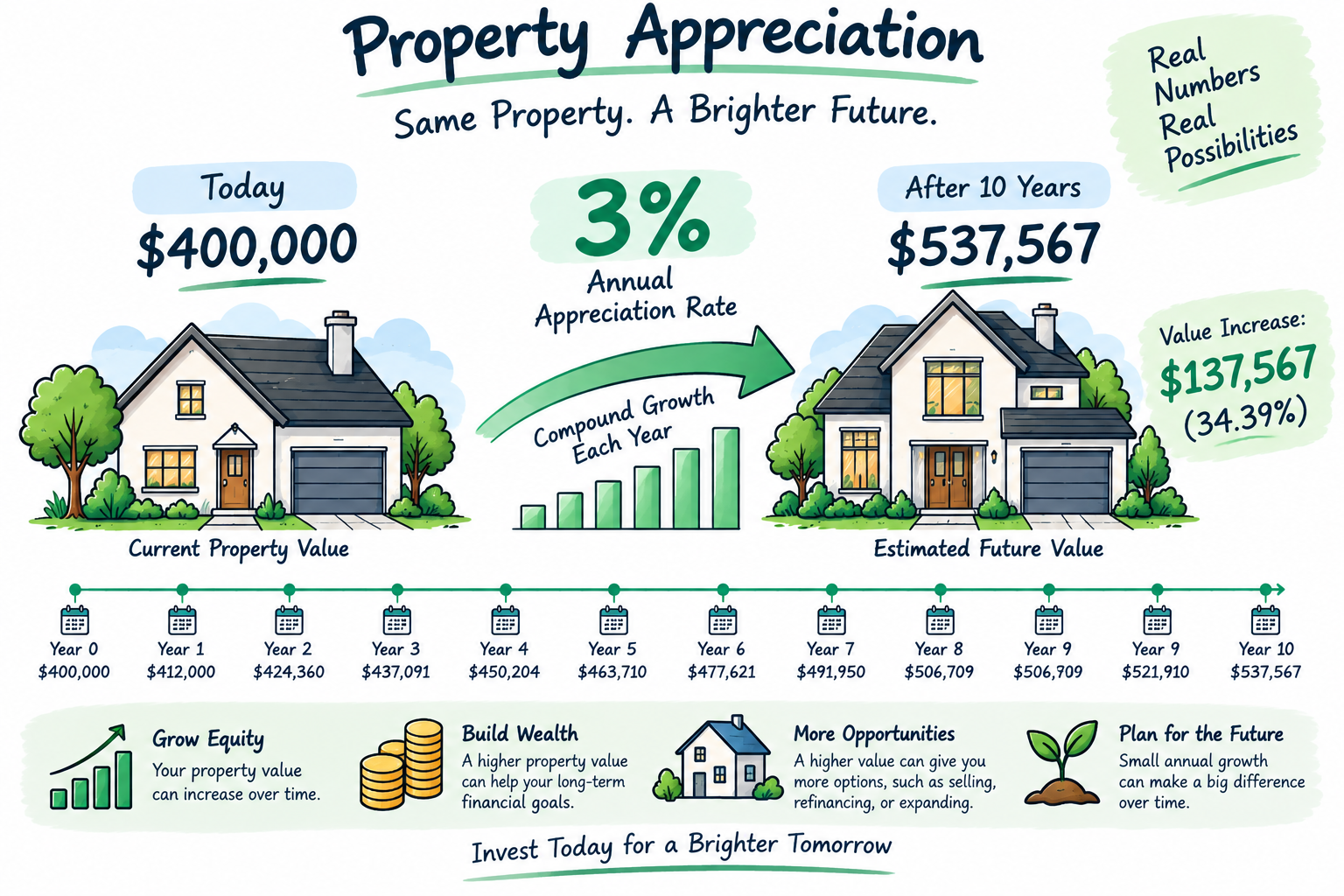
For example, a $400,000 property appreciating at an assumed 3% per year for 10 years would have an estimated future value of about $537,567. That is an estimated value increase of about $137,567, or 34.39% over the starting value.
Property Appreciation Example
Suppose a home is currently worth $400,000 and you want to estimate its value after 10 years using an assumed annual appreciation rate of 3%.
Using compound appreciation, the estimated property value after 10 years would be approximately $537,567.
This represents an estimated increase of about $137,567, or approximately 34.39% compared with the starting property value.
This is only an estimate. A property is unlikely to increase by exactly the same percentage every year. Its actual market value can rise, remain flat, or fall.
What Can Affect Property Appreciation?
Location and Local Demand
Property values can be influenced by demand for homes in a particular city, neighborhood, or area. Employment, schools, transportation, amenities, and new development can also affect local demand.
Housing Supply
The number of homes available compared with the number of buyers can influence prices. Limited supply combined with strong demand may put upward pressure on property values, while weaker demand can have the opposite effect.
Property Condition and Improvements
Renovations and improvements may affect a property’s market value, but the increase in value does not always equal the amount spent. Property condition, buyer preferences, and the local market also matter.
Interest Rates
Interest rates can affect how much buyers can afford to borrow. Changes in mortgage rates can influence housing demand and may affect property prices in a local market.
Economic Conditions
Employment, household income, population growth, consumer confidence, and broader economic conditions can influence demand for real estate. Different locations can perform differently even during the same economic period.
Inflation and Construction Costs
Inflation and changes in land, labor, and construction costs can influence real estate prices. However, higher costs do not automatically mean that every property’s market value will increase. Because these factors can change over time, an appreciation rate should be treated as an assumption rather than a guaranteed prediction of future property value.
Understanding Compound Property Appreciation
Property appreciation compounds when each year’s estimated growth is calculated using the property’s new value rather than only its original value. This is why a 3% annual appreciation assumption for 10 years produces more than a 30% total increase.
For example: $400,000 → $412,000 after Year 1 → $424,360 after Year 2 → approximately $537,567 after Year 10, assuming the property increases by exactly 3% every year.
How to Use the Property Appreciation Calculator
Using the calculator is simple. Enter your property’s current value, choose an estimated annual appreciation rate, select the number of years, and the calculator will automatically estimate how the property’s value could change over time.
1. Enter the Current Property Value
Enter the estimated market value of the property today. For example, if the home is currently worth $400,000, enter 400000.
2. Enter an Annual Appreciation Rate
Enter the annual percentage you want to use for your estimate. This is an assumption for the calculation, not a guaranteed future growth rate.
3. Choose the Number of Years
Enter how many years you want to estimate. The calculator will show the estimated future property value, total value change, total appreciation percentage, average value increase per year, a growth chart, and a year-by-year breakdown. Try different appreciation rates and time periods to compare possible scenarios, but remember that actual real estate prices can rise or fall.
Frequently Asked Questions
Is property appreciation guaranteed?
No. Property values can increase, stay relatively flat, or decrease. Local housing demand, economic conditions, interest rates, property condition, and many other factors can affect actual value.
How is future property value calculated?
The calculator uses compound growth. Each year’s estimated appreciation is applied to the property’s estimated value from the previous year.
Can I use a negative appreciation rate?
Yes. A negative rate can be used to explore a scenario where the property’s estimated value decreases over time.
Does renovating a property guarantee appreciation?
No. Improvements may affect market value, but the increase in value can be higher or lower than the renovation cost. Location, buyer demand, property condition, and the type of improvement also matter.
What annual appreciation rate should I use?
There is no single rate that is appropriate for every property. Consider researching historical price changes for the relevant local market and testing several rates instead of relying on only one scenario.
Related Real Estate Calculators
Rental Property ROI Calculator, House Flipping Calculator, Rent vs Buy Calculator, and Mortgage Payment Calculator.
Important Note
This calculator is provided for educational and informational purposes only. Results are estimates based on the information and assumptions you enter. They are not predictions or guarantees of future property values and should not be considered financial, investment, tax, or legal advice.