
NOI vs cash flow is an important comparison when analyzing rental property performance. Net Operating Income (NOI) measures income from property operations after operating expenses, while cash flow can show how much money remains after financing costs and other costs included in the analysis are considered.
The main difference is that NOI focuses on property operations before financing, while cash flow can show how much money remains after operating expenses and financing costs such as mortgage payments are considered.
What Is NOI in Real Estate?
NOI stands for Net Operating Income. It estimates the income a property generates from its operations after normal operating expenses are deducted.
NOI = Effective Gross Operating Income − Operating Expenses
Mortgage principal and interest are generally not treated as operating expenses when calculating NOI.
Suppose a rental property has $34,200 in effective annual rental income and $10,536 in annual operating expenses.
$34,200 − $10,536 = $23,664 NOI
For additional U.S. guidance, rental property owners can review IRS information about rental income and expenses.
What Is Rental Property Cash Flow?
Rental property cash flow estimates how much money remains after the costs included in the analysis are deducted from property income. Unlike NOI, a simplified cash flow calculation can also include mortgage payments or other financing costs.
Cash Flow = NOI − Financing Costs
If the property has $23,664 in annual NOI and $18,000 in annual mortgage payments, the simplified annual cash flow would be:
$23,664 − $18,000 = $5,664 annual cash flow
$5,664 ÷ 12 = $472 monthly cash flow
NOI vs Cash Flow: Key Differences
The easiest way to understand NOI and cash flow is to look at what each metric includes. NOI focuses on the property’s operating performance, while cash flow can go one step further by accounting for financing costs.
NOI Focuses on Property Operations
NOI measures income after normal property operating expenses. It generally does not subtract mortgage principal and interest, which makes it useful for looking at the property’s operations separately from an investor’s financing.
Cash Flow Can Include Financing
Cash flow can show how much money remains after operating expenses and financing costs are considered. Because investors may use different loans, the same property can produce the same NOI but different cash flow for different investors.
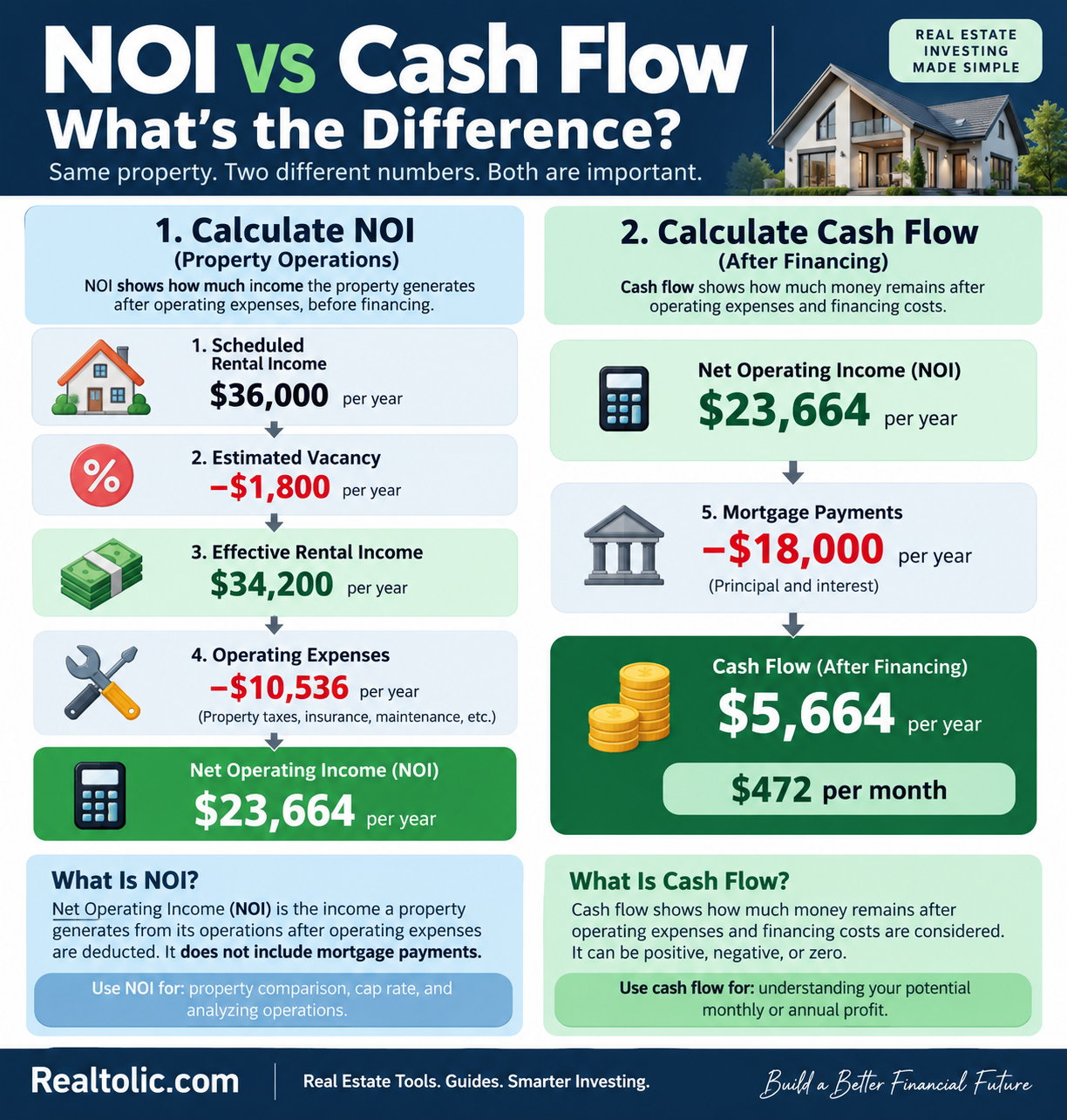
NOI vs Cash Flow Example
Scheduled Rental Income: $36,000/year
Estimated Vacancy: −$1,800/year
Effective Rental Income: $34,200/year
Operating Expenses: −$10,536/year
NOI: $23,664/year
Mortgage Payments: −$18,000/year
Cash Flow: $5,664/year
In this simplified example, the property’s NOI is $23,664, but after subtracting the assumed mortgage payments, estimated cash flow is $5,664 per year, or $472 per month.
Why Can Two Investors Have Different Cash Flow?
Two investors can buy similar properties but use different down payments, interest rates, loan terms, or financing structures. These differences can change mortgage payments and therefore change cash flow.
NOI, however, focuses on the property’s operations before those financing differences are considered.
When Is NOI Useful?
NOI can help evaluate a property’s operating performance and is commonly used when calculating cap rate. It can also make it easier to compare properties without mixing in different financing arrangements.
When Is Cash Flow Useful?
Cash flow can help estimate how much money may remain after the expenses and financing costs included in your analysis. Positive cash flow means the calculated income is greater than those costs, while negative cash flow means the calculated costs are greater than the income.
NOI vs Cash Flow vs Cap Rate
NOI, cash flow, and cap rate are related real estate metrics, but they answer different questions. NOI focuses on property operations, cash flow can account for financing, and cap rate compares NOI with property value.
NOI: Effective property income minus operating expenses.
Cash Flow: NOI minus financing costs in this simplified analysis.
Cap Rate: Annual NOI divided by property value, multiplied by 100.
Which Is More Important: NOI or Cash Flow?
Neither metric replaces the other. NOI can help you understand the property’s operating performance, while cash flow can help you understand what may remain after financing costs are considered. Looking at both can provide a clearer picture than relying on only one number.
Frequently Asked Questions
Is NOI the same as cash flow?
No. NOI generally measures property income after operating expenses but before financing costs. Cash flow can also subtract financing costs such as mortgage payments.
Does NOI include mortgage payments?
Generally, no. Mortgage principal and interest are financing costs rather than normal property operating expenses.
Can NOI be positive while cash flow is negative?
Yes. A property can have positive NOI but negative cash flow if financing costs and other costs included in the cash-flow analysis are high enough.
Why is NOI higher than cash flow in some examples?
When cash flow is calculated after mortgage payments, financing costs reduce the amount remaining. Because NOI is calculated before those financing costs, NOI can be higher than cash flow.
Calculate Your Rental Property Numbers
You can use Realtolic’s free calculators to estimate these numbers using your own property assumptions.
Final Thoughts
NOI and cash flow measure different parts of rental property performance. NOI focuses on income from property operations before financing, while cash flow can show what remains after financing costs are considered. Using both metrics alongside cap rate, ROI, and other property information can give you a more complete view of the numbers.
Important Note: This article is for general educational purposes only. The examples are simplified, and actual property income, expenses, financing costs, taxes, and results can vary. This is not financial, investment, tax, or legal advice.