
Cap rate is a common real estate metric used to compare the income a property produces with its value or purchase price. It can help rental property investors understand a property’s income performance before considering mortgage financing.
In this guide, you will learn what cap rate means, how to calculate it, and how the formula works using a simple rental property example.
What Is Cap Rate in Real Estate?
Cap rate, short for capitalization rate, compares a property’s annual Net Operating Income (NOI) with its property value or purchase price. The result is shown as a percentage.
Cap rate generally looks at the property’s operating performance before mortgage payments, which makes it useful for comparing properties without focusing on their individual financing structures.
Cap Rate Formula
Cap Rate = (Net Operating Income ÷ Property Value) × 100
To calculate cap rate, first calculate the property’s annual NOI. Then divide NOI by the property’s value or purchase price and multiply the result by 100.
How to Calculate Cap Rate Step by Step
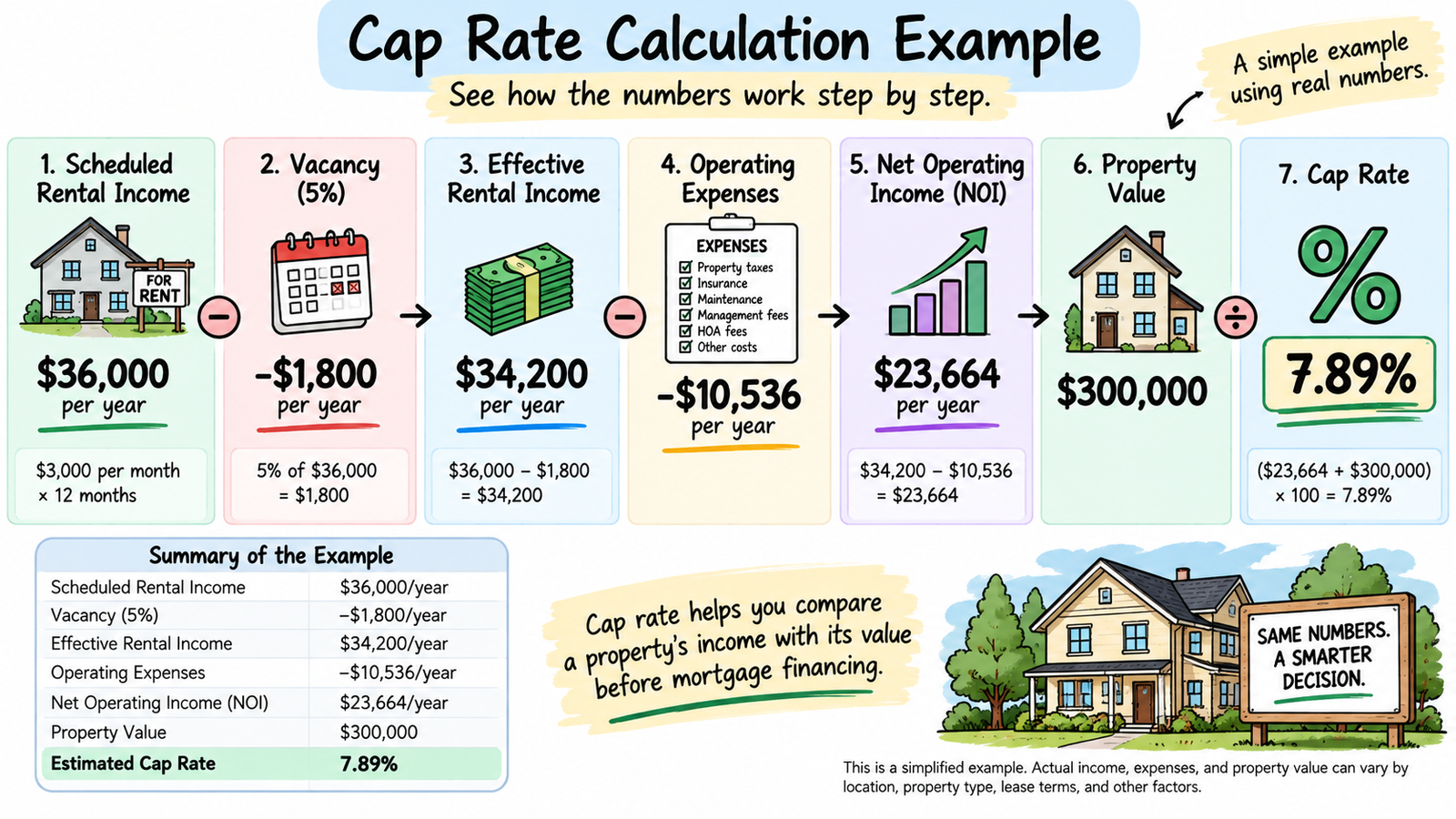
Step 1 — Calculate Annual Rental Income
Suppose a rental property generates $3,000 per month in scheduled rent. Its scheduled annual rental income would be:
$3,000 × 12 = $36,000 annual rental income
Step 2 — Account for Vacancy
If we use a 5% vacancy assumption, estimated vacancy would be $1,800 per year. Effective rental income would therefore be $34,200.
$36,000 − $1,800 = $34,200 effective rental income
Step 3 — Calculate Operating Expenses
Next, estimate the property’s annual operating expenses. These may include property taxes, insurance, maintenance, property management fees, HOA fees, and owner-paid utilities.
Suppose the property has $10,536 in annual operating expenses.
Step 4 — Calculate Net Operating Income (NOI)
Net Operating Income is the income remaining after operating expenses are subtracted from effective rental income.
NOI = Effective Rental Income − Operating Expenses
$34,200 − $10,536 = $23,664 annual NOI
In this example, the rental property produces an estimated $23,664 in annual NOI.
Step 5 — Determine the Property Value
For this example, suppose the property’s purchase price or value is $300,000.
Step 6 — Calculate the Cap Rate
Now divide the property’s annual NOI by its $300,000 value and multiply the result by 100.
($23,664 ÷ $300,000) × 100 = 7.89%
Based on these assumptions, the property’s estimated cap rate is approximately 7.89%.
Complete Cap Rate Example
Scheduled Rental Income: $36,000/year
Vacancy: −$1,800/year
Effective Rental Income: $34,200/year
Operating Expenses: −$10,536/year
NOI: $23,664/year
Property Value: $300,000
Estimated Cap Rate: 7.89%
This example is simplified. Actual income and operating expenses can vary by property, location, lease terms, and other factors.
What Expenses Are Included in Cap Rate?
Cap rate uses Net Operating Income, so it is important to include normal operating expenses when calculating NOI.
Common operating expenses can include property taxes, insurance, maintenance, repairs, property management fees, HOA fees, landscaping, and owner-paid utilities.
Does Cap Rate Include Mortgage Payments?
Mortgage principal and interest payments are generally not included when calculating NOI or cap rate. Cap rate focuses on the property’s operating income compared with its value, before considering how the property is financed.
Why Is Cap Rate Useful?
Cap rate can help you compare the income performance of different rental properties using the same basic calculation. For example, you can compare two properties with different prices by looking at the NOI each property produces relative to its value.
However, cap rate should not be used alone. A property can have an attractive cap rate while also having higher repair needs, vacancy risk, management costs, or other risks.
Cap Rate vs Cash-on-Cash Return
Cap rate generally ignores mortgage financing. Cash-on-cash return compares annual pre-tax cash flow with the actual cash invested, so financing can have a major effect on cash-on-cash return.
Cap Rate vs ROI
Cap rate focuses on NOI compared with property value. ROI is a broader return measure, and its calculation can vary depending on which costs and gains are included.
Calculate Your Property’s Cap Rate
Instead of calculating everything manually, enter your property value, rental income, vacancy, and operating expenses into our free Cap Rate Calculator.
Frequently Asked Questions
What is the formula for cap rate?
The basic formula is: Cap Rate = (Net Operating Income ÷ Property Value) × 100. For example, $24,000 of annual NOI divided by a $300,000 property value would produce an 8% cap rate.
Does cap rate include mortgage payments?
Generally, no. Mortgage principal and interest are not included in NOI when calculating cap rate. This allows the property’s operating performance to be considered separately from its financing.
Is a higher cap rate always better?
Not necessarily. A higher cap rate can indicate more income relative to property value, but it may also appear alongside different levels of vacancy, property condition, location, operating costs, or other risks. Cap rate should be considered with other property information.
What is the difference between cap rate and ROI?
Cap rate compares annual NOI with property value and generally excludes financing. ROI is a broader return measure that can include different gains and costs depending on how it is calculated.
Can cap rate change over time?
Yes. Cap rate can change when a property’s NOI or value changes. Changes in rent, vacancy, operating expenses, or property value can therefore affect the calculated cap rate.
Final Thoughts
Cap rate is a simple way to compare a rental property’s Net Operating Income with its value. But it is only one metric. Consider cash flow, cash-on-cash return, ROI, property condition, vacancy, expenses, financing, and other relevant factors when reviewing a property.
Important Note
This guide and Realtolic calculators are for general educational and estimation purposes only. Results depend on the information and assumptions used and are not financial, investment, tax, or legal advice.