Cash-on-cash return vs ROI is a useful comparison when evaluating real estate investment performance, but the two metrics measure different things. Cash-on-cash return focuses on annual pre-tax cash flow compared with the actual cash invested, while ROI is a broader measure of return that can vary depending on what is included in the calculation.
What Is Cash-on-Cash Return?
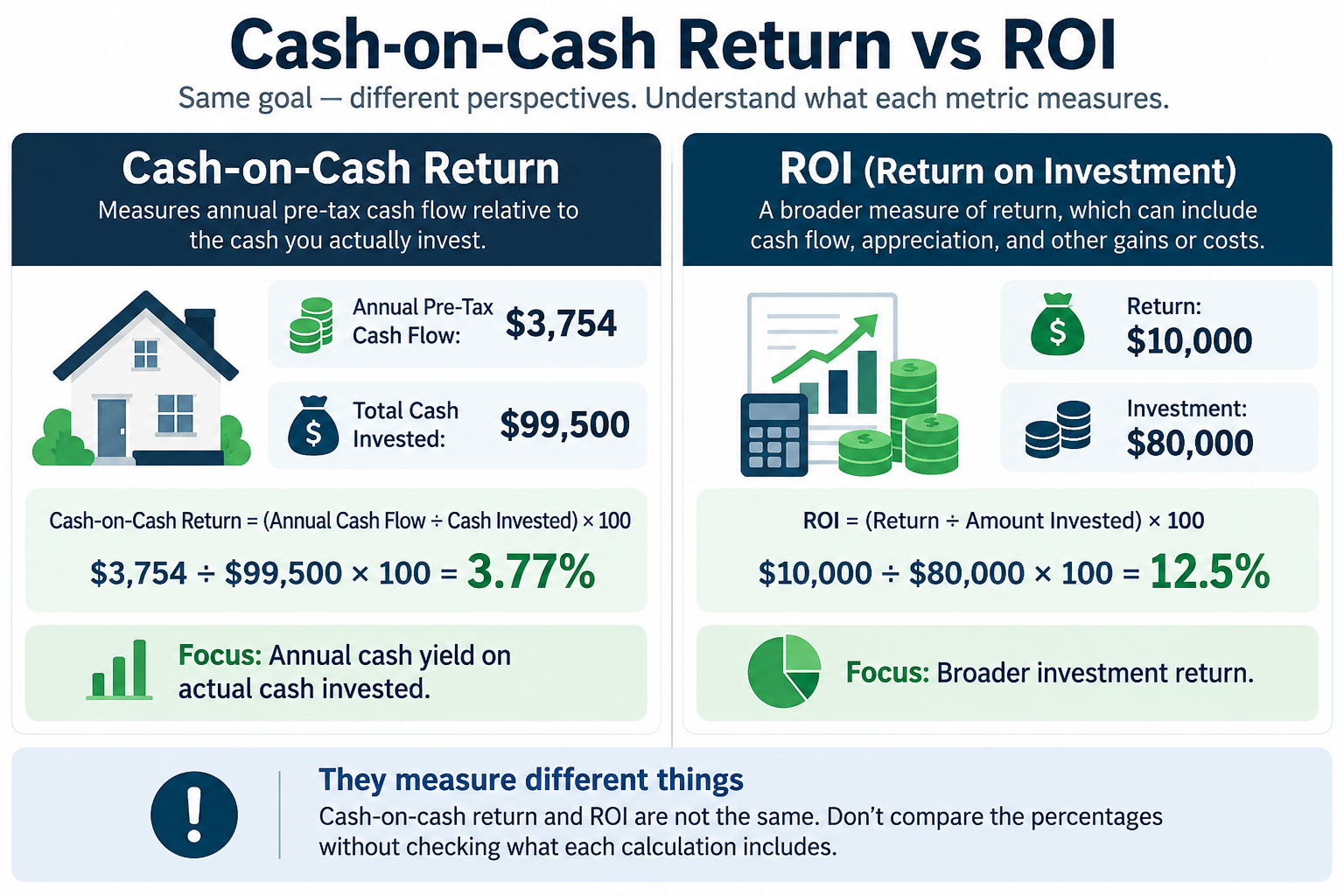
Cash-on-cash return shows how much annual pre-tax cash flow a property produces compared with the amount of cash you have invested in it.
Cash-on-Cash Return = (Annual Pre-Tax Cash Flow ÷ Total Cash Invested) × 100
Cash-on-Cash Return Example
Suppose you invest $99,500 in a rental property. This includes your down payment, closing costs, and initial renovation costs. If the property produces $3,754 in annual pre-tax cash flow:
($3,754 ÷ $99,500) × 100 = 3.77%
The cash-on-cash return in this example is approximately 3.77%. This number describes the relationship between annual pre-tax cash flow and the cash invested; by itself, it does not tell you whether the investment is suitable for you.
What Is ROI in Real Estate?
ROI stands for Return on Investment. It is a broader way of comparing an investment’s return with the amount invested. In real estate, the exact ROI calculation can vary depending on what is included, such as rental cash flow, property appreciation, renovation costs, financing costs, or selling costs.
ROI = (Return ÷ Amount Invested) × 100
Suppose an investor measures a $10,000 return against an $80,000 investment. Using the simplified formula:
($10,000 ÷ $80,000) × 100 = 12.5%
The resulting ROI is 12.5%. However, always check what a particular ROI calculation includes before comparing it with another investment.
Investors should consider both potential return and risk when evaluating an investment rather than relying on a single performance metric.
Cash-on-Cash Return vs ROI: The Main Difference
Cash-on-cash return is focused specifically on annual pre-tax cash flow relative to the cash invested. ROI is broader and can measure different forms of investment return depending on the calculation being used.
Cash-on-Cash Return vs ROI: A Complete Property Example
Consider a rental property purchased for $350,000. The investor uses financing and pays $87,500 as a down payment, $7,000 in closing costs, and $5,000 for initial renovations.
Step 1 — Calculate Total Cash Invested
Down Payment: $87,500
Closing Costs: $7,000
Initial Renovation: $5,000
Total Cash Invested = $99,500
Step 2 — Calculate Annual Cash Flow
Suppose the property generates $23,664 in annual NOI and the annual mortgage debt service is $19,910.Annual Pre-Tax Cash Flow = $23,664 − $19,910 = $3,754
Step 3 — Calculate Cash-on-Cash Return
Cash-on-Cash Return = ($3,754 ÷ $99,500) × 100
Cash-on-Cash Return ≈ 3.77%
This tells us how the property’s annual pre-tax cash flow compares with the investor’s cash invested.
Step 4 — What About ROI?
ROI requires us to define exactly what “return” means. A broader real estate ROI calculation might consider cash flow along with other gains or costs, such as property appreciation, principal paydown, renovation costs, or selling costs.
Because ROI can be calculated in different ways, you should check the assumptions before comparing an ROI percentage with a cash-on-cash return percentage.
When Is Cash-on-Cash Return Useful?
Cash-on-cash return can be useful when evaluating the relationship between a rental property’s annual pre-tax cash flow and the amount of cash invested. It can also help investors compare how different financing structures affect cash yield.
When Is ROI Useful?
ROI can be useful when you want a broader view of investment return. However, the result depends on which gains, expenses, and time period are included, so the calculation method should always be clearly stated.
Common Mistakes When Comparing Cash-on-Cash Return and ROI
Using the terms interchangeably: Cash-on-cash return and ROI do not necessarily measure the same thing.
Ignoring financing: Financing directly affects cash flow and therefore cash-on-cash return.
Using different time periods: Make sure the numbers being compared cover compatible periods.
Ignoring upfront cash costs: Closing costs and initial renovation expenses can increase total cash invested.
Comparing percentages without checking formulas: Two websites may calculate “ROI” differently, so always understand what is included.
Cash-on-Cash Return vs Cap Rate
Cash-on-cash return considers annual pre-tax cash flow relative to the investor’s cash invested, while cap rate compares a property’s NOI with its property value and generally does not include financing.
Cap Rate = (NOI ÷ Property Value) × 100
These metrics answer different questions, so one should not automatically replace the other.
Can Cash-on-Cash Return and ROI Be Different?
Yes. Cash-on-cash return and ROI can produce different percentages because they measure different things. Cash-on-cash return focuses on annual pre-tax cash flow relative to the actual cash invested, while ROI may include a broader range of gains and costs. Financing, appreciation, selling costs, and the time period being measured can all affect the results.
Frequently Asked Questions
Is cash-on-cash return the same as ROI?
No. Cash-on-cash return measures annual pre-tax cash flow relative to cash invested. ROI is a broader measure, and its exact calculation depends on what returns and costs are included.
Does cash-on-cash return include a mortgage?
Financing affects cash-on-cash return because mortgage debt service reduces the property’s pre-tax cash flow. The amount of the down payment also affects the total cash invested.
Is cash-on-cash return the same as cap rate?
No. Cap rate generally compares NOI with property value without considering financing. Cash-on-cash return compares annual pre-tax cash flow with the investor’s actual cash invested.
Can cash-on-cash return be negative?
Yes. If a property’s annual pre-tax cash flow is negative, its cash-on-cash return can also be negative.
Which metric should I use for a rental property?
The metrics answer different questions. Cash-on-cash return can help analyze cash yield, cap rate can help evaluate property income relative to value, and ROI can provide a broader measure depending on how it is defined. Looking at multiple metrics can provide more context than relying on only one number.
Calculate Your Cash-on-Cash Return
Instead of calculating everything manually, use our free Cash-on-Cash Return Calculator to estimate annual cash flow, total cash invested, cash-on-cash return, and other useful property metrics.
Related Real Estate Calculators
Rental Property ROI Calculator
Cap Rate Calculator
Rental Cash Flow Calculator
NOI Calculator
Final Thoughts
Cash-on-cash return and ROI can both provide useful information about a real estate investment, but they should not be treated as identical metrics. Cash-on-cash return focuses on annual pre-tax cash flow relative to cash invested, while ROI can represent a broader measure of investment return. Understanding how each number is calculated makes it easier to interpret property analysis correctly.
Disclaimer: This article and the Realtolic calculators are provided for educational and informational purposes only. They are not financial, investment, tax, or legal advice. Actual property results can vary based on financing, expenses, market conditions, taxes, and other factors.