Cash-on-cash return in real estate is a metric that compares a property’s annual pre-tax cash flow with the amount of cash invested. It can help rental property investors understand the return generated on the cash they actually put into an investment. Unlike cap rate, cash-on-cash return can reflect financing because it uses cash flow after debt service and compares it with the investor’s cash invested.
Unlike cap rate, cash-on-cash return can reflect financing because it uses cash flow after debt service and compares it with the investor’s cash invested. In this guide, we’ll explain the formula and walk through a simple rental property example.
What Is Cash-on-Cash Return in Real Estate?
Cash-on-cash return, sometimes shortened to CoC return, measures annual pre-tax cash flow as a percentage of the total cash invested in a property.
It focuses on the investor’s actual cash investment rather than the property’s full purchase price.
Cash-on-Cash Return Formula
Cash-on-Cash Return = (Annual Pre-Tax Cash Flow ÷ Total Cash Invested) × 100
How to Calculate Cash-on-Cash Return
Step 1 — Calculate Total Cash Invested
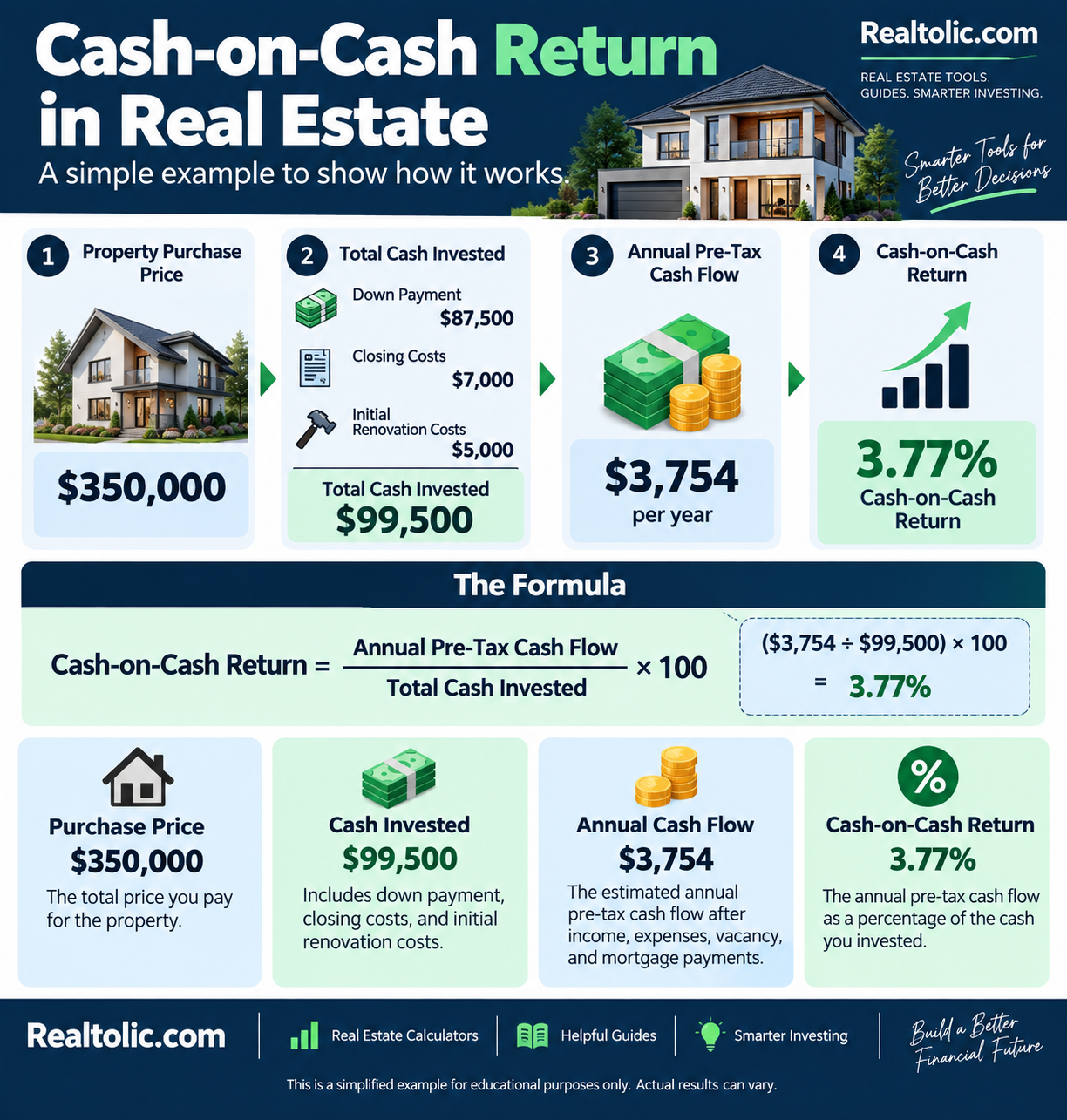
Suppose you buy a $350,000 rental property using financing. Your down payment is $87,500, closing costs are $7,000, and initial renovation costs are $5,000.
$87,500 + $7,000 + $5,000 = $99,500 total cash invested
Step 2 — Calculate Annual Cash Flow
After rental income, operating expenses, vacancy, and mortgage payments are considered, suppose the property produces approximately $3,754 in annual pre-tax cash flow.
Step 3 — Calculate Cash-on-Cash Return
($3,754 ÷ $99,500) × 100 ≈ 3.77% Cash-on-Cash Return.
What Does a 3.77% Cash-on-Cash Return Mean?
In this simplified example, a 3.77% cash-on-cash return means the estimated annual pre-tax cash flow equals about 3.77% of the $99,500 cash invested in the property.
This percentage should not automatically be considered “good” or “bad.” The result should be viewed alongside property risk, location, financing, expenses, vacancy, property condition, and other investment metrics.
Investment returns should be considered alongside risk, financing, property conditions, and other factors rather than relying on a single percentage.
What Is Included in Total Cash Invested?
Total cash invested can include the money you personally put into the property at purchase and before operation begins.
Down Payment: $87,500
Closing Costs: $7,000
Initial Renovation Costs: $5,000
Total Cash Invested: $99,500
Depending on the investment, other upfront cash costs may also need to be considered.
What Is Included in Annual Cash Flow?
Annual pre-tax cash flow generally starts with property income and accounts for vacancy, operating expenses, and financing costs included in the analysis.
Annual Cash Flow = NOI − Annual Debt Service
For this example, estimated annual pre-tax cash flow is $3,754.
Cash-on-Cash Return vs Cap Rate
Cap rate and cash-on-cash return measure different things. Cap rate compares a property’s NOI with its value and generally excludes financing. Cash-on-cash return compares annual pre-tax cash flow with the investor’s cash invested, so financing can affect the result.
Cash-on-Cash Return vs ROI
Cash-on-cash return focuses specifically on annual pre-tax cash flow relative to cash invested. ROI is a broader term, and its calculation can include different types of gains, costs, or changes in property value depending on how ROI is defined.
Complete Cash-on-Cash Return Example
Here is the complete simplified example in one place so you can see how the calculation works from purchase to cash-on-cash return.
Property Purchase Price: $350,000
Down Payment: $87,500
Closing Costs: $7,000
Initial Renovation Costs: $5,000
Total Cash Invested: $99,500
Annual Pre-Tax Cash Flow: $3,754
Cash-on-Cash Return = ($3,754 ÷ $99,500) × 100
Estimated Cash-on-Cash Return = 3.77%
This is a simplified example for learning purposes. Actual cash flow and cash invested can vary depending on the property and financing.
What Can Affect Cash-on-Cash Return?
Rental Income
Changes in rental income can affect annual cash flow and therefore change the cash-on-cash return.
Vacancy
Vacant periods can reduce effective rental income. Using a realistic vacancy assumption can make the calculation more useful.
Operating Expenses
Property taxes, insurance, maintenance, management fees, HOA fees, owner-paid utilities, and other operating costs can reduce cash flow.
Financing
Your down payment, interest rate, loan term, and other financing details can affect both the cash you invest and your mortgage payments. Because of this, financing can significantly change cash-on-cash return.
Upfront Costs
Closing costs, initial renovations, and other cash paid before the property begins operating can increase total cash invested and change the calculated return.
Is a Higher Cash-on-Cash Return Always Better?
A higher cash-on-cash return means more annual pre-tax cash flow relative to the cash invested in the calculation. However, a higher percentage does not automatically mean a property is a better investment.
Property condition, vacancy risk, location, financing, future repairs, tenant demand, and other factors can affect the overall investment. Cash-on-cash return is best considered alongside other property information and metrics.
How Can Cash-on-Cash Return Change?
Cash-on-cash return can change when rental income, operating expenses, mortgage payments, or the amount of cash invested changes. For example, higher expenses can reduce annual cash flow, while different financing can change both the mortgage payment and upfront cash required.
Frequently Asked Questions
Does cash-on-cash return include mortgage payments?
Cash-on-cash return generally uses pre-tax cash flow after debt service, so mortgage payments can affect the calculation when a property is financed.
Is cash-on-cash return the same as cap rate?
No. Cap rate generally compares NOI with property value before financing, while cash-on-cash return compares annual pre-tax cash flow with the investor’s cash invested.
Is cash-on-cash return the same as ROI?
No. Cash-on-cash return focuses on annual pre-tax cash flow relative to cash invested. ROI is a broader measure and can be calculated differently depending on which gains and costs are included.
Can cash-on-cash return be negative?
Yes. If the property’s annual pre-tax cash flow is negative, its calculated cash-on-cash return will also be negative.
Calculate Your Cash-on-Cash Return
Instead of calculating everything manually, use Realtolic’s free Cash-on-Cash Return Calculator to enter your property numbers and estimate annual cash flow, total cash invested, and cash-on-cash return.
Final Thoughts
Cash-on-cash return can help you understand how annual pre-tax cash flow compares with the cash invested in a rental property. It can be useful when analyzing financing, but it should not be considered alone. NOI, cash flow, cap rate, ROI, property condition, and other factors can provide additional context.
Important Note: This article is for general educational purposes only. Examples are simplified, and actual rental income, expenses, financing costs, taxes, property values, and investment results can vary. This is not financial, investment, tax, or legal advice.