Cap rate vs ROI is a common comparison when analyzing rental property performance, but these two real estate metrics measure different things.. Cap rate focuses on property income compared with property value, while ROI is a broader measure of return.
Understanding the difference can help you use each metric correctly when analyzing a rental property. In this guide, we’ll compare cap rate and ROI using simple formulas and examples.
What Is Cap Rate?
Cap rate, or capitalization rate, compares a property’s annual Net Operating Income (NOI) with its value or purchase price.
Cap Rate = (Net Operating Income ÷ Property Value) × 100
Cap rate generally does not include mortgage principal and interest payments, so it can help compare the operating performance of properties without focusing on how each property is financed.
Simple Cap Rate Example
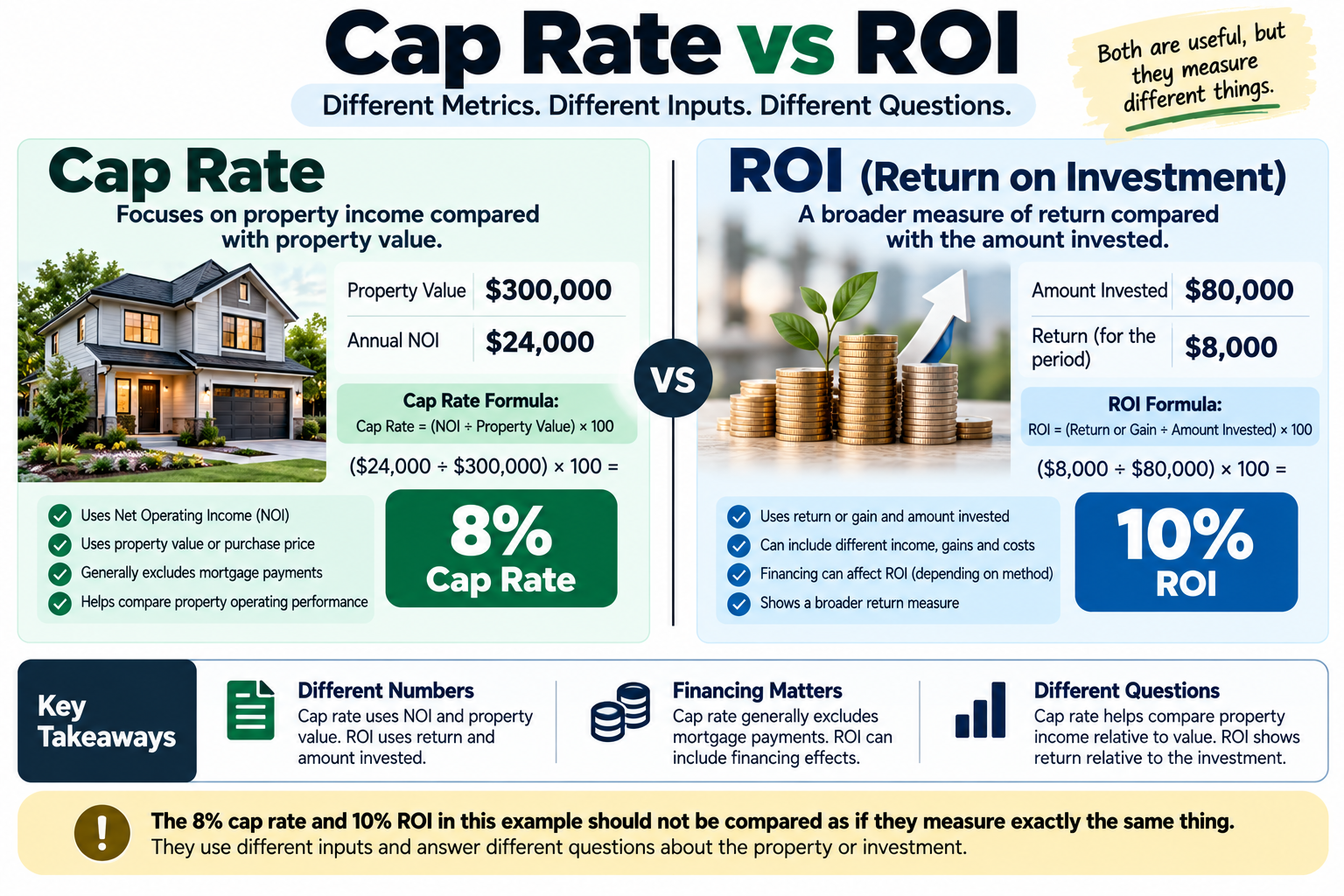
Suppose a rental property is worth $300,000 and produces $24,000 in annual NOI.
($24,000 ÷ $300,000) × 100 = 8% cap rate
Based on these simplified numbers, the property’s estimated cap rate is 8%.
What Is ROI in Real Estate?
ROI stands for Return on Investment. It is a broader way of comparing a return or gain with the amount invested. However, ROI can be calculated in different ways depending on which income, expenses, gains, and costs are included.
ROI = (Return or Gain ÷ Amount Invested) × 100
Simple ROI Example
Suppose $80,000 of cash was invested in a rental property and the return being measured for the period is $8,000. Using this simplified ROI calculation:
($8,000 ÷ $80,000) × 100 = 10% ROI
This example is for explaining the formula. The actual ROI calculation can differ depending on what is included in the return and investment amount.
Cap Rate vs ROI
Cap rate and ROI can both describe property performance, but they answer different questions. Cap rate focuses on property operations and value, while ROI focuses more broadly on the return compared with the investment being measured.
1. They Use Different Numbers
Cap rate uses Net Operating Income and property value. ROI uses the return or gain and the amount invested, depending on the ROI method being used.
2. Financing Affects Them Differently
Cap rate generally excludes mortgage principal and interest because NOI is calculated before financing costs. Some ROI calculations can include financing-related effects, depending on how return and investment are defined.
3. They Answer Different Questions
Cap rate can help compare the operating income of properties relative to their values. ROI can provide a broader view of how much return is being generated relative to the investment being measured.
Cap Rate vs ROI ExampleThis is a title
Suppose a rental property has a value of $300,000 and produces $24,000 in annual NOI. Its estimated cap rate would be:
($24,000 ÷ $300,000) × 100 = 8% cap rate
Now suppose the investor has $80,000 invested, and the return being measured for the period is $8,000.
($8,000 ÷ $80,000) × 100 = 10% ROI
The 8% cap rate and 10% ROI should not be compared as if they measure exactly the same thing. They use different inputs and answer different questions about the property or investment.
When Is Cap Rate Useful?
Cap rate can be useful when comparing the operating income of rental properties relative to their values, especially when you want to examine property performance separately from financing.
When Is ROI Useful?
ROI can be useful when evaluating a broader return relative to the amount invested. Because ROI can be defined in different ways, make sure you understand which income, gains, expenses, and investment costs are included before comparing ROI figures.
Should You Use Cap Rate or ROI?
You do not necessarily need to choose only one metric. Cap rate and ROI measure different parts of property performance, so they can be used together when reviewing a rental property.
Cap rate can help you understand the property’s operating income relative to its value, while ROI can help you examine a broader return relative to the investment being measured.
When comparing cap rate vs ROI, remember that each metric measures a different part of rental property performance.
Cap Rate vs Cash-on-Cash Return
Cash-on-cash return is another useful metric. It compares annual pre-tax cash flow with the amount of cash invested in the property. Unlike cap rate, financing can directly affect cash-on-cash return because mortgage payments affect cash flow.
Calculate Cap Rate and ROI
Instead of calculating everything manually, you can use Realtolic’s free real estate calculators to estimate these metrics using your own property numbers.
Common Mistakes When Comparing Cap Rate and ROI
Treating Them as the Same Metric
An 8% cap rate and an 8% ROI do not necessarily mean the same thing. The calculations use different inputs and measure different aspects of an investment.
Ignoring What Is Included in ROI
ROI calculations can vary. Before comparing ROI figures, check which income, costs, gains, and investment amounts were included.
Including Mortgage Payments in NOI
Mortgage principal and interest are generally not operating expenses when calculating NOI for cap rate. Mixing financing costs into NOI can produce an inconsistent cap rate calculation.
Looking at Only One Metric
A single percentage cannot describe every part of a rental property. Income, expenses, vacancy, financing, property condition, cash flow, and other relevant factors can provide additional context.
Frequently Asked Questions
Is cap rate the same as ROI?
No. Cap rate compares a property’s Net Operating Income with its value, while ROI compares a return or gain with the amount invested. They use different inputs and measure different things.
Does cap rate include mortgage payments?
Generally, no. Cap rate uses NOI, which is normally calculated before mortgage principal and interest payments. This helps separate property operating performance from financing.
Can ROI include financing?
It can, depending on how ROI is defined and calculated. Different ROI methods may include different income, costs, gains, and financing effects, so it is important to understand the assumptions behind the percentage.
Which is better for comparing rental properties?
Cap rate can help compare property operating income relative to property value, while ROI can provide a broader view of return relative to the investment being measured. Using multiple metrics can provide more context than relying on only one percentage.
Final Thoughts
Cap rate and ROI are both useful real estate metrics, but they should not be treated as the same measurement. Cap rate focuses on NOI relative to property value, while ROI measures a broader return relative to an investment. Understanding the calculation behind each number can make property comparisons clearer.
Important Note
This guide and Realtolic calculators are for general educational and estimation purposes only. Results depend on the information, definitions, and assumptions used and are not financial, investment, tax, or legal advice.