
Rental property vacancy can reduce the income a landlord receives, even when the property’s regular expenses continue. If a rental home stays empty between tenants, the owner may still need to pay property taxes, insurance, maintenance costs, and mortgage payments.
Understanding how vacancy affects rental property cash flow helps landlords create more realistic income estimates. This guide explains vacancy loss, shows a simple calculation, and describes why even a short period without rent can change a property’s financial results.
What Is Vacancy Loss in Rental Property?
Vacancy loss is the rental income a property does not collect because it is unoccupied or unavailable to rent. For example, a home that could rent for $2,000 per month but remains vacant for one month may lose $2,000 in scheduled rental income during that period.
Vacancy is different from an operating expense such as insurance or repairs. It reduces the rental income collected, while operating expenses reduce the income remaining after those costs are paid. Both can affect a landlord’s financial results.
Why Vacancy Matters for Rental Property Cash Flow
Cash flow depends on the income a property receives and the costs required to operate and finance it. When rent stops during a vacancy, some expenses may continue. This can reduce monthly cash flow or create a negative cash flow period.
Vacancy can also affect annual results. A property may generate positive cash flow during occupied months but earn considerably less over the full year if it experiences an extended vacancy.
How Vacancy Affects Rental Property Cash Flow
Vacancy reduces the rental income available to cover property expenses and mortgage payments. To understand the impact, compare estimated cash flow with and without vacancy while keeping the other costs the same.
Cash Flow Example Without Vacancy
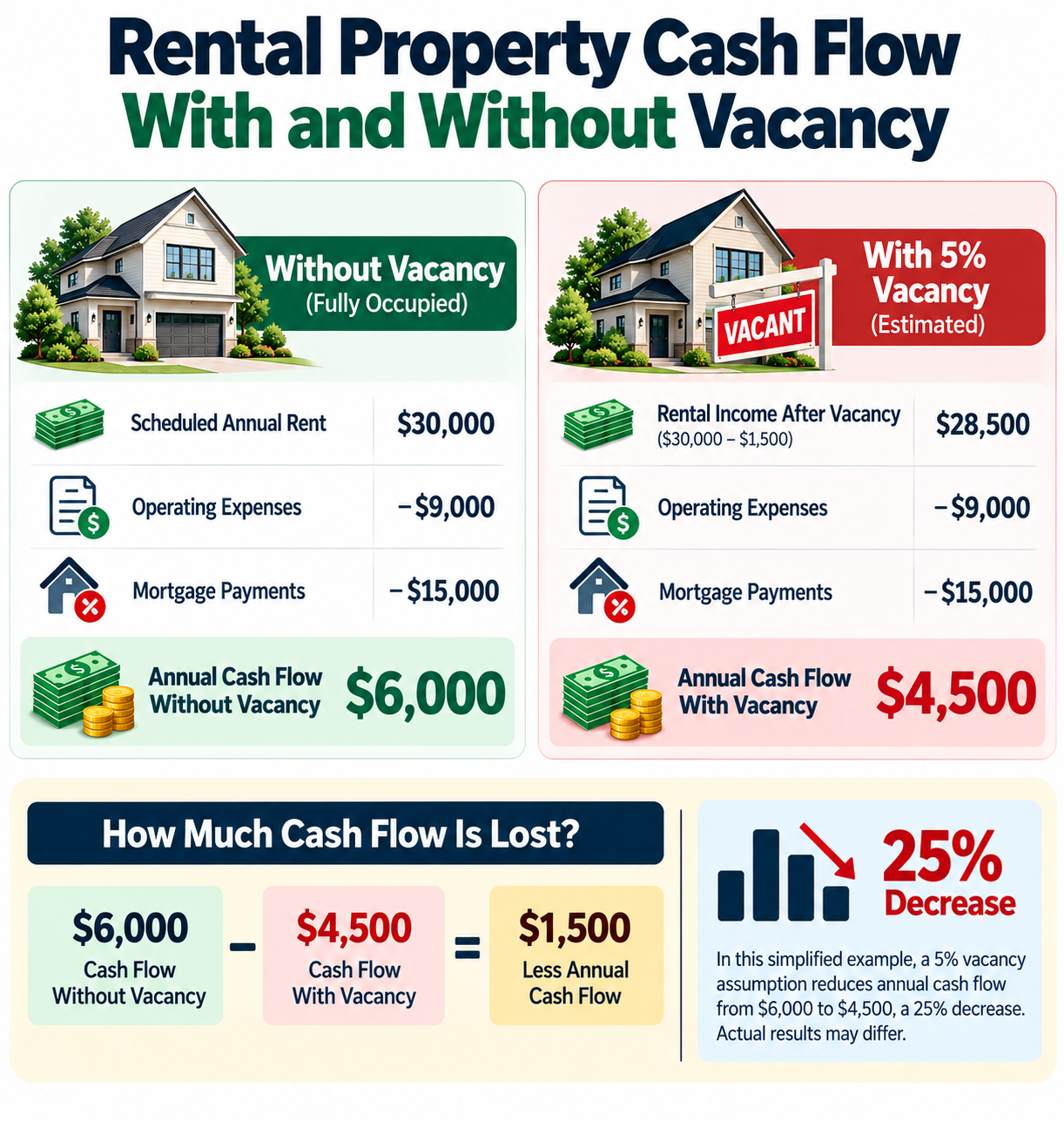
Suppose a rental property has $30,000 in scheduled annual rent, $9,000 in annual operating expenses, and $15,000 in annual mortgage payments.
Scheduled Annual Rent: $30,000
Operating Expenses: −$9,000
Mortgage Payments: −$15,000
Annual Cash Flow Without Vacancy = $6,000
Now apply the $1,500 estimated vacancy loss from our earlier example. The property receives $28,500 in estimated annual rental income instead of $30,000.
Rental Income After Vacancy: $28,500
Operating Expenses: −$9,000
Mortgage Payments: −$15,000
Annual Cash Flow With Vacancy = $4,500
How Much Cash Flow Is Lost?
$6,000 − $4,500 = $1,500 Less Annual Cash Flow
In this simplified example, a 5% vacancy assumption reduces annual cash flow from $6,000 to $4,500, a 25% decrease. The example assumes operating expenses and mortgage payments remain unchanged. Actual results may differ.
Why Vacancy Can Be More Expensive Than Lost Rent
A vacant property may also create additional costs, such as advertising, cleaning, tenant turnover repairs, and leasing fees. Some operating expenses and mortgage payments may continue even when no rent is collected. These extra costs can make the total financial impact of vacancy greater than the lost rental income alone.
How to Plan for Vacancy in a Rental Property
Vacancy is difficult to predict exactly, but landlords can include an estimated vacancy allowance when planning rental income and expenses. This helps avoid assuming that a property will collect rent every month of the year.
1. Research Local Rental Demand
Look at rental listings, typical marketing periods, and local rental market conditions. Vacancy can differ between neighborhoods, property types, and seasons, so a single estimate may not fit every property.
Local rental market conditions can vary, so landlords can also review official housing vacancy data when researching broader market trends.
2. Include a Vacancy Allowance
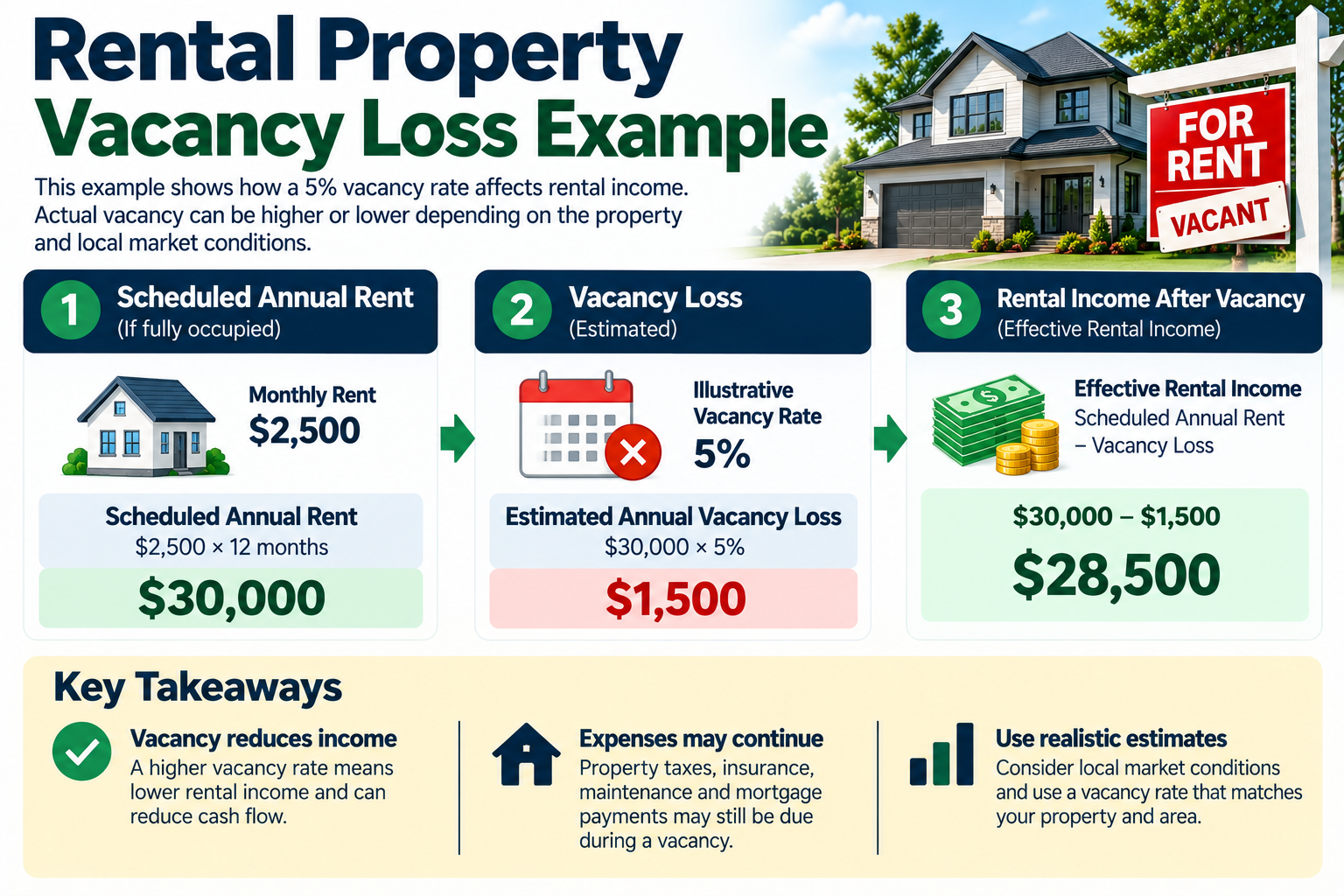
Estimate potential vacancy loss before calculating rental property cash flow. For example, using an illustrative 5% vacancy allowance on $30,000 in scheduled annual rent produces $1,500 in estimated lost income. This percentage is only an example, not a recommended rate for every property.
3. Prepare for Tenant Turnover
When one tenant leaves, the property may need cleaning, repairs, advertising, or other preparation before a new tenant moves in. Budget for these possible costs separately from lost rent.
4. Maintain an Emergency Reserve
Keeping money available for unexpected expenses and periods without rent may help landlords manage ongoing property costs. The appropriate reserve amount depends on the property, financing, and owner’s circumstances.
Vacancy Rate vs Vacancy Loss
Vacancy rate expresses the amount of vacancy as a percentage. Vacancy loss expresses the estimated rental income lost because of vacancy. Both measures can help landlords understand how empty rental periods affect property income.
For example, a 5% vacancy rate applied to $30,000 in scheduled annual rent produces $1,500 in estimated vacancy loss. The percentage and dollar amount describe different parts of the same calculation.
How to Estimate Cash Flow With Vacancy
Start with scheduled rental income, subtract estimated vacancy loss, then subtract operating expenses and mortgage payments. In a simplified analysis, the amount remaining is estimated cash flow before other relevant cash outflows.
Estimated Cash Flow = Scheduled Rental Income − Vacancy Loss − Operating Expenses − Mortgage Payments
Try our free Rental Cash Flow Calculator to estimate income, expenses, and financing costs.
Frequently Asked Questions About Rental Property Vacancy
Does vacancy affect rental property cash flow?
Yes. Vacancy reduces collected rental income while expenses such as insurance, property taxes, and mortgage payments may continue. This can reduce cash flow or result in negative cash flow.
Is a 5% vacancy rate good for every rental property?
A 5% vacancy rate is only an illustrative assumption in this guide. Actual vacancy depends on the property, location, rental demand, and other market conditions.
Is vacancy loss an operating expense?
Vacancy loss is generally treated as a reduction in potential rental income rather than a separate operating expense. It reduces effective rental income before operating expenses are deducted.
Can a rental property have negative cash flow during vacancy?
Yes. If rent collected is not enough to cover operating expenses and mortgage payments, the property may have negative cash flow during a vacant period.
Final Thoughts
Rental property vacancy can affect more than the rent collected during an empty period. It can reduce annual income, lower cash flow, and create additional tenant turnover costs.
When evaluating a rental property, use a realistic vacancy estimate based on local conditions and include possible ongoing expenses. Compare results with and without vacancy to better understand the property’s financial sensitivity.
For more details about calculating vacancy percentages, read our Rental Property Vacancy Rate guide.
Disclaimer: This article is for general educational purposes only. The examples use simplified assumptions. Actual vacancy, expenses, financing costs, and cash flow can vary by property and location.