
Vacancy rate shows the percentage of time a rental property is unoccupied during a specific period. It can help landlords and property investors estimate how vacancy may affect rental income, NOI, cash flow, and other property calculations.
Even if a property has strong scheduled rent, periods without a paying tenant can reduce the income actually collected. That is why vacancy should be considered when analyzing a rental property.
What Is Vacancy Rate in Real Estate?
Vacancy rate measures how much of a rental property’s available rental time is vacant. It is usually expressed as a percentage.
How to Calculate Rental Property Vacancy Rate
Vacancy Rate = (Vacant Time ÷ Total Available Rental Time) × 100
Simple Vacancy Rate Example
Suppose a rental property is available to rent for 12 months during the year but remains vacant for 1 month.
(1 ÷ 12) × 100 = 8.33% vacancy rate
In this illustrative example, the property was vacant for about 8.33% of the year. This does not mean 8.33% is a normal or recommended vacancy rate—actual vacancy can vary by property and market.
How Vacancy Affects Rental Income
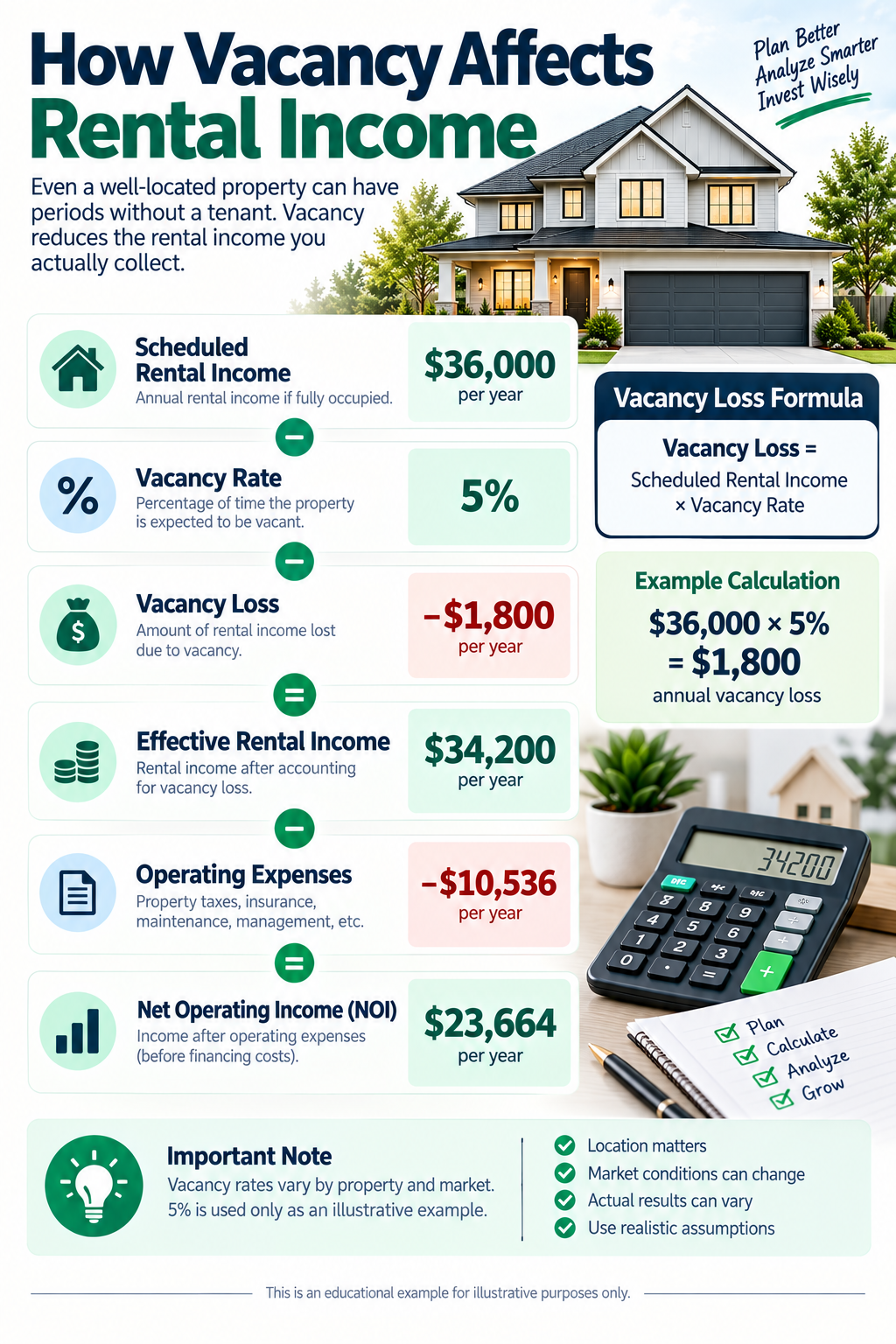
Vacancy can reduce the rental income a property actually produces. One simple way to estimate this effect is to calculate vacancy loss.
Vacancy Loss = Scheduled Rental Income × Vacancy Rate
Vacancy Loss Example
Suppose a rental property could generate $3,000 per month when fully occupied.
Scheduled Annual Rental Income = $3,000 × 12 = $36,000
If we use a 5% vacancy assumption for this illustrative example
Vacancy Loss = $36,000 × 5% = $1,800
Effective Rental Income = $36,000 − $1,800 = $34,200
This means the example uses $34,200 as estimated effective rental income after accounting for the 5% vacancy assumption.
How Vacancy Affects NOI
Because vacancy can reduce effective rental income, it can also reduce Net Operating Income (NOI) when other factors remain unchanged.
Effective Rental Income: $34,200 → Operating Expenses: $10,536 → NOI: $23,664
$34,200 − $10,536 = $23,664 NOI
How Vacancy Affects Rental Property Cash Flow
Lower effective rental income can also reduce cash flow when expenses and financing costs remain the same. This is why using a realistic vacancy assumption can be important when estimating rental property performance.
Vacancy assumptions should not be treated as universal. Actual vacancy can vary based on location, rental demand, property type, condition, rent level, tenant turnover, and other market factors.
Vacancy Rate vs Occupancy Rate
Vacancy rate measures the percentage of available rental time that is vacant, while occupancy rate measures the percentage that is occupied. In a simplified calculation, the two percentages add up to 100%. For example, an 8% vacancy rate corresponds to a 92% occupancy rate.
What Causes Rental Property Vacancy?
Rental properties can become vacant for many reasons. Some vacancies happen during normal tenant turnover, while others may be affected by the property, rent, location, or local rental market.
Tenant Turnover
“A property may remain vacant between the time one tenant moves out and another tenant moves in.
Rental Price
The asking rent can affect tenant demand. Rental pricing should be considered alongside the property’s location, condition, features, and local market.
Property Condition
Properties that need repairs, cleaning, or improvements may take longer to prepare or rent to a new tenant.
Local Rental Demand
Vacancy can vary between cities, neighborhoods, property types, and different periods of the year. Local market conditions can therefore affect actual vacancy.
For broader U.S. housing vacancy data, the U.S. Census Bureau publishes regularly updated Housing Vacancy Survey information.
How Can Vacancy Affect Rental Property Analysis?
Vacancy can affect several rental property calculations because it reduces effective rental income. Lower effective income can result in lower NOI and may also affect cash flow, cap rate, DSCR, cash-on-cash return, and ROI calculations.
Should You Use a Fixed Vacancy Rate?
There is no single vacancy percentage that is correct for every rental property. When possible, use information relevant to the specific property and local rental market rather than assuming the same vacancy rate everywhere.
Calculate Your Rental Property Numbers
Use Realtolic’s calculators to see how vacancy, rental income, expenses, and financing can affect your property estimates.
Rental ROI Calculator
NOI Calculator
Rental Cash Flow Calculator
Cap Rate Calculator
Frequently Asked Questions
What is a vacancy rate in rental property?
Vacancy rate is the percentage of available rental time that a property is unoccupied during a specific period.
How do you calculate rental property vacancy rate?
A simple formula is: Vacancy Rate = (Vacant Time ÷ Total Available Rental Time) × 100. For example, if a property is vacant for 1 month out of 12 months, the vacancy rate is about 8.33%.
What is vacancy loss?
Vacancy loss is the estimated rental income not collected because the property is vacant. A simplified formula is: Vacancy Loss = Scheduled Rental Income × Vacancy Rate.
What is the difference between vacancy rate and occupancy rate?
Vacancy rate measures the percentage of available rental time that is vacant, while occupancy rate measures the percentage that is occupied. In a simplified calculation, they add up to 100%.
What is a good vacancy rate for a rental property?
There is no single vacancy rate that is good for every rental property. Vacancy can vary by location, property type, rental demand, rent level, condition, tenant turnover, and market conditions. Property-specific and local market information is more useful than relying on one universal percentage.
Does vacancy affect NOI?
Yes. Vacancy can reduce effective rental income. If other expenses remain unchanged, lower effective rental income can result in lower Net Operating Income (NOI).
Does vacancy affect rental property cash flow?
Yes. If vacancy reduces rental income while expenses and financing costs remain the same, estimated rental property cash flow can also decrease.
Final Thoughts
Vacancy is an important part of rental property analysis because a property may not remain occupied every day of the year. Accounting for vacancy can help create more realistic estimates of effective rental income, NOI, cash flow, and other property metrics.
Instead of assuming the same vacancy percentage for every property, consider the specific property, tenant turnover, rent level, location, and local rental market whenever reliable information is available.
Disclaimer: This article and Realtolic calculators are for educational and informational purposes only. Examples and results are estimates and are not financial, investment, lending, tax, accounting, or legal advice. Actual vacancy, rental income, expenses, and market conditions can vary.