
A good DSCR for rental property financing is not one universal number. DSCR shows how a property’s Net Operating Income (NOI) compares with its debt service.
A higher ratio means more NOI is available relative to the debt payments used in the calculation, but lender requirements can vary by loan program, property type, borrower, and underwriting method.
Investors and lenders can use DSCR when analyzing rental property financing, but the required ratio can vary by lender, loan program, property type, borrower, and underwriting method. For that reason, a DSCR should be understood in context rather than treated as a universal pass-or-fail number.
What Does DSCR Measure?
DSCR stands for Debt Service Coverage Ratio. It measures the relationship between a property’s Net Operating Income and its required debt service for the same period.
DSCR Formula
DSCR = Net Operating Income (NOI) ÷ Total Debt Service
For example, if a rental property produces $30,000 in annual NOI and has $24,000 in annual debt service:
$30,000 ÷ $24,000 = 1.25 DSCR
This means the property’s NOI is 1.25 times its annual debt service in this example.
What Do Different DSCR Numbers Mean?
DSCR Below 1.00
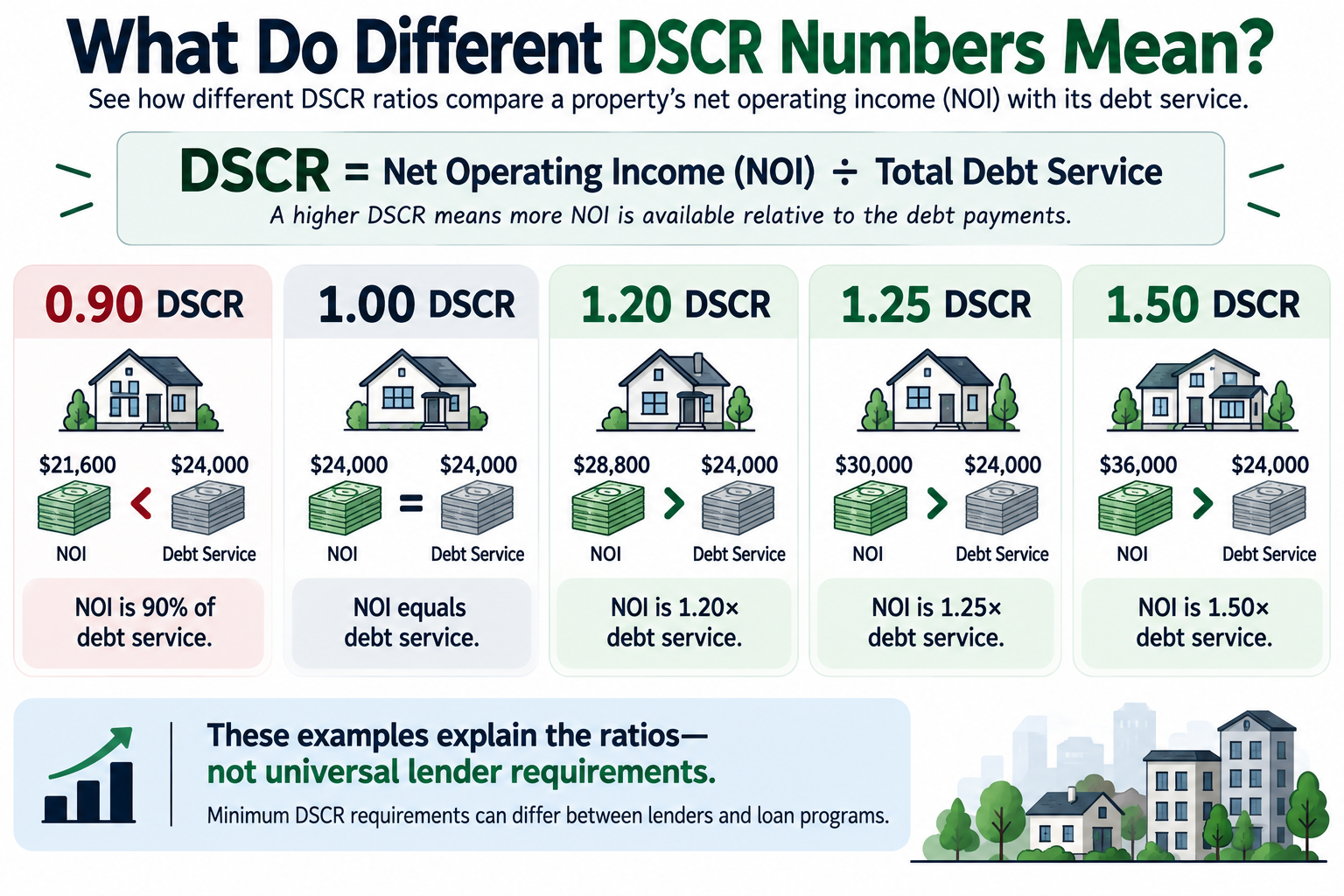
A DSCR below 1.00 means the property’s NOI is less than the debt service used in the calculation. For example, a 0.90 DSCR means NOI equals 90% of that debt service.
DSCR of 1.00
A 1.00 DSCR means NOI and debt service are equal. For example, $24,000 of NOI divided by $24,000 of debt service equals 1.00.
DSCR of 1.20
A 1.20 DSCR means NOI is 1.20 times the debt service. For example, $28,800 of NOI divided by $24,000 of debt service equals 1.20.
DSCR of 1.25
A 1.25 DSCR means NOI is 1.25 times the debt service. For example, $30,000 of NOI divided by $24,000 of debt service equals 1.25.
DSCR of 1.50
A 1.50 DSCR means NOI is 1.50 times the debt service. For example, $36,000 of NOI divided by $24,000 of debt service equals 1.50.
Important: These examples explain what the ratios mathematically represent. They are not universal lending requirements. Minimum DSCR requirements can differ between lenders and loan programs.
So, What Is a Good DSCR for a Rental Property?
There is no single DSCR that is “good” for every rental property or every loan. In general, a higher DSCR means the property has more Net Operating Income relative to its debt service. However, the DSCR required for financing can vary by lender, loan program, property type, and underwriting rules.
For example, a property with a 1.25 DSCR has NOI equal to 1.25 times its debt service. That mathematical relationship does not automatically mean the property will qualify for a particular loan.
Why Do Lenders Look at DSCR?
DSCR gives lenders a way to compare a property’s operating income with its debt obligations. A larger gap between NOI and debt service provides more income coverage in the calculation, while a lower ratio provides less coverage.
Lending guidelines can use property income and debt obligations differently depending on the loan type and underwriting requirements.
How to Improve a Rental Property’s DSCR
Increase Effective Rental Income
Higher collected rental income can increase NOI if other factors remain the same. Changes should be based on realistic market rents and occupancy assumptions.
Reduce Vacancy
Reducing vacancy can increase effective rental income, which may improve NOI and therefore DSCR.
Control Operating Expenses
Reviewing expenses such as maintenance, insurance, property management, utilities paid by the owner, and other operating costs may help improve NOI when legitimate savings are available.
Change the Financing Structure
Because debt service is part of the DSCR formula, changes to the loan amount, interest rate, amortization period, or other financing terms can change the calculated DSCR.
DSCR Example With a Rental Property
Imagine a rental property has $36,000 in scheduled annual rent. After accounting for vacancy and operating expenses, the property produces $30,000 in annual NOI.
If annual debt service is $24,000:
DSCR = $30,000 ÷ $24,000 = 1.25
The property’s NOI is therefore 1.25 times its annual debt service in this example.
DSCR vs Cash Flow
DSCR and cash flow are related but are not the same measurement. DSCR is a ratio comparing NOI with debt service. Cash flow is generally expressed as the amount of money remaining after the expenses and financing payments included in the calculation.
DSCR vs Cap Rate
DSCR includes the relationship between property income and financing payments. Cap rate instead compares a property’s NOI with its value and generally does not include financing.
Cap Rate = (NOI ÷ Property Value) × 100
Calculate Your Rental Property DSCR
Use the free Realtolic DSCR Calculator to enter your property income, operating expenses, and financing information and estimate the property’s DSCR.
Common Mistakes When Evaluating DSCR
Using gross rent instead of NOI: DSCR generally compares Net Operating Income with debt service, not scheduled gross rent.
Mixing monthly and annual numbers: Keep NOI and debt service on the same time period.
Underestimating vacancy or expenses: Unrealistic assumptions can make NOI—and therefore DSCR—look stronger than the actual property numbers support.
Treating one DSCR number as universal: Financing requirements can vary between lenders, loan programs, and properties.
Looking only at DSCR: DSCR provides useful information, but it does not replace analysis of cash flow, expenses, financing, property condition, and other factors.
Frequently Asked Questions
What is considered a good DSCR for rental property?
There is no single DSCR that is appropriate for every rental property or financing situation. A higher DSCR means more NOI is available relative to debt service, but lender requirements can vary.
What does a 1.25 DSCR mean?
A 1.25 DSCR means the property’s NOI is 1.25 times its debt service for the period being measured. For example, $30,000 of NOI divided by $24,000 of debt service equals 1.25.
What does a DSCR below 1.00 mean?
A DSCR below 1.00 means the property’s NOI is less than its debt service in the calculation. For example, $21,600 of NOI divided by $24,000 of debt service equals 0.90.
Is a higher DSCR always better?
A higher DSCR means greater income coverage relative to debt service mathematically. However, DSCR alone does not determine whether a property is a suitable investment or whether a lender will approve financing.
Can rental income increase DSCR?
If higher collected rental income increases NOI while debt service remains unchanged, the calculated DSCR can increase. Vacancy and operating expenses also affect NOI.
Does the interest rate affect DSCR?
It can. A change in interest rate can change required debt payments, which can change debt service and therefore the calculated DSCR.
Related Real Estate Calculators
DSCR Calculator
NOI Calculator
Rental Cash Flow Calculator
Cap Rate Calculator
Cash-on-Cash Return Calculator
Final Thoughts
A “good” DSCR cannot be reduced to one number that works for every rental property. The ratio simply shows how a property’s NOI compares with its debt service. Understanding that relationship—and using realistic income, expense, and financing assumptions—can make DSCR more useful when analyzing a rental property.
Disclaimer: This article and Realtolic calculators are for educational and informational purposes only. They are not financial, investment, lending, tax, or legal advice. Lending requirements and calculation methods can vary by lender and loan program.