Good cash flow on rental property investments is not one fixed dollar amount that works for every property. A useful cash flow depends on the property’s rent, expenses, financing, location, condition, vacancy risk, and the amount of money invested. Instead of looking for one perfect monthly cash flow number, it is better to understand how the cash flow was calculated and whether the income and expense assumptions are realistic.
Instead of looking for one perfect monthly cash flow number, it is better to understand how the cash flow was calculated and whether the income and expense assumptions are realistic.
What Does Positive Cash Flow Mean?
Positive cash flow means a rental property brings in more money than the costs included in your calculation. For example, if a property collects $2,500 per month and the included expenses and mortgage payments total $2,200, the estimated monthly cash flow is $300.
$2,500 − $2,200 = $300 monthly cash flow
What Is Considered Good Cash Flow on Rental Property Investments?
There is no universal monthly cash flow amount that makes every rental property a good investment. A $200 monthly cash flow may have a different meaning on a lower-cost property than on a much more expensive property.
Investors may also have different goals, financing costs, repair expectations, and risk tolerance. This is why cash flow should be evaluated together with the property’s purchase price, cash invested, expenses, vacancy assumptions, and other return measures.
Why Higher Cash Flow Is Not Always Better
A larger projected cash flow can look attractive, but the estimate is only as useful as the numbers behind it. Unrealistically high rent, very low repair costs, or ignoring vacancy can make projected cash flow look stronger than it may actually be.
Two properties can also produce similar monthly cash flow while requiring very different amounts of cash to purchase. Looking at cash-on-cash return can help compare cash flow with the amount of cash invested.
Potential returns should be evaluated together with investment risk rather than relying on one projected cash flow number alone.
Simple Rental Property Cash Flow Example
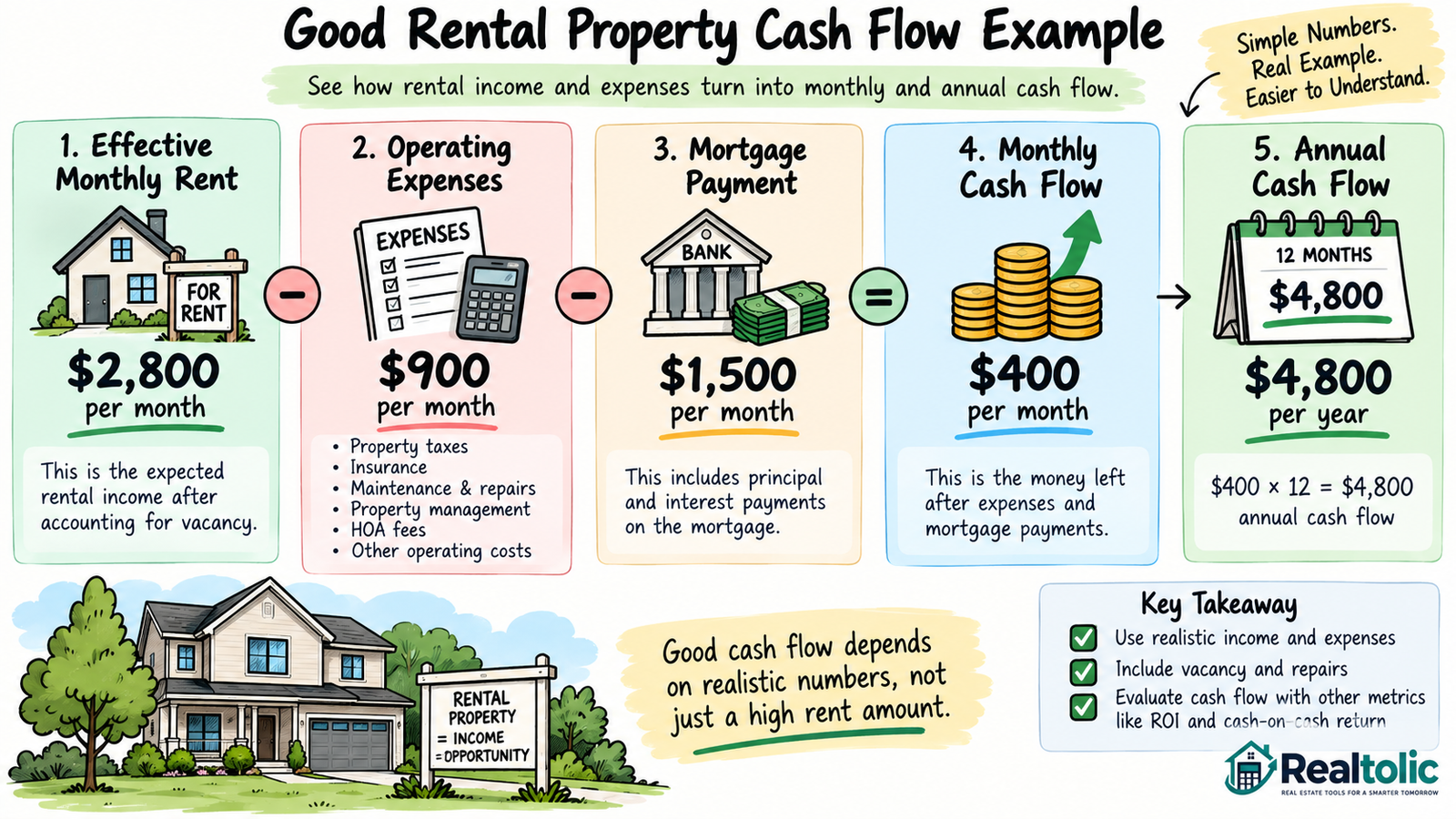
Suppose a rental property produces $2,800 in effective monthly rental income after accounting for vacancy. Operating expenses are $900 per month and the mortgage payment is $1,500 per month. Estimated cash flow would be $400 per month, or $4,800 per year.
$2,800 − $900 − $1,500 = $400 monthly cash flow
$400 × 12 = $4,800 annual cash flow
In this simplified example, the property produces positive cash flow. However, the result depends on the income, expenses, vacancy, and financing assumptions used.
What Factors Affect Rental Property Cash Flow?
Rental Income
Higher rent can increase cash flow, but use a realistic market rent instead of assuming the highest possible amount.
Vacancy
Empty periods reduce the rent collected. Including a reasonable vacancy estimate can help make the cash flow projection more realistic.
Operating Expenses
Property taxes, insurance, maintenance, repairs, management fees, HOA fees, and owner-paid utilities can all reduce cash flow.
Mortgage and Financing
The down payment, interest rate, loan term, and mortgage payment can significantly affect the amount of cash left each month.
Repairs and Property Condition
A property that needs frequent repairs may produce less cash flow than expected. Larger future replacements, such as a roof or HVAC system, may also affect the property’s overall financial performance.
How to Evaluate Rental Property Cash Flow
Instead of judging a rental property by one monthly cash flow number, look at the income, expenses, financing, vacancy assumptions, property condition, and amount of cash invested.
A positive cash flow can be useful, but it should be considered together with other property metrics to understand the numbers more clearly.
Cash Flow vs Cash-on-Cash Return
Cash flow shows the estimated dollar amount left after the costs included in your calculation. Cash-on-cash return compares annual pre-tax cash flow with the amount of cash invested in the property.
Cash Flow vs ROI
Cash flow focuses on money remaining over a period, such as each month or year. ROI is a broader return measure, and the exact calculation can vary depending on which gains and costs are included.
Cash Flow vs Cap Rate
Cap rate compares a property’s net operating income with its value or purchase price and generally does not include mortgage financing. Cash flow can include mortgage payments, so financing can significantly change the result.
Calculate Your Rental Property Cash Flow
Want to check your own property numbers? Use our free Rental Cash Flow Calculator to estimate rental income, operating expenses, NOI, mortgage payments, monthly cash flow, and annual cash flow.
For a broader rental-property analysis, you can also use our Rental Property ROI Calculator to compare cash flow with other return estimates.
Frequently Asked Questions
What is a good monthly cash flow for a rental property?
There is no single monthly cash flow amount that is good for every rental property. The result should be considered together with the property’s price, expenses, financing, cash invested, condition, vacancy risk, and investment goals.
Is $300 a month good cash flow for a rental property?
$300 per month means $3,600 in estimated annual cash flow, but that number alone does not show whether a property fits an investor’s goals. Consider how much cash was invested and whether realistic expenses, repairs, and vacancy were included.
Can a rental property have negative cash flow?
Yes. Negative cash flow occurs when the costs included in the calculation are greater than the rental income. For example, $2,500 of income and $2,700 of included monthly costs would produce an estimated cash flow of −$200 per month.
How can I calculate rental property cash flow?
Start with expected rental income, account for vacancy, subtract operating expenses, and then subtract financing costs such as mortgage payments. You can use the Realtolic Rental Cash Flow Calculator to calculate these numbers more quickly.
Final Thoughts
Good rental property cash flow is not defined by one universal dollar amount. Focus on realistic income, vacancy, operating expenses, financing, property condition, and the amount of cash invested. Comparing cash flow with NOI, cap rate, cash-on-cash return, and ROI can provide a broader view of the property’s numbers.
Important Note
This guide and Realtolic calculators are for general educational and estimation purposes only. Results depend on the information and assumptions entered and are not financial, investment, tax, or legal advice.