Rental property ROI shows how much return a property may generate compared with the money invested. To calculate ROI on a rental property, you need to look at rental income, operating expenses, financing costs, and the amount of cash you invested. In this guide, we’ll explain the calculation step by step with simple examples.
Quick answer: A simple cash-based ROI calculation is: Annual Profit ÷ Total Cash Invested × 100. For example, if you invest $75,000 and earn $9,000 in annual profit, the return is 12%. However, real estate investors use several return measures, so ROI should not be confused with cap rate or cash-on-cash return.
What Is ROI on a Rental Property?
ROI stands for return on investment. It helps you compare the return from a rental property with the money you put into the investment. A higher percentage means the property generated more return relative to the amount invested, but ROI alone does not tell you whether a property is a good investment. Costs, financing, risk, location, vacancy, and your investment goals also matter.
How to Calculate ROI on a Rental Property
A simple way to estimate rental property ROI is to compare the annual profit from the property with the total amount of cash you invested.
Rental Property ROI Formula
ROI (%) = Annual Profit ÷ Total Cash Invested × 100
Rental Property ROI Example
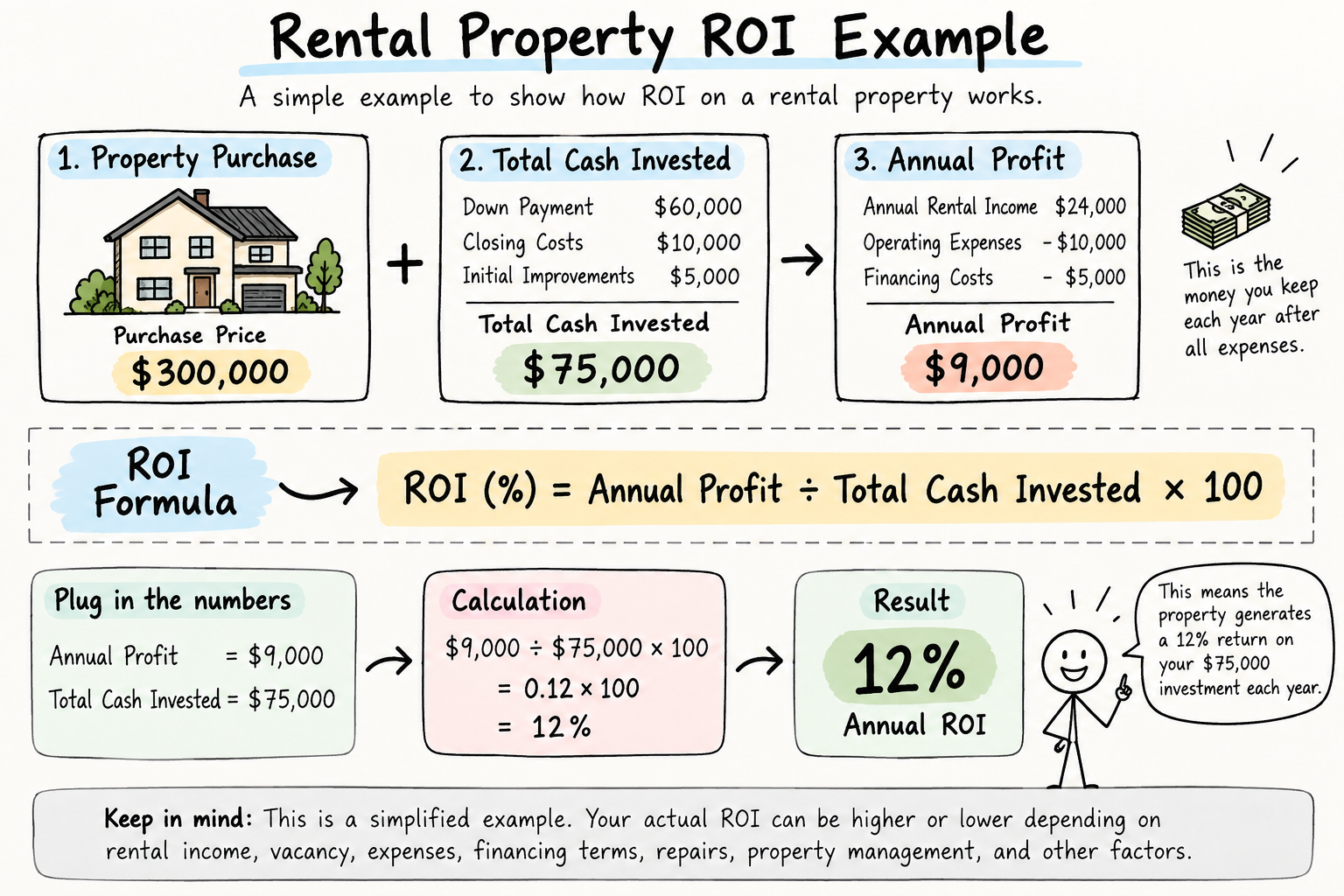
magine you buy a rental property for $300,000. You make a $60,000 down payment and spend another $15,000 on closing costs and initial improvements. Your total cash invested is $75,000.
After collecting rent and paying operating expenses and financing costs, suppose the property produces $9,000 in annual profit.
$9,000 ÷ $75,000 × 100 = 12%
In this simplified example, the property produces a 12% annual cash-based return on the $75,000 invested. This does not mean every $300,000 property will produce a 12% return. Your actual result depends on rent, vacancy, expenses, financing, repairs, and other costs.
What Costs Should You Include When Calculating Rental Property ROI?
A rental property can look profitable until you include all of its costs. For a more useful ROI estimate, include the major costs you expect to pay when buying, financing, owning, and operating the property.
Common costs include the down payment, closing costs, renovation or repair costs, mortgage payments, property taxes, insurance, maintenance, vacancy, property management fees, HOA fees, utilities paid by the owner, and other operating expenses.
Some costs happen once, while others happen every month or every year. Using realistic numbers is important because leaving out expenses can make the estimated return look higher than it really is.
ROI vs Cap Rate vs Cash-on-Cash Return
ROI, cap rate, and cash-on-cash return all help investors look at property performance, but they measure different things. You should not treat these percentages as if they mean exactly the same thing.
ROI
ROI is a broad way to compare the return from an investment with the money invested. The exact ROI calculation can vary depending on which gains and costs are included, so always check what a particular ROI figure represents.
Cap Rate
Cap rate compares a property’s annual net operating income (NOI) with its value or purchase price. It focuses on property operations and normally does not include mortgage financing in the calculation.
You can estimate it with our Cap Rate Calculator.
Cash-on-Cash Return
Cash-on-cash return compares annual pre-tax cash flow with the actual cash invested in the property. Because it focuses on cash invested, financing can have a major effect on the result.
Try our Cash-on-Cash Return Calculator to estimate this percentage.
None of these measurements tells the whole story by itself. Looking at ROI together with cash flow, NOI, cap rate, financing, expenses, and risk can give you a more complete picture of a rental property.
What Is a Good ROI on a Rental Property?
There is no single ROI percentage that makes every rental property a good investment. A useful return depends on the property’s location, financing, condition, expenses, vacancy risk, expected appreciation, and the investor’s goals.
Instead of choosing a property only because its estimated ROI looks high, compare the return with the risks and assumptions behind the calculation. For example, unusually high projected rent or unrealistically low repair and vacancy costs can make an ROI estimate look better than the property may actually perform.
How to Improve Rental Property ROI
Rental property ROI can improve when income increases, expenses decrease, or the amount of cash required for the investment changes. However, every decision should be based on realistic costs and local market conditions.
Possible ways to improve the numbers include reducing unnecessary operating expenses, keeping the property well maintained, reducing avoidable vacancy, reviewing insurance and management costs, and making improvements that may support appropriate market rent.
Calculate Your Rental Property ROI
You do not have to calculate every number by hand. Enter your purchase price, financing, rental income, vacancy, and property expenses into our Rental Property ROI Calculator to see an estimated breakdown of cash flow, NOI, cap rate, cash-on-cash return, ROI, and other useful numbers.
Common Rental Property ROI Calculation Mistakes
A small mistake in your income or expense assumptions can significantly change the estimated ROI. Before making a decision, check that your calculation includes realistic numbers.
Forgetting Vacancy
A rental property may not stay occupied every month. Including a reasonable vacancy estimate can make your income projection more realistic.
Ignoring Repairs and Maintenance
Repairs and regular maintenance cost money. Leaving these expenses out can make projected profit and ROI look higher than they may actually be.
Forgetting Property Management Costs
If you use a property manager, include the expected management fee. Even if you manage the property yourself today, consider how your costs could change in the future.
Using Unrealistic Rental Income
Do not assume a higher rent simply to make the investment look better. Research comparable rentals in the local market and use a reasonable estimate.
Frequently Asked Questions
How do you calculate ROI on a rental property?
One simple method is to divide annual profit by the total cash invested and multiply the result by 100. The exact calculation can vary depending on what you include as profit and investment cost.
Is rental property ROI the same as cap rate?
No. Cap rate compares net operating income with property value and generally excludes mortgage financing. ROI is a broader return measure and can be calculated in different ways depending on the costs and gains included.
Is ROI the same as cash-on-cash return?
Not necessarily. Cash-on-cash return specifically compares annual pre-tax cash flow with the cash invested. ROI may be defined more broadly and can include different gains or costs.
Should mortgage payments be included when calculating rental returns?
It depends on the metric. Mortgage payments affect cash flow and cash-on-cash return, while cap rate normally evaluates property operations before mortgage financing.
Can appreciation increase my real estate return?
Property appreciation can increase the value of an investment over time, but future appreciation is uncertain. It is useful to keep appreciation assumptions separate from current rental income and operating performance.
Related Real Estate Calculators
Use these free Realtolic calculators to analyze different parts of a rental property investment.
Rental Property ROI Calculator
Rental Cash Flow Calculator
Cap Rate Calculator
Cash-on-Cash Return Calculator
NOI Calculator
Final Thoughts
Calculating rental property ROI can help you understand how a property’s potential return compares with the money you invest. Start with realistic rental income and include vacancy, operating expenses, financing costs, repairs, and other important costs. Then compare ROI with cash flow, NOI, cap rate, and cash-on-cash return for a broader view of the investment.
Before evaluating a property, try our Rental Property ROI Calculator to estimate these numbers in one place.
Important Note
This article and the Realtolic calculators provide estimates for educational and informational purposes only. Results depend on the information and assumptions you enter. Actual property income, expenses, financing, taxes, values, and investment returns can differ. Consider verifying important numbers and seeking appropriate professional advice before making financial or real estate decisions.